Imagine logging into your bank, hospital, or government portal without a password. No username. No security questions. Just a quick tap on your phone - and you’re in. That’s not science fiction. By 2026, decentralized identity is turning that idea into reality for millions. Unlike the old system where companies like Google, Facebook, or your employer hold your personal data, decentralized identity puts you in control. Your identity lives in your wallet - encrypted, portable, and only shared when you say so.
Why Decentralized Identity Matters Now
In 2024, 81% of data breaches started with stolen passwords or weak credentials, according to Verizon’s annual report. That’s not a glitch - it’s the design flaw of centralized systems. One hack at Okta in 2023 exposed 36 million user accounts. One weak link, and the whole chain breaks. Decentralized identity fixes that by removing the central database entirely. No more single points of failure. No more hackers targeting a server full of Social Security numbers, birthdates, and addresses. Instead, your identity is built on Decentralized Identifiers (DIDs) - unique, cryptographically secure digital keys tied to you, not a company. These DIDs follow the W3C standard ratified in July 2024. They’re stored on distributed ledgers, mostly using Hyperledger Indy (used by 62% of enterprises) or Ethereum. Your credentials - like your driver’s license, degree, or age verification - are issued as Verifiable Credentials, signed by trusted parties (like a university or government agency) and stored on your device. No cloud. No middleman.How It Actually Works in Real Life
Let’s say you’re applying for a mortgage. Traditional process? You email scanned copies of your pay stubs, bank statements, and ID. The bank stores them. You have no idea who else might access them later. With decentralized identity: You open your digital wallet. You select the verifiable credential from your local government that proves your income. You use a zero-knowledge proof to show you earn over $75,000 - without revealing your exact salary, employer, or bank account. The lender verifies the signature, not the data. Done in 90 seconds. No files uploaded. No copies stored. This isn’t theoretical. In healthcare, hospitals in New Zealand and Canada are using it to share patient records securely between clinics. A patient grants temporary access to their vaccination history - only the necessary data, only for the time needed. No more faxing paper records. No more waiting days for transfers. In finance, KYC (Know Your Customer) checks that used to take five days now take 90 minutes. Javelin Strategy found fraud dropped by 92% in pilot programs. Why? Because you can’t fake a cryptographic signature tied to your private key.Who’s Leading the Charge?
Big tech isn’t sitting still. Microsoft’s Entra Verified ID holds 32% of the enterprise market. IBM’s Verify Decentralized ID has 24%. But the real innovation is coming from specialists like Spruce ID and Sovrin Network. These platforms focus purely on identity - not ads, not cloud storage, not social media. The European Union made a huge move in January 2025 by launching its Digital Identity Wallet framework. By 2026, every EU citizen will be able to use a government-issued digital ID that works across borders. Singapore rolled out its Trust Framework v3.0 in April 2025. California’s Decentralized Identity Act is still under review, but momentum is building. Even Windows 12, launching in October 2025, will integrate decentralized identity natively. You’ll be able to log into apps, sign documents, or access services using your DID - no Microsoft account needed.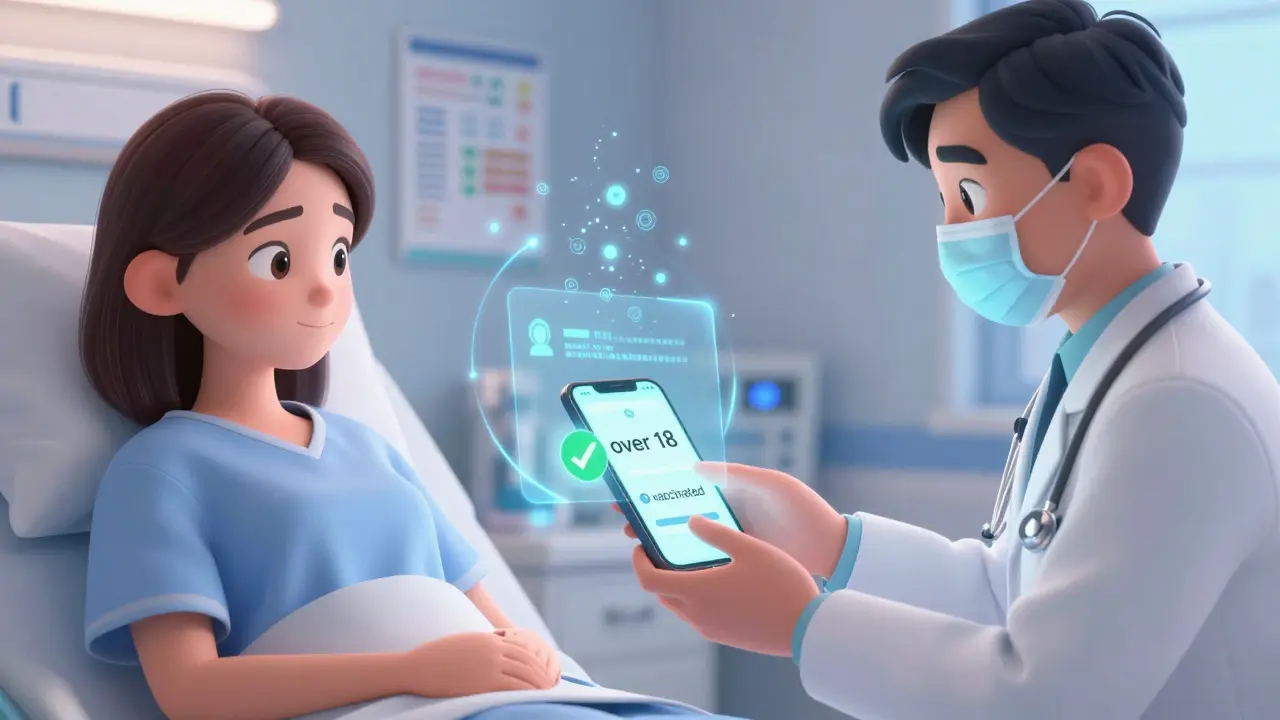
The Hidden Costs and Real Challenges
This isn’t magic. There are trade-offs. First, speed. Decentralized systems handle 15-35 transactions per second. Traditional systems? 100-500. That’s fine for logging in or verifying credentials - but it won’t work for high-volume apps like TikTok or Instagram. Decentralized identity isn’t replacing your Facebook login anytime soon. Second, complexity. Integrating with legacy HR or banking systems can take six months instead of three. One CTO on Reddit reported spending $375,000 extra just to connect their old payroll system. That’s why 41% of enterprises still struggle with compatibility, according to IDC’s 2025 survey. Third, recovery. If you lose your private key - and you don’t have a backup - you lose your identity forever. No “forgot password” button. That’s why 68% of implementations now use social recovery: you pick 3 trusted friends or family members who can help you reset access if needed. And then there’s education. Only 28% of consumers understand what decentralized identity even means, according to Pew Research. If users don’t know how to manage their keys or verify credentials, adoption stalls.What You Need to Know to Get Started
If you’re an enterprise or a tech professional, here’s what you need to focus on:- Learn the standards: W3C DID 1.0 and Verifiable Credentials 2.0 are non-negotiable. These are the rules everyone follows.
- Master zero-knowledge proofs: zk-SNARKs are used in 78% of systems. zk-STARKs are growing fast - they’re more scalable and don’t need trusted setup.
- Choose your blockchain: Hyperledger Indy is the enterprise favorite. Ethereum is great for public use cases. Proprietary chains work for closed ecosystems.
- Train your team: Organizations are spending $18,500 per employee on training. Certifications like the Certified Decentralized Identity Professional (CDIP) are seeing 42% annual growth.
The Road Ahead: AI, Regulation, and the Next Five Years
By 2027, 73% of identity professionals expect AI to be layered on top of decentralized identity. Imagine your wallet learning your habits - suggesting which credentials to share based on context. Need to rent a car? Your wallet auto-approves your license and credit score - without you lifting a finger. Regulation is catching up. The EU’s framework is already live. The U.S. will follow. By 2028, Gartner predicts 60% of enterprises will have abandoned centralized identity stores. That’s a $41.7 billion market by 2030. But the biggest win? Trust. People are tired of being tracked, sold, and breached. Decentralized identity gives back control. It’s not just a better tech - it’s a better way to be human online.Frequently Asked Questions
What is a Decentralized Identifier (DID)?
A Decentralized Identifier (DID) is a unique, cryptographically secure digital key that represents your identity without relying on a central authority like a company or government. Unlike usernames or email addresses, DIDs are stored on distributed ledgers and controlled entirely by you. They follow the W3C DID Specification 1.0 and are used to link your verifiable credentials - like your driver’s license or degree - to your personal wallet.
How is decentralized identity different from blockchain-based logins?
Blockchain logins, like using a MetaMask wallet to sign into a website, still rely on the platform to verify your identity. Decentralized identity goes further: it lets you prove who you are using cryptographically signed credentials issued by trusted third parties - like your university or government - without giving anyone else access to your data. You’re not logging in with a wallet; you’re presenting verified proof of attributes, like age or employment, without revealing unnecessary details.
Can I lose my decentralized identity?
Yes - if you lose your private key and haven’t set up a recovery method. That’s why most systems now use social recovery: you choose 2-5 trusted contacts who can help you regain access if you lose your device or forget your password. Think of it like a digital emergency contact list for your identity. Without this, you could be permanently locked out - which is why experts warn that recovery design is just as important as security.
Is decentralized identity secure against quantum computing?
Current systems use elliptic curve cryptography, which is vulnerable to future quantum attacks. But the industry is already preparing. zk-STARKs - a newer zero-knowledge proof method - are being adopted because they’re quantum-resistant. The Decentralized Identity Foundation and W3C are working on post-quantum standards expected to be finalized by 2027. For now, the risk is low, but long-term planning is essential for enterprises.
Will decentralized identity replace passwords completely?
Not overnight - but yes, eventually. Passwords are the weakest link in 81% of breaches. Decentralized identity eliminates them by replacing them with cryptographic proof. Major platforms like Microsoft and Google are already testing passwordless logins using FIDO2 and DIDs. By 2030, most services will offer decentralized identity as the default option. You’ll still be able to use passwords - but you’ll be strongly encouraged not to.
What industries are adopting decentralized identity fastest?
Financial services lead with 38% enterprise adoption, followed by healthcare (29%) and government (24%). Banks use it to cut KYC times from days to minutes. Hospitals use it to securely share patient records between clinics without exposing full medical histories. Governments use it for digital IDs that work across departments and borders. Consumer-facing sectors like retail and social media are slower because they prioritize speed and scale over privacy.
How do I get started as a regular user?
Download a wallet app like Sovrin, uPort, or Microsoft’s ION-based wallet. Look for your local government or university offering verifiable credentials - many in Canada, New Zealand, and the EU already do. Once you have a credential, practice sharing only what’s needed: for example, prove you’re over 21 without showing your birthdate. Start small, stay in control, and avoid uploading sensitive data anywhere.

22 Comments
Rob Duber
This is the most exciting thing to happen since we stopped using floppy disks. No more passwords? I’m already crying. 🥲
Joshua Clark
I’ve been following DID standards since 2023, and honestly, the W3C VC 2.0 spec is the real MVP here - it’s clean, extensible, and interoperable across sovereign chains. The real win isn’t just the tech, it’s the shift from ‘trust us’ to ‘prove it’ - and that’s a cultural revolution wrapped in cryptography. Also, zero-knowledge proofs are finally moving out of academia and into real-world UX, which means we’re not just building better systems - we’re rebuilding human digital relationships.
William Hanson
So let me get this straight - you’re telling me we’re gonna replace passwords with… more tech that I have to manage? And if I lose my key, I’m just SOL? That’s not freedom, that’s digital feudalism with extra steps.
Dahlia Nurcahya
I love how this isn’t just about tech - it’s about dignity. Imagine not having to hand over your whole life story just to open a bank account. I tried using my government-issued DID last week to prove my age at a dispensary. Didn’t show my name, didn’t show my birthday. Just ‘over 21’. Felt like a superpower.
Brandon Vaidyanathan
Everyone’s acting like this is some utopia. Bro, 68% of people use social recovery. That means your ‘secure identity’ is only as safe as your drunk cousin who texts you memes at 3am. Also, Microsoft’s Entra? That’s still a corporate walled garden with a blockchain sticker on it.
Will Pimblett
I’ve seen this movie before - remember when we were all gonna ditch email for blockchain messaging? It didn’t end well. Decentralized identity sounds great until you’re trying to get your grandma to use a wallet. The tech’s solid, but the onboarding? A dumpster fire.
Parth Makwana
The adoption curve in emerging markets is fascinating. In India, where 70% of the population lacks formal ID, decentralized identity could be a game-changer - but only if we decouple it from Western blockchain paradigms and build for low-bandwidth, high-trust community nodes. Hyperledger Indy is the only viable path here, not Ethereum.
Crystal Underwood
Of course the EU is leading. They love controlling everything - now they’re just controlling your identity with a digital stamp. This isn’t freedom. It’s compliance with extra encryption. And don’t get me started on Windows 12 integrating this. Microsoft’s not saving you. They’re locking you in better.
Raymond Pute
Honestly, the entire premise feels like a TED Talk dressed up as a whitepaper. You’re replacing one centralized authority with a constellation of semi-trusted issuers, all relying on a ledger that’s still ultimately controlled by a handful of validator nodes. It’s not decentralized - it’s distributed centralization with a side of crypto bro jargon.
Meenal Sharma
They say this will prevent breaches. But what if the government issues a credential that secretly logs your every movement? What if the university that signs your degree is bought by a defense contractor? This isn’t liberation - it’s surveillance with a better UI.
Freddy Wiryadi
I just got my verifiable credential from my state DMV last week. Took 2 mins. Used it to rent a car. Didn’t show my license, didn’t show my address. Just ‘licensed to drive’. Felt like I was in a sci-fi movie. Also, I spilled coffee on my phone and lost my key. Used my sister’s recovery code. She’s not techy at all. But she remembered. So… it works? 🤷♂️
Brianne Hurley
I’m so tired of people acting like this is some kind of moral victory. You think people are gonna care about their ‘digital sovereignty’ when TikTok’s algorithm is whispering in their ear? This is a luxury feature for tech bros who can afford to lose their identity. The rest of us just want to log in without a 12-step process.
christal Rodriguez
The only thing more naive than trusting corporations is trusting decentralized systems. You think your DID won’t be mined for data? Your ‘zero-knowledge’ proof is just a new way to profile you without knowing your name. It’s the same game. New cards. Same table.
Gareth Fitzjohn
I work in local government IT. We rolled out a pilot last month. The feedback? Elderly users loved it. Younger users didn’t care. Middle-aged users were terrified. The tech works. The human part? Still broken. We need better education, not better cryptography.
Gavin Francis
This is the future, but we’re not ready. I showed my dad how to use his digital ID. He said, ‘So if I lose my phone, I lose my life?’ I had to sit there for 45 minutes explaining social recovery. He still doesn’t trust it. And he’s not wrong.
Dylan Morrison
It’s not about the tech. It’s about who gets to decide what ‘identity’ means. Right now, it’s corporations. Soon, it’ll be governments. Maybe one day, it’ll be us. But we have to fight for that. Not with code - with conversation. 🌱
mary irons
I don’t trust this. I don’t trust governments. I don’t trust tech companies. And I especially don’t trust the people who say ‘trust me, this is safe.’ If I can’t hold my identity in my hand, I don’t want it. Paper still works.
Edward Drawde
You call this progress? I lost my key once. Took me 3 weeks to get my identity back. Meanwhile, my bank account was frozen. No one helped. No one cared. This isn’t empowerment. It’s a trap for the naive.
Wayne mutunga
I’ve been using Sovrin for a year now. I’ve shared my vaccination record, my degree, my income - all without ever uploading a file. It’s quiet. It’s secure. And honestly? It’s kind of beautiful. You don’t need to shout about it. You just live it.
Ramona Langthaler
This is just the government’s way of tracking us better. They want to know everything. Now they just make you think you’re in control. Wake up. This is the new social credit system. And you’re handing them the keys.
Dylan Morrison
I think the real win is that kids now are growing up with this. My 12-year-old niece used her DID to prove she was old enough to join a Discord server. She didn’t even know what a password was. That’s the future. Not the tech. The kids.
Calvin Tucker
The fact that we’re even having this conversation is progress. Ten years ago, people thought blockchain was just for Bitcoin. Now we’re talking about identity as a human right. That’s not nothing. Even if the implementation is messy - we’re moving.