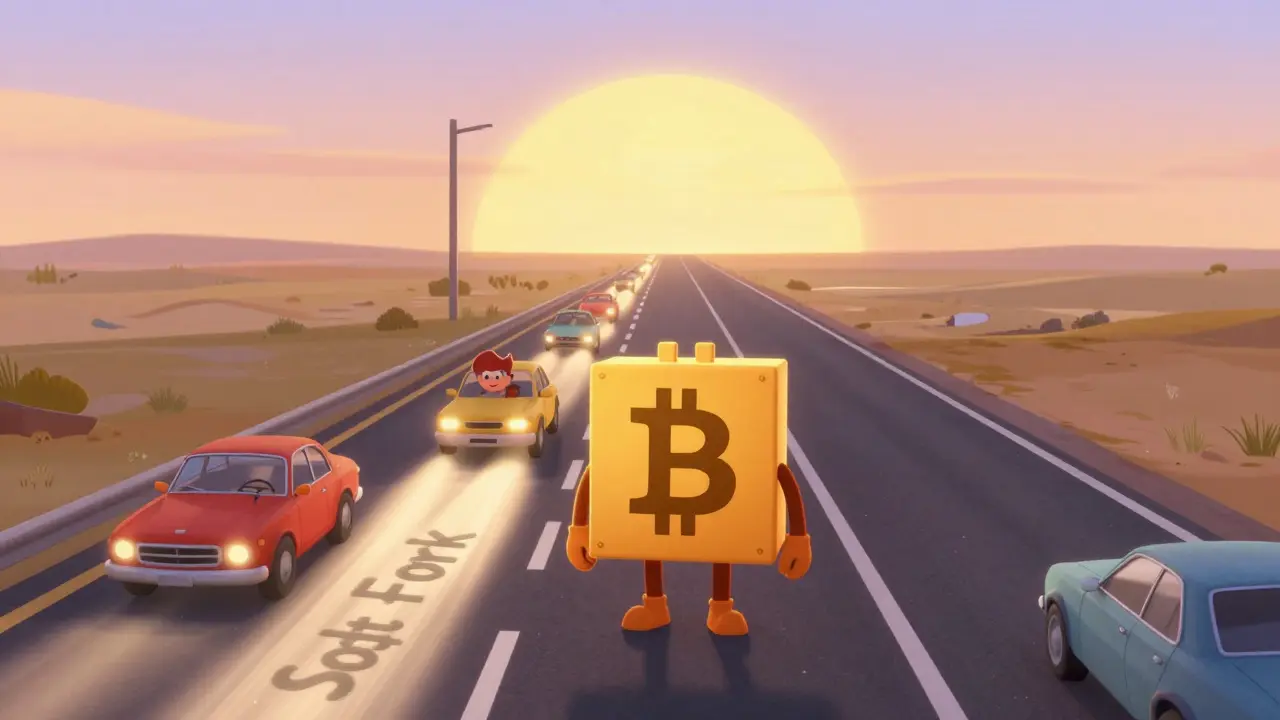
When a cryptocurrency network needs to change how it works, it doesn’t just update like your phone app. It has to decide between two very different paths: a hard fork or a soft fork. One keeps everyone on the same chain. The other splits the network in two. And the choice can change everything - from how transactions are processed to whether you end up with two different coins in your wallet.
What Is a Soft Fork?
A soft fork is like a quiet upgrade. It makes the rules tighter, but doesn’t break old software. Think of it like adding a new lane to a highway without tearing down the old one. Cars that don’t know about the new lane can still drive - they just can’t use it. The old cars still recognize all the traffic signs, so nothing crashes.Soft forks are backward-compatible. That means nodes running older versions of the software can still validate new blocks. They might not understand all the new features, but they won’t reject them. As long as most miners and users upgrade, the network keeps moving as one.
The most famous example is Bitcoin’s SegWit upgrade in 2017. Before SegWit, Bitcoin transactions could be altered mid-process - a problem called transaction malleability. SegWit fixed that by changing how data was stored in blocks, without changing the block size limit. Nodes that didn’t upgrade could still confirm transactions. The network didn’t split. No new coin was created. Just a smoother, more secure Bitcoin.
Soft forks are used for security patches, efficiency tweaks, and small feature additions. They’re the go-to for routine upgrades because they’re low-risk. No drama. No chaos. No wallet confusion. That’s why about 80% of all blockchain upgrades in 2025 were soft forks.
What Is a Hard Fork?
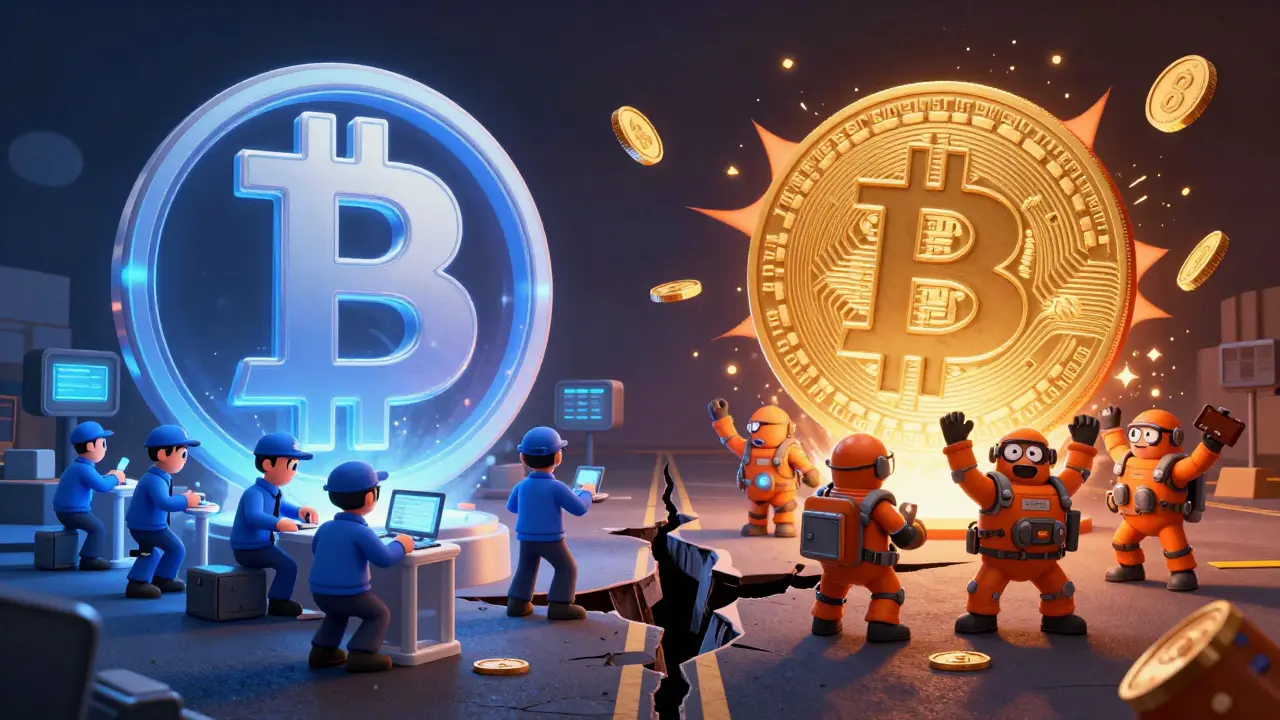
A hard fork is a major rewrite. It breaks the old rules - permanently. Nodes running the old software suddenly can’t understand the new ones. It’s like switching from driving on the right side of the road to the left. If half the drivers don’t change, you get two separate roads - and two separate traffic systems.Hard forks require every participant - miners, exchanges, wallet providers, users - to upgrade their software. If even one big player refuses, the chain splits. Now you have two blockchains: the original and the new one. Each has its own rules, its own history, and often, its own coin.
The most well-known hard fork was Bitcoin Cash in 2017. A group of developers and miners wanted bigger blocks to handle more transactions. Bitcoin’s core team disagreed. The result? Bitcoin stayed the same. And Bitcoin Cash was born - a new cryptocurrency with 8 MB blocks instead of 1 MB. People who held Bitcoin at the time got an equal amount of Bitcoin Cash. Suddenly, one asset became two.
Another major example is Ethereum Classic. In 2016, hackers stole $60 million from a smart contract called The DAO. Ethereum’s team proposed a hard fork to reverse the theft and return the funds. Most of the community agreed. But a minority believed blockchain should be immutable - no matter what. They kept running the old chain. That became Ethereum Classic. Ethereum (ETH) continued on the new chain. Two coins. One origin.
Soft Fork vs Hard Fork: Key Differences
Here’s how they really stack up:
| Feature | Soft Fork | Hard Fork |
|---|---|---|
| Backward Compatible? | Yes | No |
| Network Split? | Never | Possible |
| New Coin Created? | No | Usually |
| Upgrade Required? | Optional for nodes | Mandatory for all |
| Use Case | Security fixes, minor improvements | Major rule changes, scaling, recovery |
| Community Conflict | Low | High |
| Market Impact | Mild price swings | Big volatility, new asset launch |
Soft forks are the quiet engineers. They fix things without making a fuss. Hard forks are the rebels. They rebuild the system - even if it means breaking it first.
Why Does It Matter to You?
If you hold cryptocurrency, this isn’t just tech jargon. It affects your money.
With a soft fork, your wallet keeps working. No action needed. Your balance stays the same. You might not even notice anything changed.
With a hard fork? Things get messy. You might get a new coin for free - but you also risk losing access to your funds if your exchange or wallet doesn’t support the new chain. Some exchanges freeze trading during hard forks. Others don’t claim the new coin at all. You could end up with less than you had before - or worse, your coins could be stuck.
And then there’s replay attacks. After a hard fork, if you send 1 BTC on the new chain, the same transaction might replay on the old chain. That means you lose 1 BTC on both sides. Smart wallets and exchanges prevent this - but not all do. If you’re moving coins right after a fork, you’re playing with fire.
When Do Developers Choose One Over the Other?
It’s not random. It’s strategic.
Developers pick soft forks when they can. Why? Because they’re safer. No splits. No community fights. No confusion. If you need to fix a bug, add a signature scheme, or improve privacy - go soft.
But sometimes, you need to change the core rules. Like increasing block size. Or switching from Proof of Work to Proof of Stake. Or reversing a hack. That’s when you need a hard fork.
Take Ethereum’s move to Proof of Stake in 2022. That was a hard fork - massive, complex, and risky. But it was the only way to cut energy use by 99.95%. No soft fork could have done that.
Developers don’t choose hard forks lightly. They know it splits communities. They know exchanges panic. They know prices swing wildly. But if the network’s future depends on it - they do it anyway.
What Happens After a Fork?
After a soft fork, life goes on. The network becomes stronger. Developers celebrate. Users barely notice.
After a hard fork? Chaos. Then clarity.
First, there’s a few days of uncertainty. Exchanges pause deposits and withdrawals. Wallet providers scramble to update. Miners pick sides. Social media explodes with arguments.
Then, market forces decide. One chain usually gets more hash power, more users, and more liquidity. That becomes the "main" chain. The other? It might fade away. Or it might survive as a niche project.
Bitcoin Cash still exists. Ethereum Classic still trades. But neither has the same value or adoption as their parent chains. Most hard forks die quietly. Only the most controversial - or the most useful - survive.
What’s the Future of Forks?
Looking ahead, soft forks will keep dominating. Why? Because users hate disruption. Exchanges hate downtime. Regulators hate uncertainty.
Major blockchains are now building Layer 2 solutions - like Bitcoin’s Lightning Network or Ethereum’s rollups - to handle scaling without touching the base layer. That means fewer hard forks needed.
But hard forks won’t disappear. They’re still the only tool for radical change. If a blockchain gets hacked. If consensus breaks. If a new technology makes the old one obsolete - hard forks will be the last resort.
The real winners? Networks that can plan upgrades smoothly, communicate clearly, and build consensus before the code even writes itself. That’s the future: not more forks - but smarter, quieter, more inclusive upgrades.
Can I lose money during a hard fork?
Yes, if you don’t take precautions. If your exchange doesn’t support the new chain, you might not get the new coins. If you send coins during a fork, you risk replay attacks where the same transaction gets copied across both chains. Always wait for official guidance from your wallet or exchange before moving funds after a fork.
Do I automatically get new coins after a hard fork?
Only if you held the original cryptocurrency at the exact moment the fork happened - and only if your wallet or exchange supports the new chain. If you stored your Bitcoin on a wallet you control (like a hardware wallet) and Bitcoin Cash forked, you’d get Bitcoin Cash too. But if you kept it on Coinbase and they didn’t support it, you wouldn’t get anything.
Why can’t all upgrades be soft forks?
Because soft forks can only add stricter rules - they can’t remove or change existing ones. If you want to shrink block size, change the reward system, or switch consensus algorithms, you need a hard fork. Soft forks are like adding a new traffic law. Hard forks are like switching from driving on the right to the left - you can’t do that without breaking the old rules.
Are hard forks dangerous for security?
Yes, temporarily. After a hard fork, two chains run side-by-side. Malicious actors can exploit replay attacks, where a transaction on one chain is copied to the other. This can drain funds if users aren’t careful. Also, the chain with less hash power is more vulnerable to 51% attacks. Security improves over time as one chain gains dominance.
How long does a fork take to complete?
Soft forks usually activate within days or weeks after miner signaling reaches 95% support. Hard forks take months - sometimes over a year. That’s because they need full network coordination: code testing, exchange support, wallet updates, community votes, and contingency plans. Bitcoin’s SegWit took 2 years to activate. Ethereum’s Merge took 5.



25 Comments
Mohamed Haybe
Soft forks are just corporate crypto babysitting. Real innovation needs blood in the streets. India doesn't need your gentle upgrades. We need revolution.
Marsha Enright
This is such a clear breakdown! 🙌 I used to get so confused between hard and soft forks, but now it makes total sense. Soft forks = quiet hero, hard forks = dramatic movie scene. Love it!
Andrew Brady
The Fed is using soft forks to quietly centralize control. SegWit wasn't about security-it was about paving the way for surveillance. You think Bitcoin is decentralized? Think again.
Sharmishtha Sohoni
So if I hold BTC and a soft fork happens, I don't get new coins?
Althea Gwen
Forks are just capitalism's way of making money from chaos 😅💸 Why can't we all just chill and use one chain? Like... why does everything have to be a drama?
Durgesh Mehta
I think soft forks are better for the community. Less stress. Less confusion. Just let the network grow slowly
Sarah Roberge
I read this article like 5 times and still think hard forks are just a scam to pump altcoins. Also I think the moon is made of cheese and this is related somehow
Jess Bothun-Berg
This is basic. You're explaining something that every 14-year-old with a crypto wallet knows. Soft forks: minor. Hard forks: catastrophic. Stop wasting bandwidth.
Steve Savage
I like how you framed soft forks as quiet engineers. That’s exactly right. Most people don’t notice when good things happen. The real magic is in the invisible upgrades. Keep building, not breaking.
Rod Filoteo
Ethereum Merge? That was a rigged vote. The devs pushed it through while normal people were sleeping. And now we’re all stuck with a blockchain that uses more electricity than Norway. You think this is progress? It’s a lie.
Layla Hu
I appreciate the clarity. But I still don’t trust exchanges after what happened with BCH.
Nora Colombie
You think soft forks are safe? They’re just the first step. Once you normalize quiet upgrades, the next thing you know, the government is controlling the consensus algorithm. This is how tyranny begins.
Greer Dauphin
So if I use a hardware wallet and a hard fork happens... I just wait for the devs to say it's safe? Lol. That's like waiting for the IRS to send you a thank you card.
Bhoomika Agarwal
Soft forks? More like soft surrender. India’s blockchain future won’t be built by people who fear disruption. We need hard forks that break the old world. Not little lane additions.
Katherine Alva
There’s a philosophical truth here: change without consensus is violence. Soft forks respect the past. Hard forks erase it. Which do you want to be? A builder or a destroyer?
Nelia Mcquiston
I think the real lesson is that technology should serve people, not the other way around. If a fork causes more confusion than benefit, maybe it shouldn’t happen. We don’t need more complexity. We need more clarity.
Mark Stoehr
Hard forks are just a way for devs to make money off their own code. The rest of us get left holding bags full of worthless altcoins. No thanks
Shari Heglin
The assertion that 80% of 2025 upgrades were soft forks lacks citation. Without empirical data, this is anecdotal and potentially misleading.
Reggie Herbert
Soft forks are for weak chains. Real networks don’t upgrade quietly. They fork. They split. They dominate. If you’re not ready for blood, get out of the arena.
Murray Dejarnette
Bro. I held BTC before Bitcoin Cash. Got free cash. Then I held ETH before ETH Classic. Got free classic. Now I’m just waiting for the next one. This is free money. Don’t sleep on forks.
Sarah Locke
You know what’s beautiful? When a community chooses unity over ego. Soft forks are the quiet anthem of cooperation. Let’s celebrate the builders who fix things without screaming.
Britney Power
The entire paradigm of blockchain governance is predicated on a fallacy: that consensus can be algorithmically achieved without sociopolitical coercion. The soft fork is a performative illusion of decentralization, masking the hegemony of miner oligarchs and dev centralization. The hard fork, by contrast, is the ontological rupture that reveals the true power structure. Your article, while syntactically competent, fails to interrogate the epistemological violence inherent in the very notion of "upgrade."
Maggie Harrison
Forks are like birthdays for crypto 🎉 You don’t always get cake, but you always get a new version of the story. Keep going, keep growing!
Lawal Ayomide
Hard fork in Nigeria? We don't need new coins. We need internet. And electricity. And food.
Darlene Johnson
Soft forks are a trap. They let the elite control the upgrade path. One day, your wallet will just stop working because the devs decided you're not "trusted" anymore. This isn't freedom. It's digital serfdom.