Over 4 million Saudis own cryptocurrency, even though the government hasn’t officially approved it. That’s not a glitch-it’s a reality shaped by tech-savvy users, global platforms, and clever workarounds. While banks are barred from handling crypto, and official warnings still hang in the air, people aren’t waiting for permission. They’re already trading, investing, and moving money. So how exactly are Saudis getting access to cryptocurrency exchanges when the rules seem stacked against them?
Why Saudis Are Using Global Exchanges
There are no licensed crypto exchanges in Saudi Arabia. Not one. So when someone in Riyadh or Jeddah wants to buy Bitcoin or Ethereum, they don’t have a local option. Instead, they turn to global platforms like Binance, a global cryptocurrency exchange platform that allows users to trade digital assets with fiat and crypto pairs, Bybit, a derivatives-focused crypto exchange popular among traders for low fees and high leverage, and OKX, a multi-asset exchange offering spot, futures, and staking services. These aren’t just options-they’re the only viable ones. Traffic data from Q2 2024 shows 78% of all crypto-related web activity from Saudi Arabia points to these international sites.Why not wait for a local exchange? Because the Saudi Central Bank (SAMA) has made it clear: banks can’t touch crypto unless they get special approval. And no bank has received it. So users bypass the system entirely. They sign up with their Saudi national ID, upload a selfie, and verify their identity directly on these global platforms. Around 52% of Saudi users report successful KYC verification using their national ID, according to Chainalysis data. It’s not foolproof-some accounts get flagged or frozen-but it works often enough to keep millions engaged.
How Saudis Fund Their Accounts
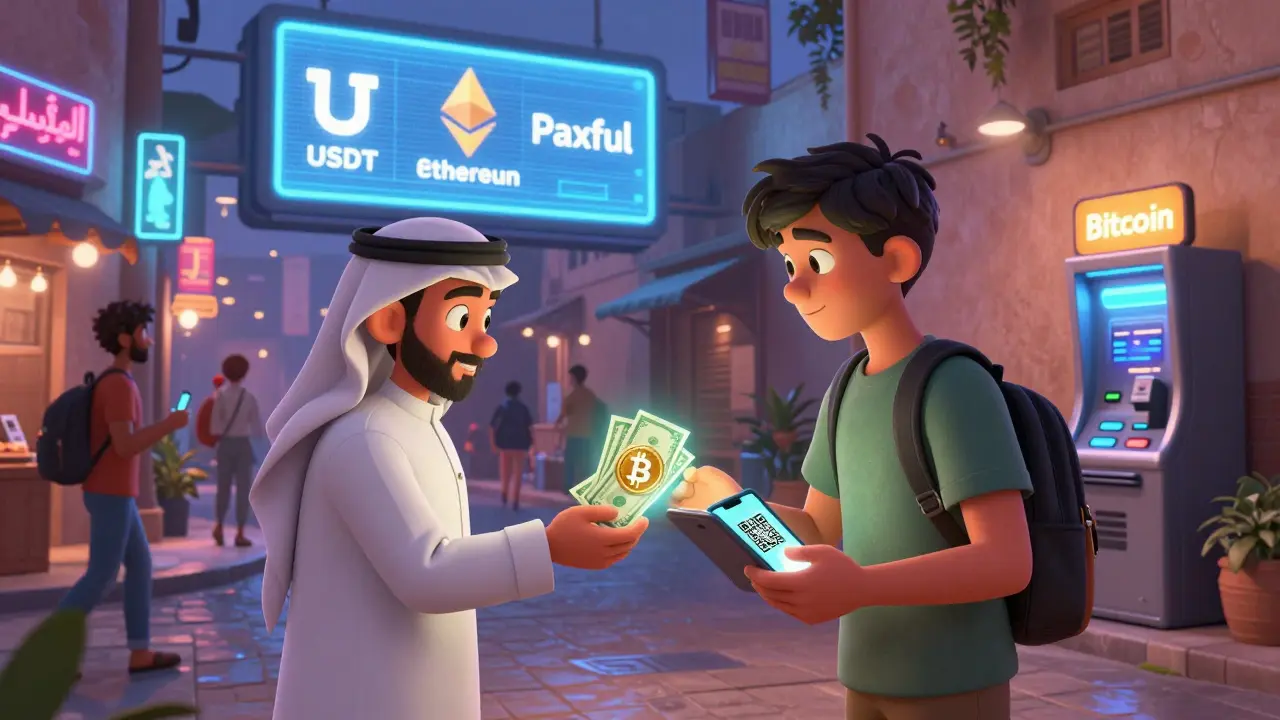
This is where things get tricky. You can’t just link your Al Rajhi or Alinma bank account to Binance. SAMA forbids it. So how do Saudis deposit SAR (Saudi Riyal)? They use alternatives.- Peer-to-peer (P2P) trading handles 37% of all fiat-to-crypto conversions. Users find sellers on platforms like Paxful, a P2P cryptocurrency marketplace enabling direct trades between users or LocalBitcoins, a decentralized platform for buying and selling Bitcoin with local payment methods. Payment is made via bank transfer, cash deposit, or even mobile wallet. Many Saudis prefer this because it feels personal and avoids banking red flags.
- Cryptocurrency-specific payment processors like NOWPayments, a crypto payment gateway that enables merchants and users to accept cryptocurrency payments handle 58% of transactions. These services let users pay with crypto and receive SAR in return, acting as a bridge between digital assets and local currency.
- Gift cards are surprisingly common. Users buy Amazon, Apple, or Steam gift cards using crypto, then sell them locally for cash or bank transfers. It’s indirect, but it works.
- International payment apps like Wise and Revolut are used by 15% of users. These platforms allow Saudis to send money abroad, then use it to fund crypto accounts on international exchanges.
Transaction fees average 3.7% across these methods, according to Trustpilot reviews from over 1,200 Saudi users. That’s higher than in the UAE or US, but users accept it as the cost of doing business in a gray zone.
The Role of VPNs and Mobile Access
Some users worry about internet restrictions. While there’s no official block on crypto websites, there are rumors of filtering. To be safe, 28% of Saudis who access crypto use a VPN, a virtual private network that encrypts internet traffic and masks location. NordVPN reported a 28% year-over-year spike in Saudi subscriptions in Q3 2024 specifically for crypto access. It’s not about hiding from the government-it’s about avoiding connectivity hiccups.Mobile is king. Sixty-three percent of Saudis under 30-nearly two-thirds of the country’s population-use crypto apps as their primary tool. The interface is simple: open the app, verify your ID, fund via P2P, and trade. No desktop needed. Apps like Binance and Bybit have Arabic interfaces and local customer support, making them feel familiar even if they’re based overseas.
Real User Experiences: Successes and Setbacks
Reddit’s r/CryptoSaudi has over 42,000 members. One top thread from March 2025, with nearly 3,000 upvotes, details a method: buy USDT (Tether) through a local P2P seller called SaudiCrypto, then transfer it to Binance. The fee? Just 1.8%. That’s the kind of ingenuity driving adoption.But it’s not all smooth. About 33% of users report account freezes. One Trustpilot review from February 2025 describes a $40,000 account locked by Binance after an inquiry from SAMA. It took 87 days to resolve. Another common complaint? Withdrawals. Some users say they’ve waited weeks to move funds out of exchanges, especially if the amount is large.
Still, sentiment is mostly positive. Brand24’s analysis shows 62% of Saudi crypto users feel optimistic about their access. Younger users are far more successful: 89% of those aged 18-24 report no major issues, compared to just 47% of users over 40. That gap isn’t about tech skills-it’s about willingness to adapt.
Legal Gray Zones and Religious Acceptance
The government hasn’t passed a law banning crypto. Instead, it’s issued warnings. In 2019, the Ministry of Finance warned against dealing in virtual currencies. That warning is still cited-but it’s not a law. That’s the loophole. No specific legislation says, "You can’t do this." So people do it anyway.And here’s the twist: Islamic scholars have weighed in. A 2023 fatwa from the Permanent Committee for Scholarly Research and Ifta ruled that Bitcoin and similar cryptocurrencies are permissible under Sharia law. That’s huge. Seventy-eight percent of Saudi crypto users say this religious approval influenced their decision to participate. It’s not just about profit-it’s about alignment with faith.
On the legal side, the Anti-Money Laundering Law (Royal Decree M/20) defines "funds" broadly to include digital assets. That means authorities could still seize crypto if they suspect illegal activity. In 2024 alone, over SAR 1.2 billion ($320 million) in fraud cases were reported to Saudi cybercrime units. Most were P2P scams or fake exchanges. Users who skip KYC or trade on sketchy platforms are the ones getting burned.

What’s Coming Next?
Change is coming. SAMA’s fintech sandbox accepted three crypto-related applications in early 2025, including a blockchain-based KYC provider. The Capital Market Authority (CMA) released a discussion paper in April 2025 proposing rules for digital asset classification. Draft regulations are expected by Q3 2025, with full laws possibly arriving by late 2025.Meanwhile, Saudi Arabia is part of the mBridge, a multinational CBDC project led by the Bank for International Settlements connecting China, Thailand, Hong Kong, UAE, and Saudi Arabia initiative-a pilot project for cross-border digital currency transfers. This isn’t about crypto. It’s about central bank digital currency (CBDC). But it signals a shift: Saudi Arabia is experimenting with blockchain, just not for retail users yet.
Goldman Sachs predicts retail crypto adoption will rise to 15.2% by 2027. That’s up from 11.4% today. The market is projected to hit $45.9 billion by 2033. That growth won’t come from government support. It’ll come from users who figured out how to make it work anyway.
How to Get Started (If You’re in Saudi Arabia)
If you’re new to crypto and live in Saudi Arabia, here’s what actually works:- Start with P2P. Use Paxful or LocalBitcoins to buy small amounts of USDT with your bank transfer. This avoids banking red flags.
- Choose a reputable exchange. Binance, Bybit, or OKX. All have Arabic support and verified ID processes.
- Use your national ID. It’s accepted by most global exchanges. Don’t use fake documents.
- Enable two-factor authentication. 92% of users who lost funds didn’t use MFA.
- Don’t use bank links. Never connect your Saudi bank account directly to an exchange.
- Learn from the community. Join Telegram group "Saudi Crypto Traders"-response time averages 14 minutes. Read r/CryptoSaudi. The best guides aren’t from banks-they’re from users who’ve been there.
It’s not easy. But it’s possible. And it’s happening-every day, in homes across Riyadh, Jeddah, and Dammam.
Is it legal to use Binance in Saudi Arabia?
There is no specific law banning Binance or other global exchanges in Saudi Arabia. However, the Saudi Central Bank (SAMA) prohibits banks from facilitating crypto transactions. Using Binance isn’t illegal, but it’s not officially recognized either. Users operate in a gray zone. Accounts can be frozen if SAMA flags activity, and there’s no legal recourse if funds are lost. Proceed with caution.
Can I use my Saudi bank account to buy crypto?
No. SAMA explicitly forbids banks from handling cryptocurrency transactions. Any attempt to link your Al Rajhi, Alinma, or National Bank account directly to a crypto exchange will fail. Saudis instead use P2P trading, gift cards, or international payment services like Wise to fund their accounts indirectly.
Are cryptocurrency ATMs available in Saudi Arabia?
Yes. As of September 2024, there are 127 operational crypto ATMs across Riyadh, Jeddah, and Dammam. These machines allow users to buy Bitcoin and Ethereum with cash. They’re one of the few physical access points for crypto in the Kingdom. Fees average 5-8%, higher than online methods, but they offer anonymity and simplicity.
Do I have to pay taxes on crypto profits in Saudi Arabia?
Individuals currently pay no capital gains tax on cryptocurrency profits. The Saudi General Authority of Zakat and Tax confirmed this in January 2024. However, businesses must pay 15% capital gains tax and 2.5% zakat on crypto holdings. Always consult a tax professional if you’re trading at scale.
Why do so many Saudis use P2P trading instead of exchanges?
P2P trading lets users avoid bank scrutiny. Since banks can’t process crypto payments, P2P platforms let buyers and sellers transact directly using local bank transfers, cash deposits, or mobile wallets. It’s slower but more reliable. About 37% of all fiat-to-crypto conversions in Saudi Arabia happen this way. It’s also easier to negotiate rates and build trust with local sellers.
Is crypto banned under Islamic law in Saudi Arabia?
No. A 2023 fatwa from the Permanent Committee for Scholarly Research and Ifta confirmed that Bitcoin and other cryptocurrencies comply with Sharia principles. This religious endorsement has been a major factor in adoption, with 78% of users citing it as a reason they feel comfortable investing. The issue isn’t religion-it’s regulation.
What’s the risk of getting my crypto account frozen?
There’s a real risk. In 2024, over 1,800 cases of frozen crypto accounts were reported to Saudi authorities, totaling SAR 1.2 billion in losses. Most were tied to large transfers or suspicious activity flagged by SAMA. If your account is frozen, you may lose access for weeks or months. Always keep records, avoid large unverified transfers, and never use unlicensed platforms.



25 Comments
Tanvi Atal
So Saudis are just using P2P like it's 2014? Cute. At least they're not pretending to be crypto natives. I've seen this exact playbook in Nigeria, Venezuela, Argentina. Same old, same old.
Dee Resin
I love how people act like this is some revolutionary hack. Nah. It's just capitalism doing what it always does: finding cracks in the wall and crawling through. The real story? The fact that 78% of users say Islamic approval made it okay for them. That's wild.
Sony Sebastian
Binance? Seriously? That's a cesspool of rug pulls and fake volume. If you're not using a decentralized DEX like Uniswap with a non-custodial wallet, you're already losing. You think KYC is safe? LOL. Your ID is already in 47 different data breaches. Welcome to Web3, dumbass.
Brian Lemke
This is one of the most fascinating grassroots financial movements I've seen in years. People aren't waiting for permission - they're building their own financial sovereignty. The fact that they're using P2P, gift cards, and even crypto ATMs? That's innovation born from necessity. And the Sharia compliance angle? That’s cultural intelligence in action. We need more stories like this.
Megan Lavery
I just love that young Saudis are using crypto like it’s TikTok - no big deal, just part of life. The fact that 89% of 18–24 year olds have zero issues? That’s the future right there. No bureaucracy, no red tape. Just tech and trust.
Mae Young
Oh wow, so the government is ‘not banning’ crypto… but banks are forbidden from touching it? And yet people are still doing it anyway? How… *dramatic*. I’m sure this isn’t just another case of people ignoring rules because they’re inconvenient. Nope. Not at all. 🙄
Trenton White
The P2P model here is actually quite elegant. It bypasses the banking system entirely and creates peer-to-peer trust networks. It’s not perfect, but it’s adaptive. And the use of gift cards? That’s low-tech, high-efficiency. Sometimes the best solutions are the ones no one thought to patent.
Cheryl Fenner Brown
so like… uhhh… if u use a vpn n buy btc with ur mom's alrajhi account… is that illegal?? 😅 also why do ppl use paxful when u can just use a crypto atm?? like i'm confused 😵💫
Reggie Fifty
This is why America is falling behind. We got regulations, lawsuits, and compliance officers. Saudi Arabia? They got people. Real people. Using cash, gift cards, and common sense. This is what freedom looks like. Not woke hashtags. Not ESG nonsense. Just people making it work.
Deborah Robinson
This is beautiful. People finding ways to thrive within constraints. The fact that they’re using local sellers, building trust, and leaning into Sharia-compliant crypto? That’s not just finance - that’s community. We should be learning from this, not laughing at it.
Kaitlyn Clark
i just tried to buy usdt on paxful and got scammed by some guy named "saudi_crypto_king" 😭 he took my 2000 sar and vanished. now i’m using a crypto atm but the fees are insane. also why is everyone using binance?? its like the myspace of crypto 🤡
Jeremy buttoncollector
The real innovation here isn’t the tech - it’s the epistemic shift. Users are operating outside institutional epistemic authority, creating decentralized knowledge networks via Telegram and r/CryptoSaudi. This is Foucault’s heterotopia in action - a space of counter-discourse, where financial legitimacy is constructed through praxis, not regulation.
Amanda Markwick
I’ve been following this for years. What’s amazing is how fast the community built its own support system - from local P2P sellers to Arabic-language guides on Reddit. No one handed them a manual. They just figured it out, together. That’s the power of human ingenuity. And honestly? It’s kind of beautiful.
Don B.
I mean… if you’re using Binance and a VPN, you’re basically playing a game of Russian roulette with your life savings. Who even are these people? Are they rich? Poor? Middle class? This whole thing feels like a Netflix documentary waiting to happen. I need to know who the real players are.
Derek Sasser
The crypto ATMs are underrated. 127 of them? That’s more than most European countries. And the fact that people use them for anonymity? That’s not just convenience - it’s privacy as a human right. We’re seeing the future of finance: decentralized, physical, and local.
Neeti Sharma
India should do this. Why do we wait for RBI? We have 1.4 billion people. If Saudis can do it with 4 million, we can do it with 100 million. Stop waiting. Start trading. Stop asking permission. Start building.
Nadia Shalaby
I just read this on my phone while waiting for my coffee. Honestly? I’m impressed. It’s not flashy. No hype. Just people solving a real problem with real tools. That’s rare.
Lucy Simmonds
Wait… so you’re telling me the government doesn’t ban crypto… but they freeze accounts? And the fatwa says it’s halal? But the anti-money laundering law says digital assets are funds? This isn’t a gray zone… it’s a legal nightmare. Someone’s got to be watching this. Someone’s got to be recording every transaction. Who? NSA? SAMA? The IFTAA? Are we being tracked? Are we all in a simulation?
Dana Sikand
I know someone who got their $40k account frozen for 87 days. She cried. She didn’t sleep. She had to hire a lawyer. But guess what? She got her money back. And now she’s teaching her cousins how to use Paxful. That’s resilience. That’s not just crypto - that’s life.
Cameron Pearce Macfarlane
All this effort just to buy Bitcoin? Why not just wait? It’s not like it’s going anywhere. Or maybe it is. But still. All this VPNs, P2P, gift cards… it’s exhausting. I just want to buy a bag of chips without a blockchain.
Elizabeth Smith
If something isn’t explicitly legal, it’s illegal. That’s how the world works. You can’t just decide to play by your own rules because you ‘feel’ it’s right. This isn’t a rebellion - it’s a recklessness. And it’s going to end badly for someone.
Robert Kromberg
I think the real takeaway is that people will always find a way to exchange value when they need to. This isn’t about crypto. It’s about human nature. Restrictions don’t stop demand. They just make it more creative.
Curtis Dunnett-Jones
It is imperative to note that the operational framework described herein constitutes a de facto parallel financial infrastructure, operating in contravention of central banking directives. While the cultural and religious dimensions are laudable, the systemic risk posed by unregulated capital flows warrants immediate regulatory attention. The absence of legal clarity is not a feature - it is a vulnerability.
Patrick Streeb
The elegance of this system lies in its simplicity: no intermediaries, no institutional gatekeepers, just individuals transacting based on mutual trust. It’s a microcosm of what decentralization was always meant to be. The fact that it emerged organically, without central planning, is profoundly significant.
Elana Vorspan
I love how the community just… figured it out. No corporate playbook. No government handout. Just people helping each other on Telegram, sharing tips, warning each other about scams. That’s the real crypto spirit. And the fact that 78% say the fatwa made it okay? That’s powerful. Faith + tech = unstoppable.