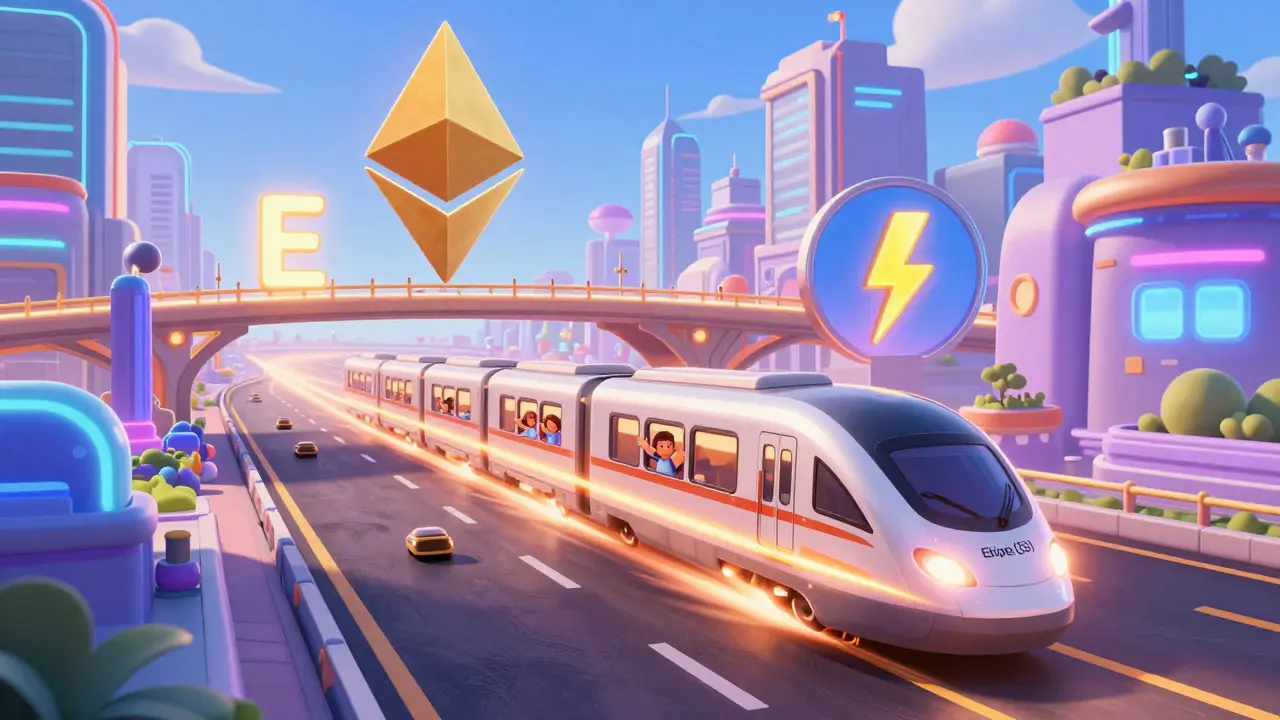
Eclipse vs. Ethereum Transaction Cost Calculator
Why this matters:
Eclipse transactions cost nearly nothing compared to Ethereum mainnet. While Ethereum charges $5-50+ per transaction, Eclipse uses its native ES token with near-zero fees due to its SVM architecture and Solana-like parallel processing.
Speed Comparison
Eclipse uses Solana's SVM (Solana Virtual Machine) for high-speed transaction processing, while inheriting Ethereum's security through settlement on Ethereum mainnet. This hybrid architecture enables near-zero fees and 9,000+ TPS throughput - all while keeping your assets secure on Ethereum.
Eclipse (ES) isn't another altcoin trying to be Bitcoin. It’s a blockchain built to fix a real problem: Ethereum’s slow, expensive transactions - but without giving up its security or liquidity. Launched in mid-2025, Eclipse combines the speed of Solana’s execution engine with Ethereum’s deep pools of capital and trust. Think of it as a high-performance express lane built directly onto Ethereum’s highway.
How Eclipse Works: The Hybrid Engine
Eclipse doesn’t compete with Ethereum - it enhances it. While most Layer 2s like Arbitrum or Optimism run on the Ethereum Virtual Machine (EVM), Eclipse uses the Solana Virtual Machine (SVM). That means it executes transactions using Solana’s parallel processing tech, which is built for speed, not just sequential logic.
Here’s the catch: every transaction still gets settled on Ethereum. That’s the security layer. And the data? It’s stored on Celestia, a dedicated data availability network. This three-part setup - SVM for speed, Ethereum for security, Celestia for data - is what Eclipse calls a “Giga Scale Virtual Machine.”
In real-world tests, Eclipse has hit nearly 9,000 transactions per second (TPS). Compare that to Ethereum’s mainnet, which handles 15-30 TPS, or even Polygon zkEVM at around 2,000 TPS. Most EVM-based L2s max out at 50 TPS in live use. Eclipse isn’t just faster - it’s in a different league.
The ES Token: Gas, Governance, and Value
The ES token is the lifeblood of the Eclipse network. It’s used as the native gas token - meaning you pay for transactions in ES, not ETH. This is a key difference from other L2s. Some sources say ETH is used for gas, but Eclipse’s own documentation confirms ES is the primary gas token through its native paymaster system. That means users don’t need to hold ETH to interact with the chain.
There’s a total supply of 1 billion ES tokens. As of July 2025, about 132.64 million are in circulation, with a market cap around $11.7 million. The token price hovered near $0.09, down slightly from its peak after the Token Generation Event (TGE) on July 16, 2025. The fully diluted valuation is $88.33 million, meaning there’s still a lot of supply left to enter the market.
Token distribution is heavily weighted toward private investors and ecosystem growth. Only 15% went to public sale. The rest is locked for team, advisors, and future development. That’s a red flag for some, but Eclipse argues it’s necessary to fund long-term infrastructure.
Why Eclipse Exists: Bridging SOL and ETH
Eclipse isn’t trying to replace Ethereum or Solana. It’s trying to connect them. Ethereum has $66 billion locked in DeFi. Solana has $12 billion and much faster transactions. Eclipse lets users move assets between both chains without leaving their wallets.
Imagine depositing SOL into Eclipse, then using it to earn yield on an Ethereum-based lending protocol - all without paying Ethereum gas fees. Or trading ETH for SOL on a decentralized exchange running on Eclipse, with 2-second finality. That’s the “Home of SOL-ETH DeFi” vision.
There are already 17 live protocols on Eclipse, including 3 major DEXs and 2 lending platforms. Early users report swapping 50 tokens in under 2 seconds with near-zero fees. For traders and gamers, that’s a game-changer.

Who’s Using It - And Who’s Struggling
Early adopters fall into two groups. Solana developers love it. They can deploy smart contracts in Rust in 2-3 days using existing tools. One Reddit user said, “I bridged SOL and did 50 swaps before my coffee got cold.”
Ethereum developers? Not so much. If you’ve built on Solidity for years, switching to SVM means learning a whole new language and architecture. One developer on Ethereum Stack Exchange said migrating their DeFi app took three extra weeks because they had to rewrite everything. The learning curve is steep.
Wallet compatibility is another hurdle. MetaMask doesn’t natively support Eclipse. Users have to manually add custom RPCs - a barrier for non-technical users. Only 1,370 wallets hold ES tokens so far. That’s tiny compared to Arbitrum’s millions.
Competition and Risks
Eclipse entered a crowded field. Arbitrum, Optimism, zkSync, and Polygon all have bigger ecosystems, more developers, and better documentation. Eclipse’s biggest weakness isn’t tech - it’s adoption. No one uses a blockchain unless other people are using it too.
Experts are divided. CryptoNinjas analyst Maria Chen called it “compelling for high-frequency trading.” But Dr. Alan Torres from Zurich warned the hybrid model could create security blind spots. Delphi Digital gave it 3.5/5 - innovative, but behind on ecosystem growth.
Regulatory risk is real. ES could be classified as a security under new EU rules. ESMA flagged hybrid L2 tokens as “novel challenges.” If regulators step in, it could delay or restrict access.
What’s Next for Eclipse
The roadmap is ambitious. By Q3 2025, Eclipse plans to launch native cross-chain messaging between Ethereum and Solana - meaning assets can move back and forth without bridges. Q4 brings hardware wallet support, which would help institutional adoption. And in Q1 2026, they plan to upgrade ES to a governance token, letting holders vote on upgrades.
Their new “Turbo Tap” feature, rolled out in August 2025, is already boosting transaction efficiency. If they deliver on their roadmap, Eclipse could become the go-to for cross-chain DeFi.
But if they don’t? They’ll be just another footnote in blockchain history. The tech is solid. The team has experience - CEO Vijay Chetty worked at Ripple, dYdX, and Uniswap. But technology alone doesn’t win. Community does.
Should You Care About Eclipse (ES)?
If you’re a trader, DeFi user, or gamer who hates slow transactions and high fees - yes. Eclipse offers real speed and low cost. If you’re an Ethereum developer who wants to stick with Solidity - maybe wait. The tooling isn’t ready yet.
For investors, ES is high-risk, high-reward. The market cap is tiny. The token supply is still mostly locked. If adoption grows even 10x, the price could surge. But if developers don’t build on it, it could stagnate.
Right now, Eclipse is a bet on the future of blockchain interoperability. It’s not the safest play. But if Ethereum and Solana keep growing, and users demand faster, cheaper access to both - Eclipse might just be the bridge that finally connects them.
Is Eclipse (ES) a good investment?
Eclipse (ES) is speculative. The token price is low, the market cap is small, and most supply is still locked. If Eclipse gains traction among DeFi users and developers, the price could rise significantly. But if adoption stalls, it may not recover. Only invest what you can afford to lose.
Can I use MetaMask with Eclipse?
Not directly. MetaMask doesn’t support Eclipse out of the box. You need to manually add Eclipse’s custom RPC network settings. There are step-by-step guides in the Eclipse Wiki, but this is a barrier for non-technical users. Wallet support is expected to improve in late 2025.
What’s the difference between SVM and EVM?
EVM (Ethereum Virtual Machine) runs code one transaction at a time, which limits speed. SVM (Solana Virtual Machine) runs many transactions in parallel using a system called Sealevel. This lets SVM handle thousands of transactions per second. Eclipse uses SVM for speed but still settles on Ethereum for security.
Do I need ETH to use Eclipse?
No. Eclipse uses ES as its native gas token through its paymaster system. You don’t need ETH to pay for transactions. However, you’ll need ETH if you’re bridging assets from Ethereum to Eclipse.
Is Eclipse safe?
Eclipse inherits Ethereum’s security by settling transactions on Ethereum’s mainnet. Data is stored on Celestia, a secure, decentralized data layer. However, the hybrid architecture is new and untested at scale. Smart contract bugs or bridge exploits could still occur. Always use trusted wallets and double-check contracts before interacting.
Where can I buy ES tokens?
ES is listed on several decentralized exchanges like Uniswap and Jupiter, and centralized exchanges including KuCoin and Gate.io. Always verify the contract address before buying - scams are common with new tokens. Use official links from eclipse.xyz.
Can I stake ES tokens?
Not yet. Staking and governance features are planned for Q1 2026. Right now, ES is primarily used for paying gas fees and as a speculative asset. Holders should watch for official announcements about staking launches.
How does Eclipse compare to Solana?
Solana is its own independent blockchain with native SOL tokens. Eclipse is a Layer 2 on Ethereum that uses Solana’s execution tech. You can’t use Eclipse to trade SOL directly - you need to bridge it from Solana first. Eclipse is designed to bring Solana’s speed to Ethereum’s ecosystem, not replace Solana.


16 Comments
Glenn Jones
this is just solana with a side of eth gas fees lmao they say 'no eth needed' but u still need eth to bridge in lmao also 1370 wallets?? bro this is a ghost chain ES token is gonna dump when the private sales unlock i'm not even mad just disappointed
Joe West
you're missing the point. eclipse isn't about replacing anything. it's about letting solana devs build on eth liquidity without the 15 gas fees. the svm is legit. i've deployed 3 contracts in rust and they're 3x faster than my old erc20s. the wallet thing is annoying but it's a v1 problem.
Josh Rivera
oh wow another 'decentralized' project that needs 3 different chains to work so eth for security, celestia for data, svm for speed... and you call this innovation? this is just a Rube Goldberg machine made of blockchain parts and you think people will trust this over a single chain with 10 years of audits? i'm sorry but this is crypto theater at its finest
Holly Cute
i love how everyone's acting like this is some revolutionary tech when it's basically just solana lite with a fancy name. 9k tps? cool. but who's actually using it? 1.3k wallets? that's less than a single popular nft drop. and the tokenomics? 85% locked? that's a rug pull waiting to happen. i'm not saying it's fake but i'm not putting my money in until i see at least 100k wallets and a live staking contract. also 👀
Neal Schechter
for anyone new to this: eclipse is basically trying to be the bridge between solana's speed and ethereum's liquidity. it's not perfect. the wallet setup is clunky, the learning curve for solidity devs is brutal, and yeah the token supply is heavily concentrated. but the tech? it's real. i've used it to swap tokens between eth and sol chains with near-zero fees and 2s finality. if you're a trader or gamer, it's worth a look. just don't expect it to be easy. it's still early.
Isha Kaur
i come from india and i've been watching this for months. the real problem isn't the tech. it's the community. most people here are either solana fans or eth purists and neither side wants to give an inch. eclipse needs developers who are open to both. i tried to onboard 3 friends from my coding bootcamp but they all got scared by the svm docs. if eclipse can make rust tutorials as simple as solidity ones, they could have a shot. but right now it feels like they're building a spaceship while everyone else is still fixing bicycles.
Cristal Consulting
if you're trading or gaming, try it. the fees are next to nothing. i did 50 swaps before my coffee cooled down. it's not for everyone but if you're tired of paying $5 to send a token, this is the real deal. just add the rpc and go. no need to overthink it.
Renelle Wilson
while the technical architecture of Eclipse is undeniably innovative, one must consider the sociotechnical implications of introducing a hybrid model that fragments user trust across three distinct layers. the psychological burden of managing multiple protocols-Ethereum for settlement, Celestia for data, SVM for execution-may inadvertently alienate non-technical participants who seek simplicity and composability. furthermore, the concentration of token supply among private stakeholders raises legitimate governance concerns, particularly under emerging regulatory frameworks such as MiCA. The project's success hinges not merely on throughput metrics, but on whether it can foster a decentralized, inclusive community capable of sustaining long-term adoption without centralizing influence.
Chris Mitchell
tech is solid. community is weak. that’s the whole story.
Tom Van bergen
why do we keep building layers on layers when we could just fix ethereum itself? this is like putting a turbo on a horse cart and calling it a spaceship
Jerry Perisho
has anyone tried the turbo tap feature? it's actually smooth. i used it to swap usdc to usdt and it was faster than my phone unlocking. the rpc setup is annoying but once it's done it just works. also the devs are active on discord.
Doreen Ochodo
just tried it. 2 second swaps. zero fees. game changer for my bot. stop overthinking. if you trade, use it.
Manish Yadav
this is just another scam. why would anyone trust a chain that needs 3 other chains to work? and 1 billion tokens? that's a dump waiting to happen. people in india are already losing money on this. don't fall for it.
Adam Bosworth
ok so i just lost 3k on this because i trusted the '9k tps' hype and now the token is down 40% and the devs are ghosting the discord. this is why crypto is a casino. and now i have to explain to my gf why i blew our rent money on a chain that needs 3 different blockchains to function. thanks eclipse
Mariam Almatrook
The structural fragility of this architecture cannot be overstated. One must consider the ontological paradox: a layer two that depends on three distinct consensus mechanisms for its integrity. This is not innovation-it is institutionalized complexity. The ES token, in its current form, functions not as a utility but as a speculative instrument, tethered to the whims of private equity allocations. One must ask: if Ethereum’s security is the bedrock, why does it not also serve as the gas medium? The answer reveals not technological brilliance, but financial engineering dressed as progress.
Tisha Berg
if you're new to crypto and thinking about trying eclipse, just take it slow. add the rpc, use a small amount first, and don't put in more than you're okay with losing. the tech is cool but the community is still small. be kind to each other out there. we're all learning.