
KEL Token Value Calculator
Compare your KEL investment at peak value ($0.4752) to current market value ($0.001736). See how much you've lost since the token's peak.
Your Investment Value
KelVPN (KEL) isn’t just another cryptocurrency. It’s a blockchain-based project built around a decentralized VPN service that claims to be immune to future quantum computer attacks. But behind the bold promises of unbreakable privacy and cutting-edge tech, there’s a much quieter reality: very few people are actually using it, the token has lost over 99% of its peak value, and the team still holds full control over the smart contract. If you’re wondering whether KEL is a legitimate privacy tool or just another crypto gamble, here’s what you need to know.
What KelVPN Actually Does
KelVPN is a virtual private network that runs on its own blockchain. Instead of connecting to servers owned by a company like NordVPN or ExpressVPN, you connect to nodes run by random people around the world. These nodes both validate blockchain transactions and route your internet traffic. The idea is simple: no central company means no one can log your activity. According to KelVPN’s website, this setup makes it technically impossible to track users.
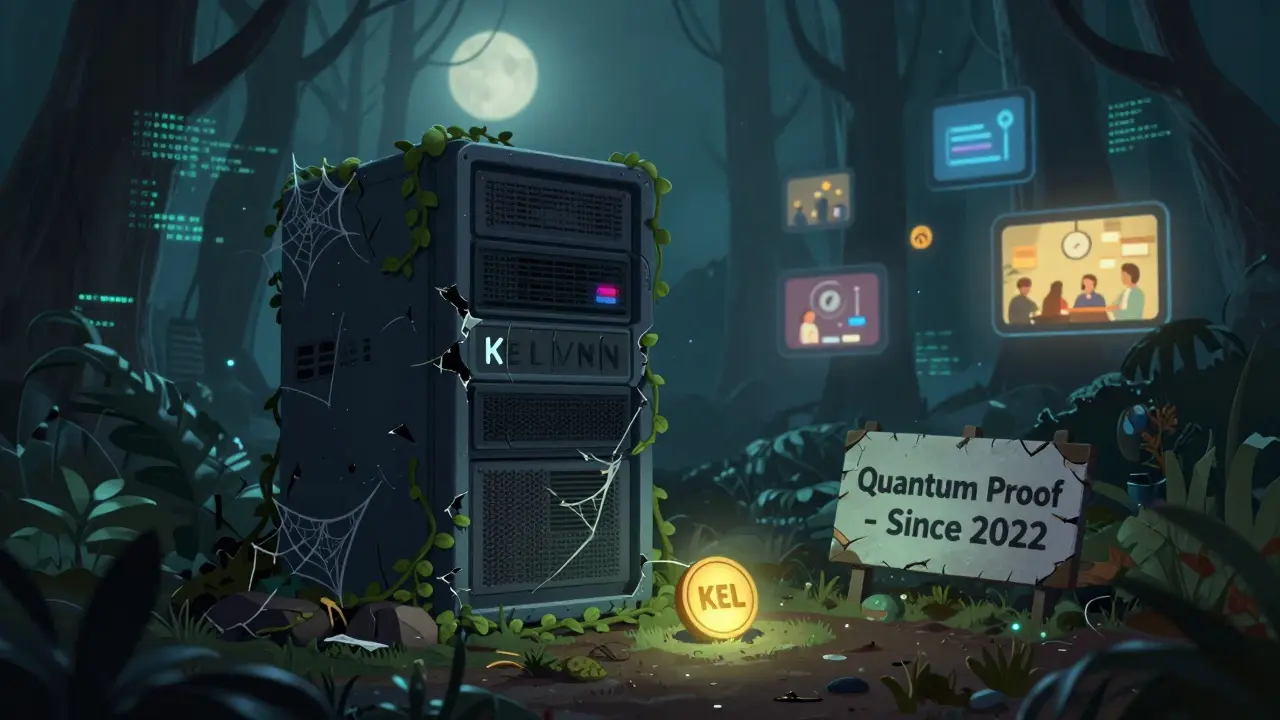
What sets KelVPN apart from other decentralized VPNs like Mysterium or Sentinel is its use of post-quantum cryptography. It uses the CRYSTALS-Dilithium algorithm for signing data and Kyber-512 for key exchange-both are standards being developed by NIST to defend against quantum computers. While most crypto projects are still using SHA-256 and ECDSA, KelVPN claims it’s already future-proofed. That’s impressive on paper. But here’s the catch: quantum computers powerful enough to break current encryption don’t exist yet. Experts estimate they’re still 10-15 years away. So you’re paying for protection against a threat that’s not real today.
The KEL Token: Utility or Speculation?
The KEL token is the lifeblood of the KelVPN network. You need it to pay for subscriptions, stake for rewards, and vote on future upgrades. The total supply is fixed at 100 million tokens. But here’s where things get messy.
KEL’s price peaked at $0.4752 in early 2023. As of November 2023, it was trading around $0.001736. That’s a 99.6% drop. Daily trading volume averages just $15,230-compared to Mysterium’s $1.2 million. That means there’s almost no liquidity. If you buy KEL, you might not be able to sell it later without crashing the price.
Even worse, the smart contract that controls KEL has administrative privileges. The original developers can still change fees, disable selling, or mint more tokens. That’s the opposite of decentralization. CryptoSlate called it a "centralization risk contradicting the project’s decentralized claims." If the team decides to pull the plug, you have zero recourse.
Who’s Actually Using KelVPN?
There are no official user numbers. No press releases. No blog posts with growth metrics. But we can guess from the data.
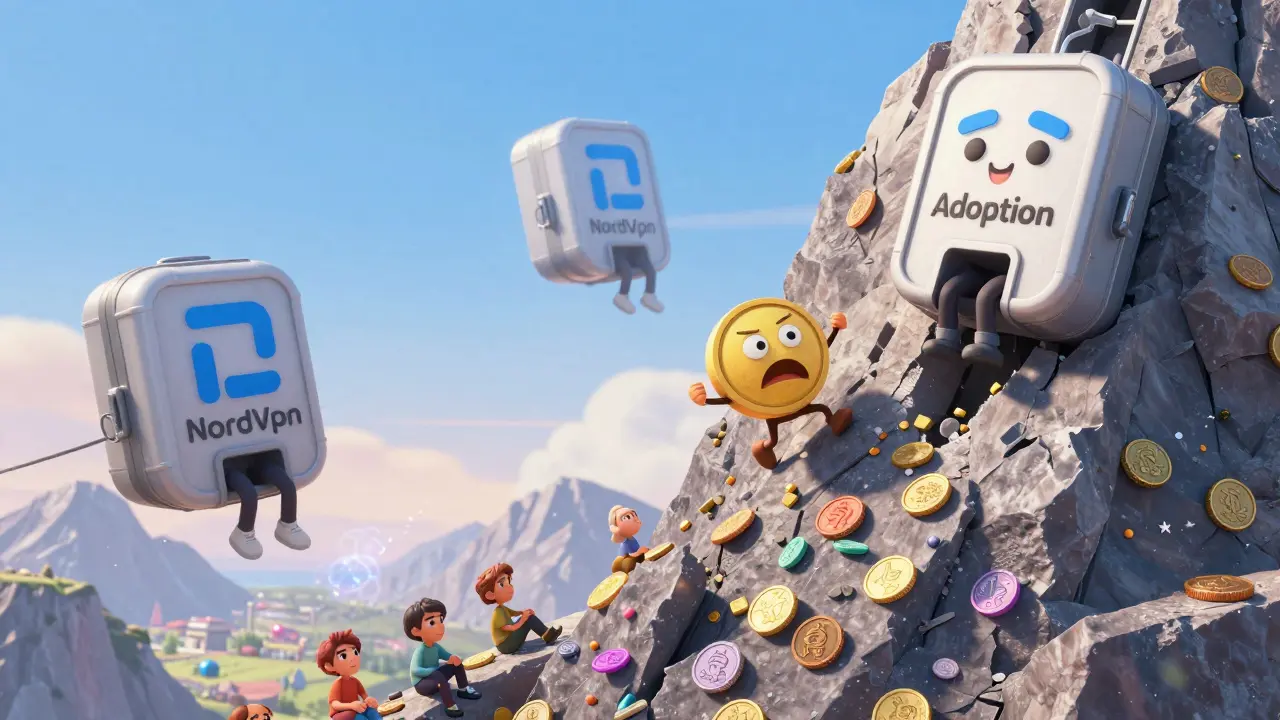
Blockchain analysis shows fewer than 500 wallet addresses hold meaningful amounts of KEL. Compare that to NordVPN’s 14 million users. Even Mysterium Network, another niche player, has over 100 times more trading volume. Reddit threads mention KelVPN in passing, mostly as a curiosity. One user on r/VPNTorrents wrote: "Extremely limited server locations compared to traditional VPNs." That’s a big problem. If you’re in New Zealand and the nearest node is in Brazil, your connection will be slow. KelVPN claims it supports 8K streaming, but no independent speed tests exist.
There’s no official Discord, no Telegram group, and no active community forum. GitHub updates are rare. The last commit was in September 2023. If you run into trouble setting it up, you’re on your own.
How to Use KelVPN (If You Want To)
Using KelVPN isn’t like clicking "Connect" in NordVPN. It requires crypto knowledge.
- Buy KEL tokens on a decentralized exchange like Uniswap or PancakeSwap. You’ll need Ethereum or Binance Coin to swap for KEL.
- Store them in a wallet like MetaMask.
- Download the KelVPN app from their website (no app stores).
- Log in with your wallet and select a node.
- Pay your subscription in KEL.
For someone new to crypto, this could take 2-3 hours. That’s a huge barrier. Most people want a VPN they can install in 30 seconds and pay with a credit card. KelVPN doesn’t fit that mold.
Staking KEL: Is It Worth It?
KelVPN offers staking rewards between 5% and 15% annually. Sounds good, right? But remember: the token’s value is collapsing. If KEL drops another 50% next month, your 10% APY won’t save you. You’re not earning income-you’re betting the token will rebound.
Bitget’s Earn platform lists KEL as a staking option, but user reviews mention "difficulty finding reliable information about actual node operators." That’s not a sign of a healthy network. If you don’t know who’s running the nodes, you can’t trust them.
KelVPN vs. Other VPNs
| Feature | KelVPN (KEL) | NordVPN / ExpressVPN | Mysterium Network (MYST) |
|---|---|---|---|
| Privacy Model | Decentralized blockchain nodes | Centralized servers (no-log claims) | Decentralized peer nodes |
| Quantum Resistance | Yes (CRYSTALS-Dilithium) | No | No |
| Payment Method | KEL token only | Credit card, PayPal | MYST token or fiat |
| Trading Volume (Daily) | $15,230 | N/A (not a crypto) | $1.2 million |
| Market Cap | $350,000 | $1.2 billion | $45 million |
| App Availability | Website only | iOS, Android, Windows, Mac | iOS, Android, desktop |
| Customer Support | None verified | 24/7 live chat | Discord, email |
KelVPN’s only real advantage is quantum resistance. Everything else-ease of use, reliability, support, adoption-is worse than both traditional and other decentralized options.
The Bigger Picture: Is This a Viable Project?
The global VPN market is worth $31 billion and will hit $75 billion by 2027. Decentralized VPNs like KelVPN make up less than 1% of that. KelVPN itself is one of the smallest players-its market cap is less than 1% of Mysterium’s.
Gartner’s 2023 report says 92% of projects combining unproven blockchain tech with niche privacy demands fail within three years. KelVPN fits that profile perfectly. It’s a solution looking for a problem. Quantum computing isn’t a threat to everyday users. Most people don’t need to hide from future hackers-they need to hide from advertisers and ISPs today.
And here’s the final nail: less than 0.1% of all KEL tokens are used to pay for actual VPN services. The rest are sitting in wallets, waiting for someone to buy them at a higher price. That’s not a utility token. That’s a speculative asset.
Final Verdict: Should You Buy KEL?
If you’re looking for a reliable, fast, easy-to-use VPN-stick with NordVPN, Surfshark, or ProtonVPN. They work. They’re affordable. They have support teams.
If you’re a crypto speculator with high risk tolerance and you believe quantum computing will become an urgent threat in the next two years, then KEL might be a gamble worth taking. But don’t expect it to be a useful tool. Don’t expect customer service. Don’t expect liquidity.
Right now, KEL is a crypto experiment with a privacy label. It’s not a product. It’s a bet on a future that may never come-and a team that still holds all the keys.
Is KelVPN (KEL) a good investment?
KEL is not a good investment for most people. Its value has dropped over 99% from its peak, trading volume is extremely low, and the team can still change the rules at any time. Unless you’re betting on quantum computing becoming an immediate threat-and you’re comfortable losing your entire stake-it’s a high-risk, low-utility asset.
Can I use KelVPN to stream Netflix or torrent safely?
Technically, yes-KelVPN claims to support 8K streaming. But in practice, it’s unreliable. There are very few nodes, no performance data, and no way to verify if your traffic is actually encrypted or routed properly. Traditional VPNs have proven track records for streaming and torrenting. KelVPN does not.
Why isn’t KEL listed on Coinbase or Binance?
Centralized exchanges like Coinbase and Binance avoid listing tokens with low liquidity, high volatility, and unclear utility. KEL has none of the traits they look for: no user base, no verified adoption, and a contract that can be altered by the creators. It’s too risky and too niche for major exchanges.
Is KelVPN truly anonymous?
KelVPN claims to be anonymous because it uses decentralized nodes and doesn’t store logs. But anonymity depends on who runs the nodes. If a node operator is malicious, they could intercept your traffic. There’s no way to verify their identity or trustworthiness. Plus, the contract’s admin keys mean the project could be shut down or manipulated at any time.
What happens if the KelVPN team disappears?
If the team vanishes, the KEL token could become worthless overnight. The smart contract still has admin controls, so they could disable trading, mint more tokens, or shut down the network. There’s no decentralized governance or community backup. You’d be left with a token that can’t be used for its intended purpose.
Are there better alternatives to KelVPN?
Yes. For traditional VPNs: NordVPN, ExpressVPN, and ProtonVPN are reliable and user-friendly. For decentralized options: Mysterium Network and Sentinel have larger communities, better liquidity, and proven infrastructure. Neither offers quantum resistance, but they’re far more practical and trustworthy than KelVPN.

15 Comments
Jon Visotzky
I tried KelVPN last month just to see what the hype was about. Took me 3 hours to get it working, then my connection dropped every 10 minutes. No support, no docs, just a GitHub repo that hasn't been updated in months. I gave up and went back to ProtonVPN. Honestly, it feels like someone built this in their garage and called it 'quantum-proof'.
Tara Marshall
The real issue isn't quantum resistance. It's that nobody needs it. Most people want a VPN that just works. KEL is a solution to a problem that doesn't exist yet while ignoring the problems we have now.
Mariam Almatrook
One must ponder, with the gravitas befitting a scholar of cryptographic evolution, whether the ostensible decentralization of KelVPN is not merely a rhetorical façade draped over the skeletal remains of centralized control. The administrative privileges vested in the original developers constitute not merely a vulnerability, but an existential contradiction to the very ethos of blockchain autonomy. One is compelled to ask: is this innovation-or merely performative crypto-theater?
Cristal Consulting
If you're into crypto and privacy, give it a shot-but only with money you're okay losing. The tech is cool, but the execution? Barely there. Don't go all in. Just dip your toes. And maybe message the devs on Twitter. They might actually reply.
Uzoma Jenfrancis
This is why the West keeps pushing fake tech. Quantum resistance? We have real problems-food, water, infrastructure. You spend your time on blockchain VPNs while your country falls apart. This is not progress. This is distraction.
Renelle Wilson
It's heartbreaking to see such potential wasted. The vision of a decentralized, quantum-resistant privacy network is noble. But without community, transparency, and incremental development, it becomes a monument to ambition rather than utility. Perhaps the team needs mentorship-not more whitepapers, but real feedback from users who just want to browse without fear. The tech is there. The heart isn't.
Elizabeth Miranda
I love the idea. I really do. But the app design looks like it was coded in 2017. No mobile app? No Discord? No FAQ? You can't just drop a whitepaper and expect people to figure it out. If you want adoption, you need UX, not just cryptography.
Chloe Hayslett
Oh wow, a crypto project that’s *actually* useless and centralized? Groundbreaking. Next they’ll release a blockchain-powered toaster that only accepts KEL and requires a PhD to toast bread. 🙃
Thomas Downey
It is a moral failure of the crypto community to elevate such a project as anything resembling innovation. To label this as "privacy technology" is to insult the very notion of digital sovereignty. The developers hold the keys. The token is illiquid. The user base is negligible. This is not decentralization-it is fraud dressed in cryptographic jargon. One must ask: who benefits? The answer is clear: only those who sold early.
Annette LeRoux
I really want to believe in this 🤍 but every time I think about staking my KEL, I imagine it like putting money into a balloon that’s slowly leaking air. The quantum stuff is cool, sure, but I’d rather have a VPN that connects in 2 seconds and doesn’t make me feel like a beta tester for the apocalypse.
Jerry Perisho
The trading volume is a joke. $15k daily? That’s less than a single whale’s sell order on a decent altcoin. And the fact that the team can still mint tokens? That’s not a bug, that’s the whole design. This isn’t Web3. It’s Web2 with a blockchain sticker on it.
Manish Yadav
Why you waste time on this? Just use free vpn. No need for token. No need for quantum. Just connect and go. This is scam. Team rich, you poor.
Vincent Cameron
There’s a deeper irony here: we’re chasing quantum resistance while ignoring the very real erosion of privacy happening right now through data brokers, AI profiling, and surveillance capitalism. We’re building a fortress against a dragon that hasn’t hatched yet, while our house is being looted by thieves with keys we handed them willingly. KEL is a distraction from the real war.
Krista Hewes
i tried it once and my ip leaked 😭 i thought it was me but then i saw the node list and like 3 of them were in the same datacenter? and the website looks like its from 2015? i just gave up. i miss the days when a vpn just worked
ronald dayrit
The philosophical underpinning of KelVPN is not technological-it is existential. It asks: in a world where every click is monetized, every movement tracked, and every identity commodified, do we have the right-or the will-to construct something truly private? The answer, as evidenced by its market cap and user base, is no. KEL is not a product. It is a monument to the quiet, unfulfilled longing for digital autonomy in an age of algorithmic control. We are not failing to adopt it because it is impractical. We are failing because we have surrendered the desire for true freedom. The quantum threat is a metaphor. The real threat is apathy.