Managing a crypto portfolio in 2025 isn’t about watching price charts all day. It’s about having a system. Without one, even the best buys can turn into losses - not because the assets failed, but because you didn’t know when to hold, when to sell, or how much to risk. The crypto market hit $4.2 trillion in early 2025, and with that growth came chaos. Thousands of coins, dozens of exchanges, DeFi protocols, and tax rules across countries. If you’re holding crypto across wallets, apps, and platforms, you’re already drowning in data. The fix isn’t more apps - it’s structure.
Start with a Simple Allocation Plan
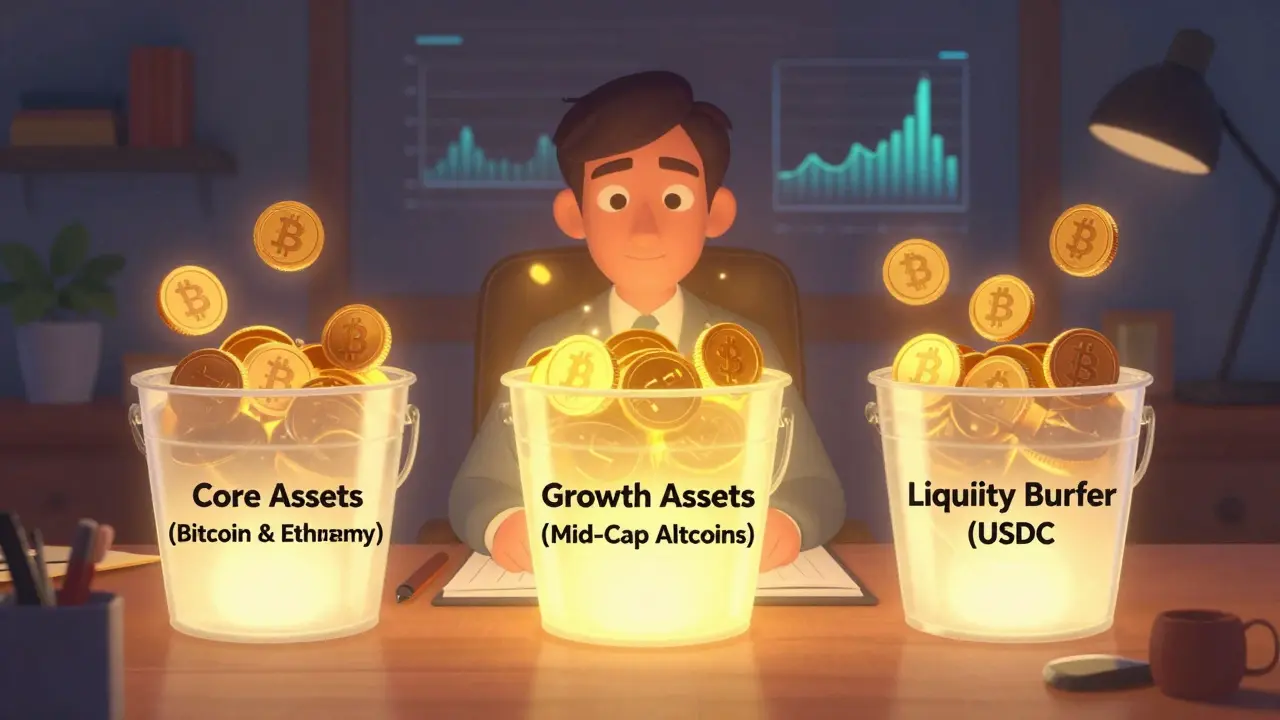
Most people start by buying Bitcoin because they heard it’s digital gold. Then they jump into Ethereum, then Solana, then some meme coin with a dog logo. Two months later, they have 27 different assets and no idea what they own or why. That’s not investing - it’s gambling with spreadsheets. A solid portfolio starts with three buckets:- Core assets (60-70%): Bitcoin and Ethereum. These aren’t speculative. They’re the foundation. Bitcoin has proven itself over 15 years. Ethereum powers the majority of DeFi and NFTs. Together, they make up over 80% of total crypto market cap.
- Growth assets (20-30%): Mid-cap altcoins with real usage. Think Chainlink, Polygon, or Arbitrum. These aren’t the latest hype coins. They’re projects with active development, clear use cases, and strong communities. Avoid anything under $100 million market cap unless you’re speculating with money you can lose.
- Liquidity buffer (5-10%): Stablecoins like USDC or USDT. These aren’t for earning big returns. They’re for staying calm. When the market crashes 30%, having 10% in stablecoins lets you buy the dip without selling your Bitcoin at a loss.
Here are three real-world examples from 2025:
- Conservative: 50% Bitcoin, 25% Ethereum, 25% USDC
- Balanced: 40% Bitcoin, 30% Ethereum, 20% mid-cap altcoins, 10% USDC
- Aggressive: 25% Bitcoin, 25% Ethereum, 30% mid-cap altcoins, 20% small-cap speculative tokens
Material Bitcoin’s 2025 analysis shows portfolios with 50-80% Bitcoin had the highest survival rate during bear markets. If you’re new, start with 70% Bitcoin, 20% Ethereum, 10% USDC. Stick to it for a year. Then adjust.
Use a Portfolio Tracker - Not Just a Wallet
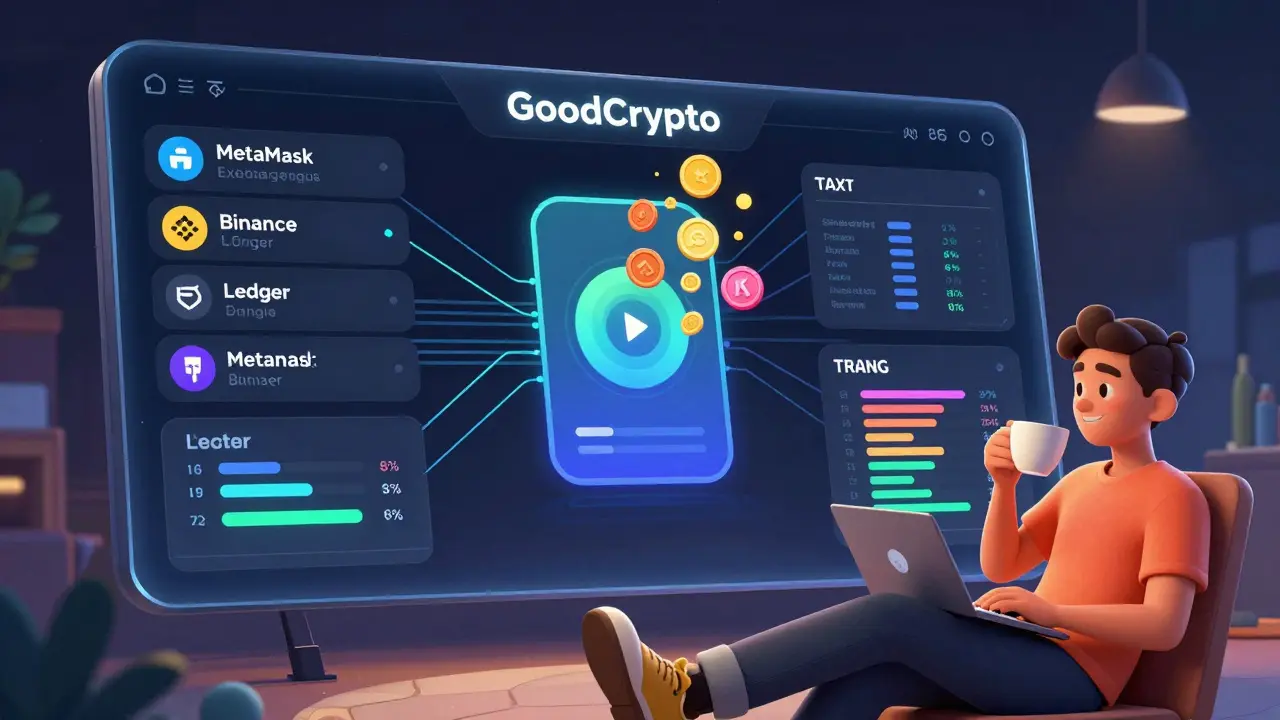
Your wallet (MetaMask, Phantom, Ledger) tells you what you own. It doesn’t tell you how much you made, how your portfolio is performing, or what you owe in taxes. That’s where portfolio trackers come in.By 2025, the top tools - Zerion, CoinStats, and GoodCrypto - connect to over 45 exchanges and 200+ DeFi protocols. They auto-sync your holdings across Binance, Coinbase, Kraken, and even your own cold wallet. They calculate your profit and loss in real time, down to the cent. And they generate tax reports for 100+ countries.
Here’s what to look for:
- API integration with all your exchanges and wallets
- Accurate DeFi transaction tracking (liquidity pools, staking rewards, swaps)
- Multi-currency support (USD, EUR, NZD - important if you’re in New Zealand)
- Customizable alerts (e.g., “Notify me if Bitcoin drops 8%”)
GoodCrypto leads the pack with a 4.7/5 rating from nearly 3,000 users. CoinStats is the easiest for beginners. Zerion is best for DeFi-heavy portfolios. Avoid free tools that don’t track taxes - you’ll regret it when the IRS or IRD comes knocking.
Dollar-Cost Averaging Beats Timing the Market
You don’t need to be a trader. In fact, most traders lose. Coinbase data shows 87% of active traders underperform the market over three years. Why? Emotions. Fear. Greed. FOMO. You buy when everyone’s screaming “to the moon.” You sell when the charts turn red.Dollar-cost averaging (DCA) fixes this. Buy a fixed amount - say $100 - every week or month. No matter the price. When Bitcoin is at $80,000, you buy less. When it’s at $50,000, you buy more. Over time, you smooth out the average cost.
Material Bitcoin’s historical data shows a $1,000 investment in Bitcoin in early 2015 at $300 per coin would be worth $350,000 by May 2025. That’s a 366x return. But if you tried to time the top and bottom? You’d likely have sold at $40,000 and missed the rest. DCA removes the guesswork. It’s the single most effective strategy for non-professionals.
Rebalance - But Only When It Matters
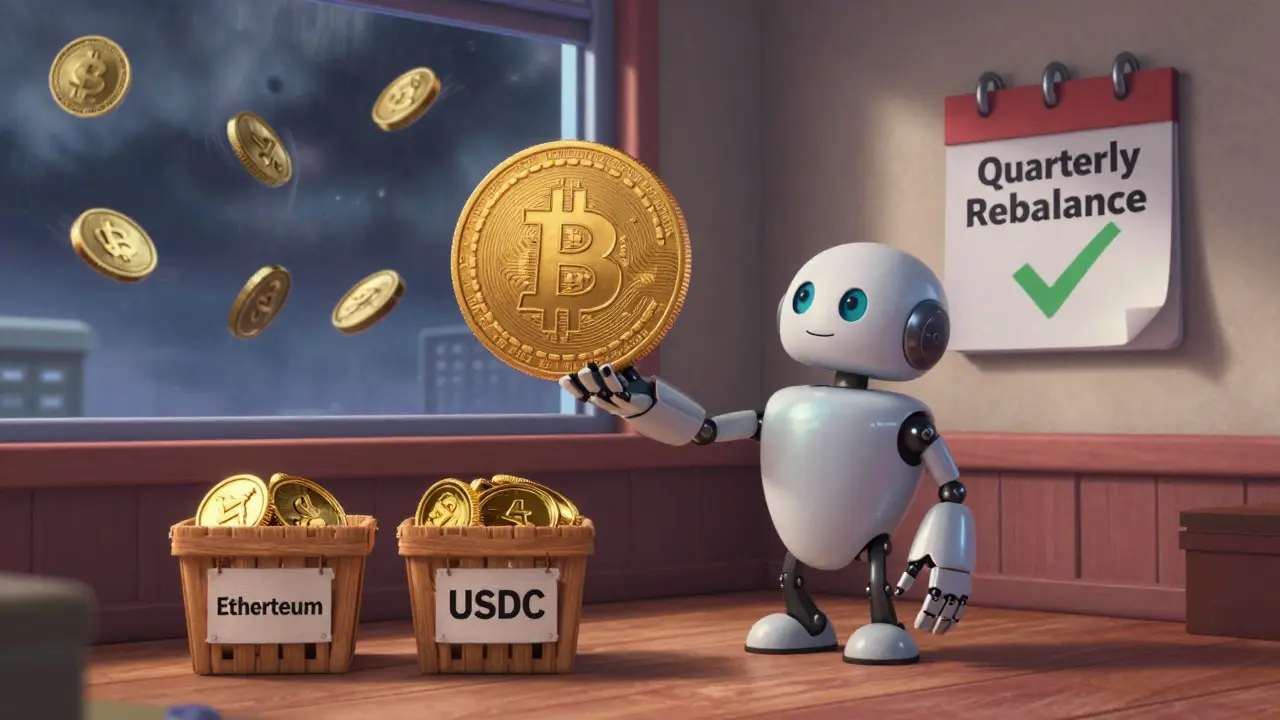
Your portfolio drifts. Bitcoin goes up 40% in a month? Now it’s 75% of your portfolio instead of 60%. That’s riskier than you planned. Rebalancing brings it back.Don’t rebalance every week. Don’t wait until you’re down 50%. Do it quarterly - or when any asset moves more than 15% from its target.
For example: Your target is 60% Bitcoin, 30% Ethereum, 10% USDC. After a rally, you’re at 72% BTC, 22% ETH, 6% USDC. Sell 12% of your Bitcoin. Buy Ethereum and USDC to restore the balance. You lock in gains and reduce exposure. This simple habit is used by 73% of institutional portfolios, according to XBTO’s 2025 report.
Some tools like Zignaly and Portifee automate this. You set your rules - “Rebalance if any asset exceeds 70%” - and the system does it. No emotional decisions. Just math.
Don’t Over-Diversify
It’s tempting to buy every new coin that trends on Twitter. “What if this one goes 100x?” But holding more than 30 assets is a trap. Altify’s 2025 study found over-diversified portfolios had 18% lower volatility - but also 22% lower returns. Why? You’re just mimicking the market. You’re not beating it.Mark Johnson from Caleb & Brown puts it bluntly: “Holding more than 30 assets essentially mirrors the market.” That’s not investing. That’s indexing with extra steps.
Benjamin Graham’s rule still holds: 10 to 30 assets is enough. Focus on quality, not quantity. One well-researched altcoin is worth ten meme coins. Stick to your plan. If you want to try a new project, take it from your altcoin bucket - not your Bitcoin or Ethereum.
Stablecoins Are Your Safety Net
Many beginners think stablecoins are boring. They’re not. They’re your emergency fund in crypto form. During the March 2024 market crash, portfolios with 5-10% in USDC or USDT lost 37% less than those without. And they still captured 89% of the rebound.Stablecoins aren’t just for holding. You can earn yield on them - 4-8% APY on platforms like Aave or Compound. That’s better than most savings accounts. And you can move them instantly between exchanges. No bank delays. No fees.
Regulators are catching up too. The SEC now requires institutions to hold at least 5% in stablecoins. The EU’s MiCA rules demand 30-day liquidity coverage. If it’s good enough for institutions, it’s good enough for you.
Track Taxes - Or Pay the Price
Every time you trade, swap, stake, or receive airdrops, you trigger a taxable event. In New Zealand, the IRD treats crypto as property. Capital gains are taxed as income. If you bought Bitcoin at $30,000 and sold at $80,000? You owe tax on $50,000 profit.Without a tracker, you’re guessing. And guessing leads to audits. CoinLedger’s 2025 survey found 31% of users had inaccurate tax reports because their tools couldn’t handle complex DeFi transactions - like liquidity pool deposits or yield farming rewards.
Use a tracker that auto-calculates your cost basis, FIFO/LIFO, and generates a NZ-specific tax report. GoodCrypto and CoinStats both support IRD formats. Export the data. Keep it. If the IRD asks, you’ll be ready.
Set Rules - And Follow Them
The biggest reason people fail in crypto isn’t bad tech. It’s bad psychology. You see your portfolio drop 20%. Panic. You sell. Then it goes up 50%. You feel stupid. Next time, you buy at the top. It’s a cycle.Write down your rules. Keep them simple:
- “I will never invest more than 10% of my portfolio in any single altcoin.”
- “I will rebalance every quarter.”
- “I will not sell Bitcoin unless I need cash for rent or medical bills.”
- “I will only buy new assets from my altcoin allocation - never from Bitcoin or Ethereum.”
Reddit user u/CryptoNewbie2025 said setting a 60-30-10 rule made them 47% more profitable than their previous random approach. Why? Because rules remove emotion. They turn investing into a routine - like brushing your teeth.
What’s Next in 2026?
The tools are getting smarter. AI-powered platforms like Portifee now suggest rebalancing based on your risk profile and market trends. Chainalysis predicts 65% of trackers will use on-chain behavior analysis by 2026 - meaning your portfolio will adapt to how you actually trade, not just what you own.Deloitte forecasts that 45% of institutions with over $1 billion in assets will have dedicated crypto portfolio teams by 2027. That’s not a trend. That’s the future. And it’s coming for retail investors too.
You don’t need to be an expert. You just need a system. Start small. Stick to Bitcoin and Ethereum. Use a tracker. DCA. Rebalance. Keep stablecoins. Track your taxes. Write your rules. That’s it. The rest is noise.
What’s the best crypto portfolio allocation for beginners?
Start with 70% Bitcoin, 20% Ethereum, and 10% USDC. This gives you exposure to the two most proven assets while keeping liquidity for buying dips. Avoid altcoins until you’ve held this mix for at least six months. Once you’re comfortable, you can slowly add mid-cap altcoins - but never more than 30% of your total portfolio.
Do I need to use a portfolio tracker?
Yes - if you own crypto on more than one exchange or wallet. Wallets only show balances. Trackers show your total value, profit/loss, tax liability, and asset allocation across all platforms. Without one, you’re flying blind. Tools like GoodCrypto, CoinStats, or Zerion sync automatically and cost less than $10/month - far cheaper than a tax audit.
How often should I rebalance my crypto portfolio?
Quarterly is ideal for most people. Rebalance when any asset moves more than 15% from your target allocation. For example, if Bitcoin was supposed to be 60% and now it’s 75%, sell 15% and buy back your other assets. This locks in gains and reduces risk. Don’t rebalance weekly - that’s trading. Don’t wait until you’re down 40% - that’s panic.
Are stablecoins safe in a crypto portfolio?
USDC and USDT are the safest stablecoins - both are backed by real reserves and regularly audited. They’re not risk-free, but they’re far safer than altcoins. Use them as your cash buffer. Keep 5-10% of your portfolio in them. They help you avoid selling Bitcoin during crashes, and you can earn 4-8% APY on them through DeFi platforms like Aave or Compound.
Can I manage my crypto portfolio without spending hours every week?
Absolutely. The most successful investors spend 3-5 hours a month - not per week. Set up automated tracking, enable quarterly rebalancing alerts, and use DCA. Most of the work happens in the background. The key is consistency, not activity. If you’re checking prices daily, you’re probably making emotional decisions. Focus on your plan, not the noise.
What’s the biggest mistake new crypto investors make?
Trying to time the market. Buying when everyone’s excited. Selling when things get scary. The market doesn’t care how you feel. The only thing that matters is your system. Stick to your allocation. DCA. Rebalance. Track taxes. Ignore the headlines. The people who win aren’t the ones who predicted the next moonshot - they’re the ones who stayed in.



22 Comments
Alison Hall
70-20-10 is the only way to start. No altcoins until you’ve held Bitcoin through a 50% drop. Trust me, I learned this the hard way.
Andy Reynolds
I used to chase every new coin until I realized I was just buying FOMO. Now I stick to BTC and ETH. The rest? Just noise. And honestly? My portfolio’s never been healthier.
Alexandra Wright
Oh sweet mercy, another post telling people to ‘just hold Bitcoin’ like it’s 2017. Yeah, sure. And I’m sure your 70% BTC portfolio didn’t tank 80% in 2022 while you were too scared to rebalance. You think stablecoins are a safety net? Try holding USDC when the issuer freezes your funds. That’s not finance, that’s faith-based accounting.
And don’t get me started on ‘DCA’ - it’s the lazy person’s excuse for not learning how markets work. If you’re not monitoring on-chain activity, liquidity depth, and macro flows, you’re not investing - you’re waiting for a lottery ticket to hit.
GoodCrypto? Sure, if you like paying $10/month to have someone else do the thinking for you. Meanwhile, real traders use on-chain analytics, volume profiles, and macro indicators. Your ‘system’ is a toddler’s coloring book compared to what’s actually happening in the market.
And don’t even mention ‘tax reports’ like that’s the endgame. Taxes are a side effect, not the goal. If you’re managing your portfolio to avoid the IRS instead of maximizing alpha, you’re already playing the wrong game.
Stop treating crypto like a savings account. It’s not. It’s a volatile, global, decentralized asset class. If you want to survive, you need to understand the mechanics - not just copy a Reddit template and call it a day.
Also, ‘avoid altcoins under $100M market cap’? That’s the exact opposite of where the next 100x is hiding. The big players are already in the microcaps. You’re just too scared to look past the first page of CoinGecko.
And don’t even get me started on ‘rebalancing quarterly’. What if BTC pumps 40% in two weeks? You just left 20% of your gains on the table because some algorithm told you to wait. Real portfolio management is dynamic, not robotic.
You’re not building wealth. You’re building a spreadsheet.
Rajappa Manohar
u/alexandra wright is right. I lost everything chasing meme coins. Now I just buy btc every month. Simple. No stress.
nayan keshari
70% BTC? You’re not investing, you’re surrendering. Bitcoin is a bubble. The real money is in Solana, Arbitrum, and DeFi 2.0 protocols. You’re clinging to a dead horse while the future moves on.
Brooklyn Servin
Bro. I had a 30-asset portfolio last year. 27 of them were dead. One was SOL. I sold 28 of them, kept SOL and BTC. My portfolio went from $8k to $42k in 9 months. Stop overcomplicating. Less is more. Like, a LOT more.
Also, DCA is your BFF. I buy $200 every Sunday. Doesn’t matter if BTC is $60k or $90k. I just keep buying. It’s not sexy. But it’s not emotional. And that’s the whole damn point.
And stablecoins? YES. I keep 10% in USDC. When things crash, I buy more. No panic. No FOMO. Just calm, cold, calculated moves. That’s how you win.
Also - tax tools? Non-negotiable. I got a letter from the IRS last year because I didn’t track a swap. $12k in penalties. Don’t be me.
And if you’re checking your portfolio every hour? You’re not an investor. You’re a gambler with a spreadsheet.
Stick to the plan. Do the boring stuff. Let the magic happen.
Ian Koerich Maciel
It is my considered opinion that the psychological discipline required to maintain a consistent, rule-based approach to cryptocurrency portfolio management is, in fact, the single most underappreciated and underdeveloped skill among retail investors.
Emotional reactivity, particularly in response to short-term price fluctuations, has been empirically demonstrated to lead to suboptimal outcomes, as evidenced by the Coinbase data referenced herein.
Therefore, the adoption of automated systems - including dollar-cost averaging and algorithmic rebalancing - is not merely advisable, but necessary for the preservation of capital in a volatile and psychologically taxing market environment.
Furthermore, the utilization of compliant, tax-aware portfolio tracking tools is not an optional convenience, but a fiduciary responsibility, particularly in jurisdictions with aggressive tax enforcement regimes.
One must not underestimate the significance of these structural safeguards.
Kenneth Mclaren
They don’t want you to know this, but all these ‘portfolio trackers’ are owned by the same Wall Street firms that run the exchanges. They’re feeding you data so you stay hooked. The real play? Buy BTC on a decentralized exchange, store it in a cold wallet, and ignore everything. No trackers. No alerts. No taxes. Just hold.
And don’t fall for the ‘stablecoin yield’ scam. Those are just Ponzi schemes with a blockchain label. You think Aave is safe? They froze withdrawals in 2023. You’re just lending to bots.
They’re training you to be a data point. Not an investor. A statistic.
Wake up.
Rick Hengehold
Stop overthinking. 70-20-10. DCA weekly. Track taxes. Done. If you need a 1000-word essay to buy Bitcoin, you shouldn’t be here.
Amy Garrett
okay so i tried the 70-20-10 thing and i swear to god it changed my life. i used to check my phone 50 times a day. now i just buy $50 every friday and forget about it. last month btc dipped and i bought extra. felt like a boss. also i use coinstats and it auto does my taxes. no more panic. no more stress. just chill. 🤘
alvin mislang
Anyone who says ‘just hold Bitcoin’ is part of the propaganda machine. The system is rigged. The Fed controls the narrative. Crypto is the only way out - but you’re being led by the nose with these ‘safe’ allocations. Real freedom means going all-in on the next big thing, not playing it safe with a government-approved portfolio.
You’re not investing. You’re assimilating.
Alex Strachan
70% Bitcoin? Bro, that’s like putting all your money in a 1998 Honda Civic because ‘it’s reliable.’ Meanwhile, Tesla’s flying. I’ve got 40% ETH, 30% SOL, 20% memecoins, 10% stablecoins. I lost 60% last year. Then I made 300%. You think I care about ‘rebalancing’? I care about moonshots.
Also, tax reports? I just pay the IRS and move on. You’re stressing over paperwork while the market’s moving.
Live a little.
Prateek Chitransh
Let me tell you something about this ‘70-20-10’ thing. I tried it. Then I saw a small cap coin with real utility - $2M market cap, 300k daily active users, team from Stanford. I put 5% in. It went up 18x. Your ‘safe’ allocation missed it. The market rewards boldness, not spreadsheets.
But I still use DCA and a tracker. I’m not an idiot. Just not a sheep.
Ryan Husain
There is merit in the core allocation framework presented. However, one must consider the macroeconomic context of 2025: interest rate cycles, institutional adoption, and regulatory fragmentation across jurisdictions. A static 70-20-10 model may not account for geopolitical shifts in crypto adoption - for instance, the rise of sovereign digital currencies in emerging markets. A dynamic framework, responsive to macro indicators, is superior to rigid percentages.
Furthermore, the reliance on centralized trackers introduces counterparty risk. One must evaluate the security and jurisdictional exposure of these platforms. Are they compliant with MiCA? Do they store user keys? These are not trivial concerns.
Structure is essential. But structure must evolve.
Bianca Martins
Just wanted to say - I started with 70/20/10 in January. Didn’t touch it. Didn’t panic. Didn’t check prices daily. My portfolio’s up 90%. I didn’t do anything fancy. Just followed the plan. Sometimes the simplest stuff works the best.
Also, I use Zerion. It’s a beast for DeFi. And yes, the tax report saved me from a nightmare. Do not skip this part.
And to the guy who said ‘Bitcoin is dead’ - I’ve got 1.2 BTC. I’m not selling. Ever.
Monty Burn
Systems are cages for those who fear freedom. The market is chaos. To impose order on it is to misunderstand its nature. Bitcoin is not a store of value. It is a signal. A signal that the old system is breaking. Your allocations, your trackers, your tax reports - they are rituals to soothe the anxiety of a dying paradigm.
True wealth is not in percentages. It is in awareness. In seeing the collapse. And stepping through it - without a plan.
Vernon Hughes
My portfolio is 65 BTC 25 ETH 10 USDC. I bought BTC in 2020 at $8k. I bought ETH in 2021 at $1.5k. I haven't touched it. I don't track it. I don't care. I sleep well. That's the real win.
Brandon Woodard
You’re all missing the point. The real innovation isn’t in allocation or tracking. It’s in behavior. The people who win aren’t the ones with the best tools. They’re the ones who don’t trade. They don’t check. They don’t react. They just exist in the system. Like a tree. The market moves around them. They don’t move with it.
That’s the real skill. Not knowing when to buy. Knowing when not to touch anything.
Jack and Christine Smith
My husband and I tried the 70-20-10 thing and it was life changing. We used to fight about crypto every week. Now we just set up auto buys and forget it. We even made a little chart on the fridge. It’s weirdly satisfying. Also we use CoinStats and I finally understand what the hell a liquidity pool is. 🤓
Jackson Storm
Just started crypto last year. Read this post. Did 70-20-10. Set up DCA on Coinbase. Used GoodCrypto. Got my tax report. Done. No stress. No panic. Just checking in once a month. I’m not rich yet - but I’m not broke either. And I actually sleep at night. That’s more than I can say for my friends chasing dog coins.
Thanks for the clarity. Seriously.
Raja Oleholeh
India is the future of crypto. Not US. Not EU. We have 500M youth. They don't care about your 70-20-10. They want to moon. Bitcoin is for old men. Solana is for us. 🇮🇳🚀
Johnny Delirious
As a financial professional with 22 years of experience, I must emphasize that the principles outlined here are not merely sound - they are foundational. The discipline of allocation, the rigor of tax compliance, and the psychological fortitude required to adhere to a long-term strategy are precisely the attributes that distinguish successful investors from the speculative herd. This post is not merely informative - it is a blueprint for financial sovereignty in an increasingly unstable world.