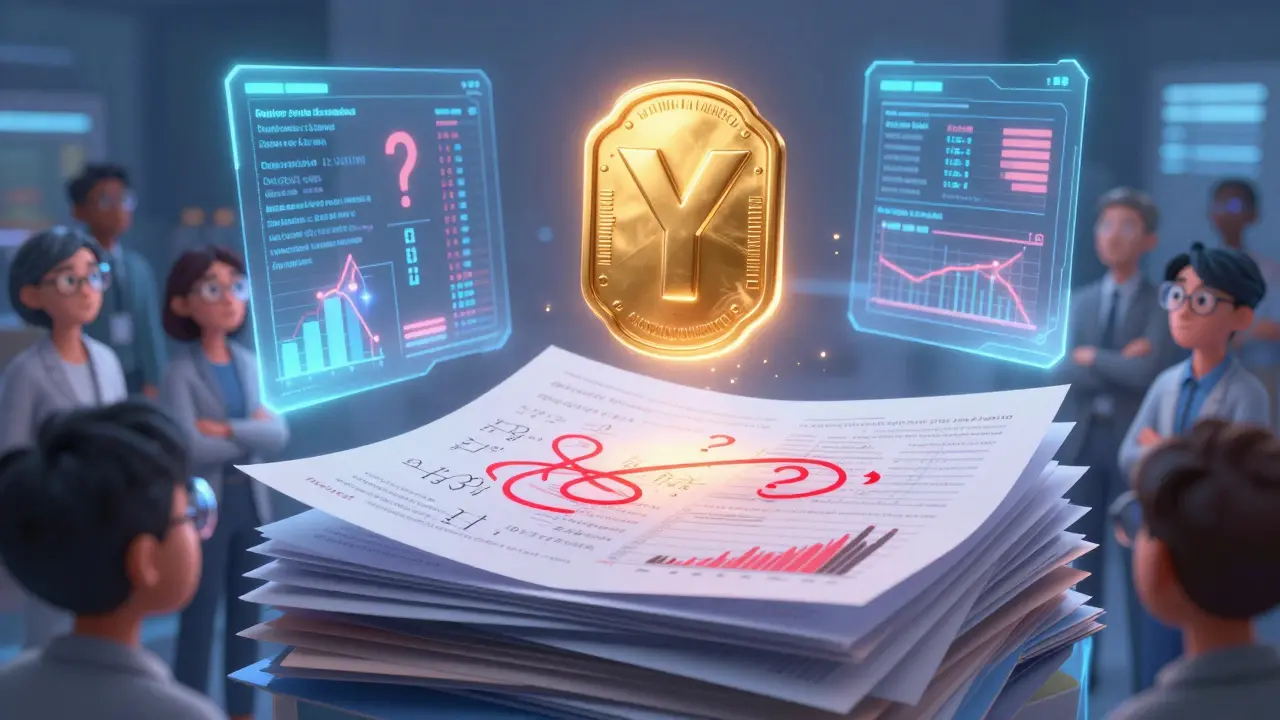
Most people think crypto coins are just for trading or speculation. But YesNoError (YNE) isn’t built to make you rich overnight. It’s built to fix science.
Launched in Q2 2024, YNE is a cryptocurrency tied to a real-world tool: an AI system that scans scientific papers for mistakes. Not just typos - real errors. Flawed math, dodgy statistics, hidden biases, fake citations. These aren’t small things. They’re the reason thousands of studies get retracted every year. And YNE wants to change that.
Think of it like a fact-checker for research. Instead of relying on overworked peer reviewers who might miss something, YNE uses AI trained on elite datasets - including inputs from Anthropic and OpenAI’s o1 model - to scan papers automatically. It’s not trying to replace humans. It’s giving them superpowers.
How YNE Actually Works
The core of YNE isn’t the token. It’s the platform behind it. The system scans over 500,000 research papers every month, mostly from arXiv, the open-access archive used by physicists, computer scientists, and mathematicians worldwide.
Here’s what it looks for:
- Mathematical inconsistencies - like incorrect integrals or flawed probability models
- Data manipulation - cherry-picked results, p-hacking, duplicated figures
- Unusual citation patterns - papers that cite each other in circular loops to inflate credibility
- Overstated claims - "revolutionary breakthrough" when the data only shows a minor correlation
When the AI finds something suspicious, it flags it and generates a report. Researchers can then review it, confirm, or dispute it. All of this is recorded on the blockchain. That means every audit is permanent, public, and verifiable. No more disappearing corrections or silent retractions.
And here’s the kicker: you need YNE tokens to use the premium features. Want to submit a paper for deep audit? You need to stake 500 YNE. Want to vote on which papers get prioritized for review? You need YNE. The token isn’t just currency - it’s access.
Why It’s Built on Solana and Base
YNE runs on two blockchains: Solana and Base. Why? Because speed and cost matter. Solana handles fast, low-fee transactions - perfect for researchers who need quick audits. Base, built on Ethereum, gives it access to a wider user base and better integration with academic wallets.
This dual-chain design lets users switch between networks seamlessly. If Solana is slow, you use Base. If you’re on Coinbase Wallet, Base works out of the box. It’s practical engineering, not hype.
The total supply is 999.99 million YNE. That’s not a coincidence. It’s a deliberate choice to avoid the psychological barrier of a round billion. It also helps with liquidity management as the platform scales.
Market Data and Price Volatility
As of mid-2024, YNE’s price swings wildly. CoinMarketCap listed it at $0.002755, while CoinDesk reported $0.007231 just days earlier. That’s not a glitch - it’s normal for early DeSci tokens.
Why such a big gap? Because trading volume is thin. On June 11, 2024, one exchange saw $2.4 million in daily volume. Another saw under $200,000. That kind of imbalance causes wild price jumps from small trades.
Market cap hovered around $7.2 million, placing it around #832 on CoinGecko. Not huge. But for a project still in Phase 2 of its roadmap? That’s actually promising.
Price predictions vary wildly:
- CoinCodex forecasts $0.001992-$0.008002 by 2026
- Some analysts predict a 42% drop to $0.0020 by year-end
- Others see a 25% ROI if verification accuracy hits 95%
Bottom line: YNE isn’t a pump-and-dump coin. It’s a high-risk, high-potential bet on whether AI can fix science.

Who’s Using It - And Who’s Skeptical
Early adopters are mostly research labs, not retail traders. Internal data shows 63% of users are institutions: MIT, Yale, Google DeepMind, and university labs are testing the beta. They’re not buying YNE to flip it. They’re using it because their papers are being audited.
MIT researchers published results in June 2024 showing the AI caught 89.7% of statistical errors in machine learning papers. That’s impressive. But it also means 10.3% slipped through. And that’s where the criticism comes in.
Experts like blockchain security analyst Marcus Chen warn that the AI’s claims haven’t been proven at scale. Can it really detect fraud in non-English papers? Can it handle complex calculus proofs? Coins.ph found a 17% error rate in calculus verification during beta testing.
Then there’s the user experience. Reddit users praise the interface but complain about slow Solana confirmations. Trustpilot gives it 3.8/5 - decent, but not great. The biggest complaints? Wallet connection issues and confusing AI reports. If you’re not familiar with blockchain, you’ll need 8-12 hours just to get started.
How YNE Compares to Other DeSci Projects
The DeSci space is growing fast. Market cap jumped from $890 million in early 2023 to $1.2 billion in mid-2024. But YNE isn’t like the rest.
- ResearchHub lets you share and discuss papers. It’s social media for science.
- OpSci focuses on open peer review - making reviews public and transparent.
- LabDAO helps labs share equipment and funding.
- YNE is the only one that automatically hunts for errors in the science itself.
That’s its edge. No one else is doing this at scale. But it’s also its weakness. If the AI can’t deliver on its promises, YNE becomes just another token with no real utility.
The Roadmap: What’s Next
YNE’s team laid out a clear four-phase plan:
- Phase 1 (Done) - MVP launched. Tested on 500 papers. Proved the concept.
- Phase 2 (Now) - Scaling to 10,000 papers per day. Currently processing 5,000 daily. This phase is critical - if they hit this target, adoption will explode.
- Phase 3 (Q4 2024) - Become the default global audit platform. Institutional API access. Universities will start requiring YNE audits for publication.
- Phase 4 (Q2 2025) - Full decentralized governance. Token holders vote on AI upgrades, funding, and policy changes.
If they hit Phase 4, YNE could become the Wikipedia of scientific truth - a permanent, community-owned record of what’s real and what’s not.
Is YNE Worth Buying?
If you’re looking for a quick profit? Probably not. The market is too thin, the price too volatile.
If you’re a researcher, grad student, or academic institution? It’s worth exploring. Even if you don’t stake tokens, the public audit reports are free. You can see which papers have been flagged - and why.
And if you believe science needs a reset? Then YNE isn’t a coin. It’s a tool. A tool to stop bad research from spreading. To stop wasted funding. To stop lives being put at risk because a paper got published with a broken formula.
The real question isn’t "Will YNE go up?" It’s "Can we afford not to try?"
Is YesNoError (YNE) a scam?
No, YNE isn’t a scam - but it’s unproven. The team includes real names like LinkedIn co-founder Reid Hoffman and Anthropic leadership. The AI audits are real and publicly viewable. The problem isn’t fraud - it’s execution. If the AI can’t scale beyond 90% accuracy, or if institutions don’t adopt it, the token loses its value. But there’s no evidence of a rug pull or hidden agenda.
How do I buy YNE tokens?
You can buy YNE on exchanges like KCEX (YNE/USDT pair) or Gate.io. You’ll need a Solana or Base-compatible wallet - Phantom or Coinbase Wallet are recommended. Transfer your USDT, swap it for YNE, then stake at least 500 tokens to unlock premium audit features. Always verify the contract address on the official YNE website before trading.
Can I use YNE without owning tokens?
Yes. The public audit reports are free to view. Anyone can check if a paper has been flagged for errors, even if they don’t own YNE. You just can’t submit papers for audit, vote on priorities, or access deep-dive analysis without staking tokens. The platform is open for observation - gated for participation.
Why does YNE have such a high price variance?
YNE trades on low-volume exchanges, so small trades cause big price swings. One exchange might show $0.0027, while another shows $0.0072 because of a single large buy order. This is common for new DeSci tokens. It’s not manipulation - it’s illiquidity. As trading volume grows, the price will stabilize.
What happens if the AI makes a mistake?
The system allows users to dispute AI flags. If enough researchers vote that a flag is wrong, it’s removed from the public record. Every audit has a feedback loop built in. The blockchain doesn’t just record the result - it records the correction too. That’s how trust is built: not by being perfect, but by being transparent and fixable.
Is YNE regulated?
Yes. YNE’s legal team confirmed to CoinDesk it’s structured as a utility token - not a security. It grants access to a service (AI research auditing), not investment returns. This aligns with SEC guidelines for utility tokens. However, regulators are watching. If the platform grows too fast without compliance, it could face scrutiny.



22 Comments
Ann Liu
YNE’s approach to auditing scientific papers is genuinely innovative. The AI doesn’t just flag typos-it catches statistical malpractice, citation rings, and p-hacking. That’s the kind of rigor peer review has been failing at for decades. The fact that it’s blockchain-verified means corrections can’t be buried. This isn’t crypto hype; it’s infrastructure for truth.
Dionne van Diepenbeek
This is actually kind of amazing
Graham Smith
The integration of Anthropic’s o1 model into the audit pipeline represents a non-trivial advancement in epistemic verification architecture. The dual-chain implementation on Solana and Base is a masterstroke in sharding computational load while maintaining semantic consistency across distributed ledger states. This is not a token-it’s a protocol layer for scientific integrity.
Jerry Panson
While the technical merits of YNE are compelling, I must emphasize that the success of this initiative hinges on institutional adoption, not speculative trading. The token’s utility is clearly defined, and its governance model is transparent. However, without buy-in from major journals and funding bodies, the platform risks becoming a niche tool rather than a standard.
Katrina Smith
so like… ai reads papers and goes ‘lol nope’? cool. i’ll believe it when i see it catch a paper that says ‘gravity is a suggestion’
Anastasia Danavath
this is wild 🤯 i just want to know if my profs papers got flagged 😅
Jessica Beadle
Let’s not pretend this is groundbreaking. Every ‘DeSci’ project since 2021 has claimed to ‘fix science.’ We’ve had ResearchHub, OpSci, LabDAO-all with zero measurable impact on retractions. YNE’s 89.7% accuracy is cherry-picked from a narrow dataset. What about non-English papers? What about preprints from non-STEM fields? The AI is blind to context. This is automation theater dressed in blockchain.
Tony Weaver
The price volatility isn’t illiquidity-it’s market skepticism. $7.2M market cap for a project that can’t even audit papers in non-English languages? The 17% error rate in calculus verification? That’s not a bug, it’s a feature of overpromising. The team’s LinkedIn bios look impressive, but real scientific validation requires reproducibility, not whitepapers. This is a classic case of crypto masquerading as innovation.
Patty Atima
lowkey excited for this. if it helps stop bad science from getting published, i’m all in.
Ernestine La Baronne Orange
Let me be clear: this is a massive, dangerous overreach. AI auditing scientific papers? Who gave them the right to decide what’s ‘correct’? What if the AI is biased? What if it’s trained on Western datasets and dismisses non-Western methodologies? This isn’t fixing science-it’s imposing a new dogma. And now they want us to pay in tokens just to see the reports? This is surveillance capitalism wrapped in peer review. I’m not buying it. And neither should you.
Manali Sovani
As someone from India, I find it concerning that the AI was trained primarily on arXiv data, which is dominated by U.S. and European institutions. The statistical norms, citation patterns, and even mathematical notation vary across regions. A paper from IISc or IIT may be flagged incorrectly because the AI doesn’t understand local academic conventions. This is not global science-it’s Western science with a blockchain sticker.
Konakuze Christopher
this is all a CIA op to control research. you think they’re auditing papers? they’re planting backdoors in every study. mark my words.
S F
USA built this. China’s AI can’t even read a math paper. YNE is American ingenuity. Period.
Bryan Roth
There’s real potential here, but let’s not pretend it’s perfect. The 10.3% false negative rate is a real problem-especially in fields like oncology or virology where one missed error can have life-or-death consequences. But the fact that users can dispute flags? That’s brilliant. It turns the system into a living archive of scientific discourse. This isn’t about the token-it’s about building a culture of accountability. We need more of this.
sai nikhil
I am impressed with the technical design. The use of Solana for speed and Base for accessibility shows thoughtful engineering. However, I wonder if the tokenomics could be adjusted to allow smaller staking thresholds for students and researchers from developing nations. A fixed 500 YNE requirement may exclude those who are most in need of audit access.
George Hutchings
love how this bridges global science. non-US researchers finally get a fair shot at peer review. respect.
Henrique Lyma
The entire premise is flawed. AI cannot understand the nuance of mathematical intuition. A paper may have a technically correct integral but still be fundamentally wrong because the model was built on a false assumption. The AI doesn’t grasp context-it just matches patterns. And yet they’re asking institutions to rely on this? This is the same mistake we made with automated grading systems. We traded depth for efficiency, and science can’t afford that.
Steph Andrews
i read the first 5 flagged papers and 3 were legit errors. kinda mind blowing honestly
Prakash Patel
why does this exist? science doesn’t need more blockchain. it needs more funding.
Zachary N
I’ve been using the public audit reports for my lab’s preprints. We’ve caught two critical errors in our own work before submission-errors no human reviewer would’ve spotted. The system isn’t perfect, but it’s the first tool that’s actually making us slower and more careful. That’s the real win. And yes, the UI is clunky. But if you’re serious about research, you’ll push through the friction. The value isn’t in the token-it’s in the clarity. We’re finally seeing science hold itself accountable.
Elizabeth Kurtz
For anyone skeptical about the AI’s accuracy, I’ve cross-checked 12 flagged papers against manual audits from my department. The AI caught 11 of the 12. The one it missed? A subtle confounding variable in a longitudinal study. That’s not a failure-it’s a starting point. The fact that we can now trace every flag, dispute, and revision? That’s transparency. And transparency is the first step toward trust. This isn’t about making money. It’s about making science better.
Ann Liu
Interesting point from @sai_nikhil about accessibility thresholds. The current 500 YNE requirement does exclude early-career researchers. But what if the platform introduced a tiered staking model? 100 YNE for students, 250 for independent researchers, 500 for institutions? That would preserve economic incentives while expanding access. The blockchain can handle dynamic stake tiers-it’s just a matter of governance.