
Remittance Cost Calculator
Send Money From Pakistan
Your Savings
Results will appear here
Enter your amount to see how much you save
When you think of countries leading in cryptocurrency use, you probably imagine the U.S., Japan, or maybe even Nigeria. But in 2025, Pakistan is sitting at number 3 or 4 on the global list - right behind India and the U.S. That’s not a fluke. It’s the result of millions of ordinary people finding crypto not as a gamble, but as a lifeline.
How Pakistan Jumped from Ban to Top 3
Just seven years ago, Pakistan’s central bank outright banned cryptocurrency transactions. Banks were told not to touch crypto. Exchanges were shut down. The message was clear: digital money was illegal. But people didn’t stop using it. They just went underground. By 2024, the rules started to shift. In July 2025, the government finally gave up on trying to stop crypto and created the Pakistan Virtual Assets Regulatory Authority - a formal body to license and oversee digital asset platforms. That same year, the Pakistan Crypto Council was formed, led by CEO Bin Saqib, to bring together regulators, exchanges, and tech firms under one roof. This wasn’t just a policy change. It was a full 180-degree turn.Why Are So Many Pakistanis Using Crypto?
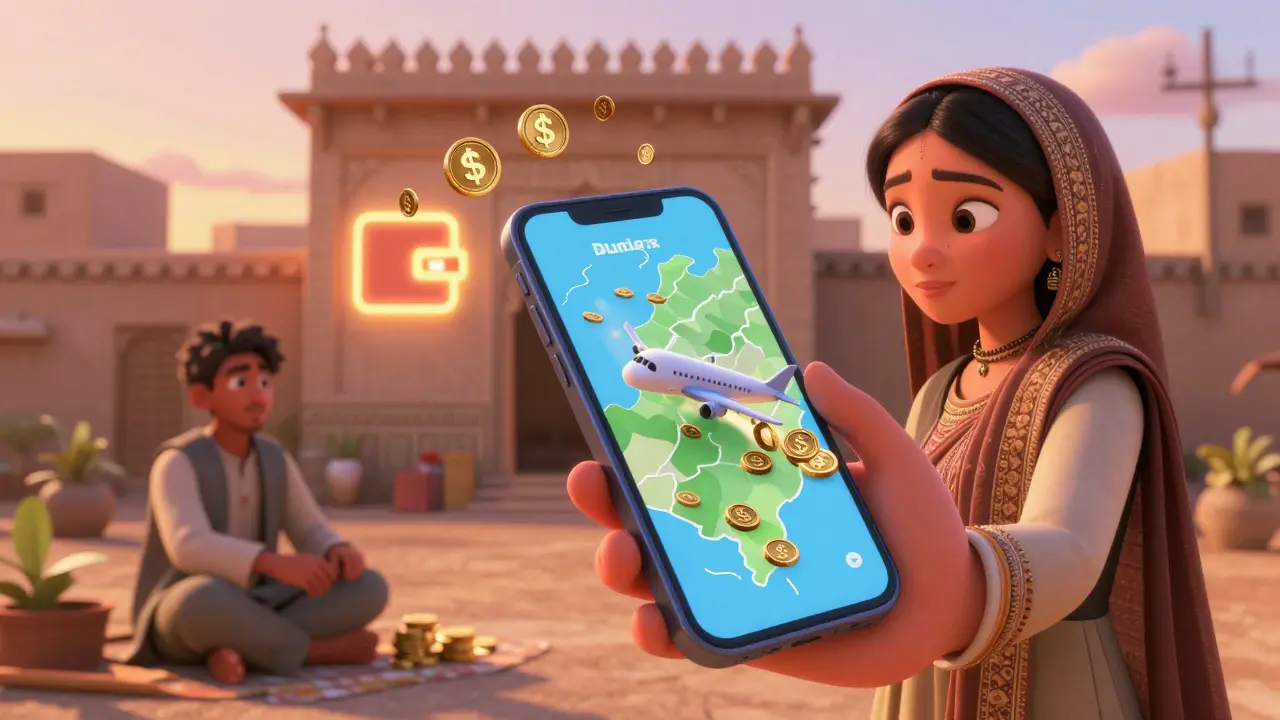
It’s not because they’re day-trading Bitcoin. It’s because they have no other choice. Pakistan’s inflation has hovered near 30% for years. The Pakistani rupee has lost more than half its value since 2020. People’s savings are evaporating. Banks are slow, unreliable, and often inaccessible outside major cities. That’s where crypto steps in. Stablecoins - digital tokens pegged to the U.S. dollar - became the go-to tool. People buy USDT or USDC with cash, store it on their phones, and use it to protect their money. It doesn’t fluctuate like Bitcoin. It holds value. And because it’s digital, you can send it anywhere in the world without a bank. Remittances are another huge driver. Pakistan receives over $30 billion in remittances every year from workers abroad - mostly in the Middle East and Europe. Before crypto, sending money home meant going through Western Union or banks, paying 8-12% in fees. Now, many send crypto directly to family wallets. Fees drop to under 1%. Delivery is instant. Chainalysis data shows that over 20 million Pakistanis - nearly 9% of the population - are actively using crypto. That’s more than the entire population of Australia. And it’s growing fast. Between July 2024 and June 2025, crypto value flowing into Pakistan jumped 147% year-over-year.How Pakistan Compares to the Rest of the World
India still leads globally in crypto adoption, with over 100 million users. The U.S. is second, thanks to ETFs and institutional interest. But Pakistan? It’s beating countries like Nigeria, Indonesia, and Vietnam on a per-capita basis. Here’s how Pakistan stacks up in the latest rankings:| Rank | Country | Adoption Score | Key Drivers |
|---|---|---|---|
| 1 | India | 9.7 | Mass retail use, low-cost exchanges, remittances |
| 2 | United States | 8.9 | ETFs, institutional investment, regulatory clarity |
| 3 | Pakistan | 8.5 | Stablecoin savings, remittances, inflation hedge |
| 4 | Vietnam | 8.3 | Young population, peer-to-peer trading, gaming tokens |
| 5 | Philippines | 8.1 | GameFi, remittances, mobile-first adoption |
Other rankings, like the one from May 2025 that uses different metrics, put Pakistan at 9th. Why the difference? Because not all rankings measure the same thing. Chainalysis looks at total crypto value received, adjusted for economic size. Others count how many people own crypto, or how often they trade. Pakistan scores high on value flow - not just ownership.
The Role of Stablecoins and Decentralized Finance
You won’t find many Pakistanis buying Dogecoin or Shiba Inu. Instead, they’re using Tether (USDT), USD Coin (USDC), and even local stablecoins backed by gold or commodities. These aren’t speculative assets - they’re digital cash. Apps like Binance, Bybit, and local platforms like Koinex and CryptoDex let users buy stablecoins with cash at local shops. You walk in, hand over 10,000 rupees, and get $35 worth of USDT in your wallet. No ID needed. No bank account. No waiting days. Some are even using DeFi protocols to earn interest on their stablecoins - something traditional banks in Pakistan won’t do. Annual yields of 5-10% are common. That’s more than double what you’d get from a savings account in any Pakistani bank.Who’s Behind the Push?
The government didn’t come to crypto out of idealism. It came because people forced the issue. The Pakistan Crypto Council has partnered with private firms like World Liberty Financial, linked to the Trump family’s network, to build blockchain infrastructure. These aren’t just business deals - they’re political moves. The council met with top military and government leaders in early 2025, signaling crypto is now part of national strategy. Even Bitcoin billionaire Michael Saylor has been involved. His firm, MicroStrategy, holds over $62 billion in Bitcoin. In June 2025, he advised Pakistan’s finance minister on how to use crypto to stabilize the economy. Not as a currency replacement - but as a reserve tool.
What Could Go Wrong?
This isn’t a fairy tale. There are risks. First, the regulatory framework is still new. Licensing is uneven. Some exchanges are legit. Others are fly-by-night operations. Scams are rising. The government hasn’t cracked down yet. Second, reliance on foreign partners like World Liberty Financial raises questions. Is Pakistan building its own system - or outsourcing its financial future to U.S.-linked firms? Third, if the U.S. tightens sanctions or changes its stance on crypto, Pakistan could be caught in the crossfire. Its economy is now partially tied to global crypto markets - which are volatile by nature. But here’s the thing: most Pakistanis aren’t betting on crypto prices. They’re betting on survival.The Bigger Picture
Pakistan’s rise in crypto adoption isn’t about getting rich quick. It’s about getting by. In a country where 40% of adults are unbanked, where inflation eats savings, and where sending money home costs a fortune - crypto isn’t a trend. It’s a necessity. The fact that it’s now recognized, regulated, and growing at one of the fastest rates in the world means something deeper: governments can no longer ignore digital money just because they don’t control it. Pakistan didn’t win by following the rules. It won by rewriting them - one crypto transaction at a time.What’s Next for Pakistan?
By 2026, the government plans to launch a national crypto education program in schools and universities. Mobile wallets will be integrated with government subsidies. And by 2027, Pakistan may even pilot a central bank digital currency (CBDC) built on blockchain - not to replace crypto, but to coexist with it. The goal isn’t to control crypto. It’s to make it work for the people. If Pakistan can keep the focus on utility - not speculation - it could become the model for other developing nations trying to escape financial exclusion. For now, it’s not the richest country using crypto. But it might be the most determined.Why is Pakistan ranked so high in crypto adoption despite past bans?
Pakistan’s high ranking comes from millions of ordinary people using crypto out of necessity - not speculation. With inflation above 30%, unreliable banks, and high remittance fees, stablecoins became a lifeline. The government only caught up in 2025 by creating formal regulators after years of underground use.
Is cryptocurrency legal in Pakistan now?
Yes. As of July 2025, Pakistan officially legalized cryptocurrency through the Pakistan Virtual Assets Regulatory Authority. Exchanges must now be licensed, and users can legally buy, sell, and hold digital assets. But enforcement is still inconsistent.
What type of crypto do Pakistanis use the most?
Stablecoins like USDT and USDC dominate. They’re used for savings, remittances, and everyday transactions because their value stays tied to the U.S. dollar. Bitcoin and other volatile coins are rarely used for daily spending.
How many people in Pakistan own cryptocurrency?
Approximately 20 million Pakistanis - nearly 9% of the population - are actively using crypto as of 2025. This is far higher than the global average of 6.9%, and it’s growing fast due to practical needs like inflation protection and low-cost remittances.
Is Pakistan’s crypto growth sustainable?
Yes - if the focus stays on utility. Experts say Pakistan’s adoption is driven by real economic needs, not hype. As long as people use crypto to save money, send remittances, and protect against inflation, demand will keep growing. The risk comes if speculation or political deals take over.



16 Comments
Kelly Burn
This is *literally* the most beautiful example of bottom-up financial revolution I've ever seen 🌍✨ Stablecoins as digital lifeboats? Yes. People bypassing broken systems with just a phone? That's not adoption-it's evolution. The state didn't lead. The people did. And now the state has to chase them. The future isn't centralized. It's cellular.
John Sebastian
I don't trust this. If the government is now 'regulating' crypto, it's just another way to control it. They'll tax it, track it, shut it down when it suits them. This isn't freedom. It's rebranding oppression.
Jessica Eacker
You don't need a bank account to survive. You just need a phone and a little courage. What Pakistanis are doing isn't tech magic-it's human resilience. And honestly? We should be learning from them, not patting ourselves on the back for our ETFs.
Ike McMahon
Stablecoins = digital rupees. That's the real story. No volatility. No delays. No fees. Just value that moves like water. And the 5-10% DeFi yields? That's not gambling-that's survival interest. Banks in the West can't even hit 0.5%.
Kim Throne
While the narrative of grassroots adoption is compelling, one must interrogate the structural dependencies introduced by foreign entities such as World Liberty Financial. The integration of U.S.-linked blockchain infrastructure into a sovereign financial ecosystem raises significant questions regarding autonomy, data sovereignty, and long-term geopolitical vulnerability.
Caroline Fletcher
So let me get this straight… Pakistan lets crypto in because people were using it illegally, and now they’re partnering with Trump’s crypto crew? 🤡 Next they’ll be selling Bitcoin on TikTok with a ‘Make Pakistan Rich Again’ banner. This isn’t innovation. It’s a cult.
Heath OBrien
I don't care how many people use it. If it's not backed by gold or the Fed, it's digital confetti. And now they're letting Americans run their financial future? Pathetic. We used to respect sovereignty. Now? We just hand it over for a 1% fee.
Taylor Farano
Let’s be real-this isn’t adoption. It’s desperation with a blockchain veneer. 20 million people using USDT because their currency is collapsing? That’s not a success story. That’s a funeral pyre with a QR code.
Toni Marucco
The elegance of this phenomenon lies not in its technological novelty, but in its ontological inversion: the state, once the sole arbiter of monetary legitimacy, has been rendered obsolete by the collective agency of the unbanked. Crypto here is not an asset class-it is a social contract written in code, ratified by necessity, and enforced by utility.
Steven Ellis
It’s humbling to see how a nation stripped of financial infrastructure rebuilt its economic dignity using nothing but smartphones and trustless networks. The real lesson isn’t about crypto-it’s about what happens when people are forced to innovate because no one else will help them.
Stanley Machuki
This is the future. No banks. No waiting. Just send money home like a text. Pakistan didn’t wait for permission. They just did it. And now the world has to catch up. 🚀
Lloyd Cooke
One might argue that the emergence of crypto in Pakistan represents not merely an economic adaptation, but a metaphysical reclamation of agency-a quiet rebellion against the ontological violence of inflation, where currency is not merely devalued, but rendered spiritually bankrupt. The stablecoin becomes the new sacrament.
Kurt Chambers
usa got scared when pakistan got ahead. now they send their corporate bots to 'help'. this is colonization with blockchain. they dont care about pakis. they care about the data. and the profits. and the control. dont be fooled.
Andy Walton
imagine being so broke you have to use crypto just to keep your family fed… and then some rich dude in america says 'hey ill help you' and suddenly you're all on his blockchain? this is not freedom. this is just a new kind of chain. 🤦♂️
Candace Murangi
I love how this story flips the script. Usually, it’s the West teaching the Global South how to do things. Here, the Global South is showing the West how to survive. No grand speeches. Just people with phones and a will to keep going.
Albert Chau
So now you're proud of a country that had to turn to crypto because their government failed? That's not a win. That's a failure with a shiny app.