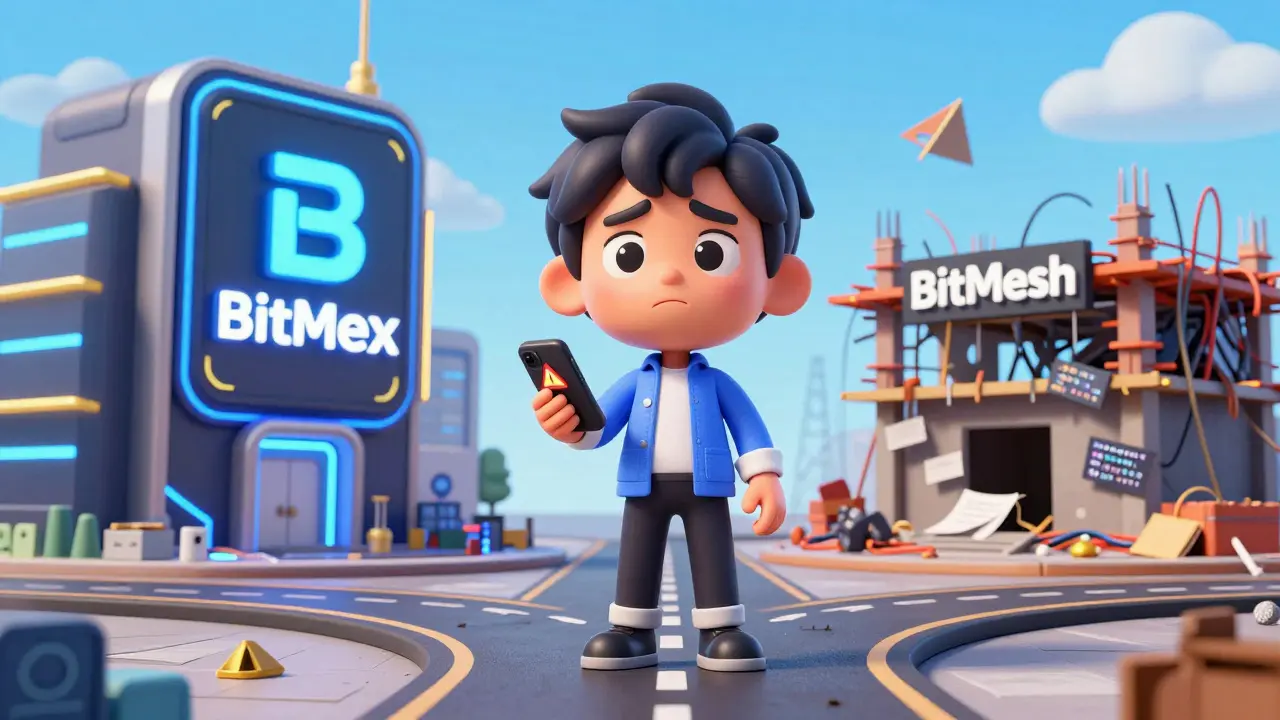
Have you been looking for a new place to trade crypto and stumbled upon "BitMesh"? You might be about to make a very expensive mistake. Or, more likely, you’re just confused by a name that sounds suspiciously like one of the most famous derivatives exchanges in history.
Here is the hard truth right out of the gate: BitMesh is not a cryptocurrency exchange. You cannot deposit funds there to buy Bitcoin, Ethereum, or Solana. You cannot leverage your position or trade futures. If you are searching for a platform to execute trades, BitMesh is the wrong destination. In fact, it doesn’t exist as a commercial service at all.
This confusion happens because the name "BitMesh" sounds nearly identical to BitMEX, which is a legitimate, high-volume cryptocurrency derivatives exchange. But they are completely different entities with different purposes. One is a trading platform; the other is an open-source code project for sharing internet access.
The Great Name Confusion: BitMesh vs. BitMEX
Let’s clear up the biggest hurdle first. When people type "BitMesh" into a search engine, they often get results for BitMEX. This isn’t just a typo issue; it’s a critical distinction for your security and financial goals.
BitMEX is a centralized cryptocurrency derivatives exchange known for high leverage trading. Founded in 2014, it became infamous-and later legendary-for allowing traders to use up to 100x (and sometimes higher) leverage on Bitcoin perpetual swaps. It has survived multiple regulatory challenges and maintains a reputation for robust infrastructure, boasting zero funds lost to hacks since its inception. It charges taker fees as low as 0.032% and uses a sub-4 millisecond matching engine.
In contrast, BitMesh is an open-source peer-to-peer internet connection sharing platform. It was developed by a contributor named adonley and is hosted on GitHub. There is no website where you log in to trade. There is no customer support team. There is no liquidity pool. BitMesh is a piece of software code designed to turn your WiFi router into a micro-hotspot that accepts Bitcoin payments for bandwidth.
If you were looking for a place to buy crypto, stop here. Go to BitMEX, Coinbase, Kraken, or Binance. If you are a developer interested in decentralized infrastructure, keep reading.
| Feature | BitMesh | BitMEX |
|---|---|---|
| Type | Open-source P2P Software | Centralized Crypto Exchange |
| Primary Function | Sell Internet Access via WiFi | Trade Crypto Derivatives & Spot |
| User Interface | Captive Portal / Code | Web Dashboard & Mobile App |
| Payment Method | Bitcoin Micropayments | Fiat & Cryptocurrency Deposits |
| Availability | GitHub Repository | bitmex.com |
| Risk Profile | Technical Implementation Risk | Market & Regulatory Risk |
What Is BitMesh Actually Doing?
So, if BitMesh isn’t an exchange, what is it? Imagine you have extra internet bandwidth. Instead of letting it go to waste, BitMesh allows you to monetize it. It creates a peer-to-peer network where users can sell their internet access to neighbors or passersby.
The concept is simple but technically complex. You run the BitMesh software on a device connected to your WiFi. This turns your hotspot into an open network. However, when someone connects, they don’t just get free internet. They are redirected to a captive portal-a landing page similar to what you see at airports or hotels.
On this portal, visitors must pay to access the web. The catch? They pay in Bitcoin. And not just a lump sum-they pay per second of usage. This is where the technology gets interesting.
The Technology Behind the Scenes
BitMesh relies on a stack of specific technologies to manage connections, payments, and security. Understanding these components helps explain why this is a developer project, not a consumer app.
- Network Management: The system uses hostapd to handle WiFi authentication and dnsmasq to assign IP addresses via DHCP. Traffic routing is managed by iptables, ensuring that only paying users can route traffic through the host’s connection.
- Payment Processing: On the server side, bitcoinj manages the Bitcoin connections and receipts. On the browser side, bitcore.js creates payment channels between the user’s browser and the server.
- User Interface: A lightweight HTTP server called nanohttpd serves the captive portal interface. The protocol used to display this landing page before standard navigation begins is WISPr, which prevents issues with HTTPS connections blocking the redirect.
The codebase is organized into distinct modules. For example, the `Sources/JavaClient` directory contains heavily modified versions of bitcoinj to support custom payment channel logic. The developers implemented formal state machines (`StateMachine.java`) to handle the complex, state-dependent nature of real-time payments and network status.

Micropayments: The Core Innovation
The most impressive part of BitMesh is its approach to transaction costs. Standard Bitcoin transactions are slow and expensive. Paying $0.001 for ten seconds of internet would cost more in gas fees than the service itself.
BitMesh solves this using Bitcoin micropayment channels. These channels allow users to make tiny payments off-chain. As you browse the web, small amounts of Bitcoin are transferred virtually between your wallet and the hotspot owner’s wallet. No data is sent to the main blockchain during this process.
Once the session ends, or after a predetermined time limit, the final balance is settled with a single on-chain transaction. This aggregates thousands of micro-transactions into one efficient block record.
To make this work across different libraries, the developers modified the standard implementation to use Pay-to-Script-Hash (P2SH) rather than raw multisig transactions. This required adapting both bitcoinj and bitcore to interoperate correctly. It’s a clever workaround for scalability, but it requires technical expertise to set up and maintain.
Is BitMesh Ready for Use?
Here is the reality check: BitMesh is not a polished product. It is an open-source project hosted on GitHub with modest adoption metrics-around 30 stars, 12 watchers, and 9 forks. These numbers indicate interest from developers, but not widespread public usage.
There are no formal releases listed on the repository. This means there is no stable version number, no automated installer, and no guaranteed security audit. The project remains in active development, which implies bugs, incomplete features, and potential security vulnerabilities.
The developers themselves acknowledge that ease of use is a challenge. Installing BitMesh requires command-line proficiency, understanding of network interfaces, and the ability to configure Java and JavaScript environments. It is not something you download from an app store.
Furthermore, mobile compatibility is limited. The JavaScript implementation for micropayments fails on many mobile devices because browsers suspend background tabs to save battery. Since the payment channel needs constant attention to update balances, switching apps breaks the connection. This limits BitMesh primarily to desktop or dedicated hardware setups.

Security and Risks
Because BitMesh involves handling private keys and real-time Bitcoin transactions, security is paramount. Unlike BitMEX, which holds custody of your funds (with all the risks that entails), BitMesh keeps funds in your non-custodial wallet. This is generally safer from a hack perspective, but introduces operational risks.
If you lose your private key while running a BitMesh node, you lose the earnings accumulated in the payment channels. If the software has a bug in the state machine logic, you could potentially drain your wallet or fail to receive payments. Without independent security audits, these risks remain theoretical but significant.
Additionally, selling internet access may violate terms of service with your own Internet Service Provider (ISP). Many residential contracts prohibit acting as a reseller or creating unauthorized hotspots. Before attempting to deploy BitMesh, check your local regulations and ISP agreement.
Future Possibilities Beyond Internet
The vision behind BitMesh extends beyond just WiFi. The architecture is designed to treat any standardized resource as a commodity. The codebase includes a `Units` directory that manages what is being sold. While currently configured for internet bandwidth, the same micropayment infrastructure could theoretically be adapted to sell electricity, water, or even physical goods like milk.
This transforms BitMesh from a networking tool into a general-purpose micropayment platform for the Internet of Things (IoT). Imagine smart meters that automatically pay each other in fractions of a cent for energy transfer. That is the long-term goal, though we are far from seeing this in practice today.
Final Verdict: Who Is This For?
If you are a trader looking for leverage, charts, and order books, BitMesh is not for you. You need a traditional exchange like BitMEX, Bybit, or Binance. Do not confuse the two names.
If you are a developer, researcher, or privacy advocate interested in decentralized infrastructure, BitMesh is worth exploring. It demonstrates how Bitcoin can be used for granular, real-time payments without clogging the blockchain. It is a fascinating experiment in peer-to-peer economics.
However, do not expect a plug-and-play solution. You will be working with raw code, configuring network interfaces, and managing your own security. Treat it as a learning project, not a revenue stream-at least until the software matures and undergoes rigorous auditing.
Can I trade cryptocurrencies on BitMesh?
No. BitMesh is not a cryptocurrency exchange. It is an open-source software project for sharing internet access via WiFi. You cannot buy, sell, or trade assets on it. You may be confusing it with BitMEX, which is a derivatives exchange.
Is BitMesh safe to use?
BitMesh is an experimental open-source project without formal security audits or stable releases. Using it involves technical risks, including potential bugs in payment logic and configuration errors. It is not recommended for storing large amounts of Bitcoin or for production environments without thorough personal testing.
How does BitMesh charge for internet?
BitMesh uses Bitcoin micropayment channels. Users connect to a WiFi hotspot and are redirected to a captive portal. They pay small amounts of Bitcoin per second of usage. These payments happen off-chain in real-time and are settled on the blockchain only at the end of the session.
What is the difference between BitMesh and BitMEX?
BitMEX is a centralized cryptocurrency exchange for trading derivatives with leverage. BitMesh is a decentralized, open-source tool for monetizing internet bandwidth. They share a similar name but have completely different functions, architectures, and user bases.
Does BitMesh work on mobile phones?
Mobile support is limited. The JavaScript micropayment functionality often fails on mobile devices because browsers suspend background tabs to conserve battery. This interrupts the continuous payment channel required for the system to function properly. It works best on desktop computers or dedicated hardware.
Where can I find the BitMesh code?
The BitMesh source code is available on GitHub under the repository github.com/adonley/BitMesh. It is an open-source project, meaning anyone can view, fork, and modify the code, but there are no official binary downloads or app store listings.



Write a comment