
AIOZ Network isn’t just another crypto coin. It’s a real-world infrastructure project built on blockchain that’s changing how video, files, and AI work online - without relying on big tech companies like Amazon or Cloudflare. If you’ve ever streamed a movie, uploaded a video, or used an app that loads fast, you’ve used a content delivery network (CDN). AIOZ is doing that same job, but in a decentralized way - powered by everyday people sharing their extra bandwidth and computing power.
How AIOZ Network Works (No Tech Jargon)
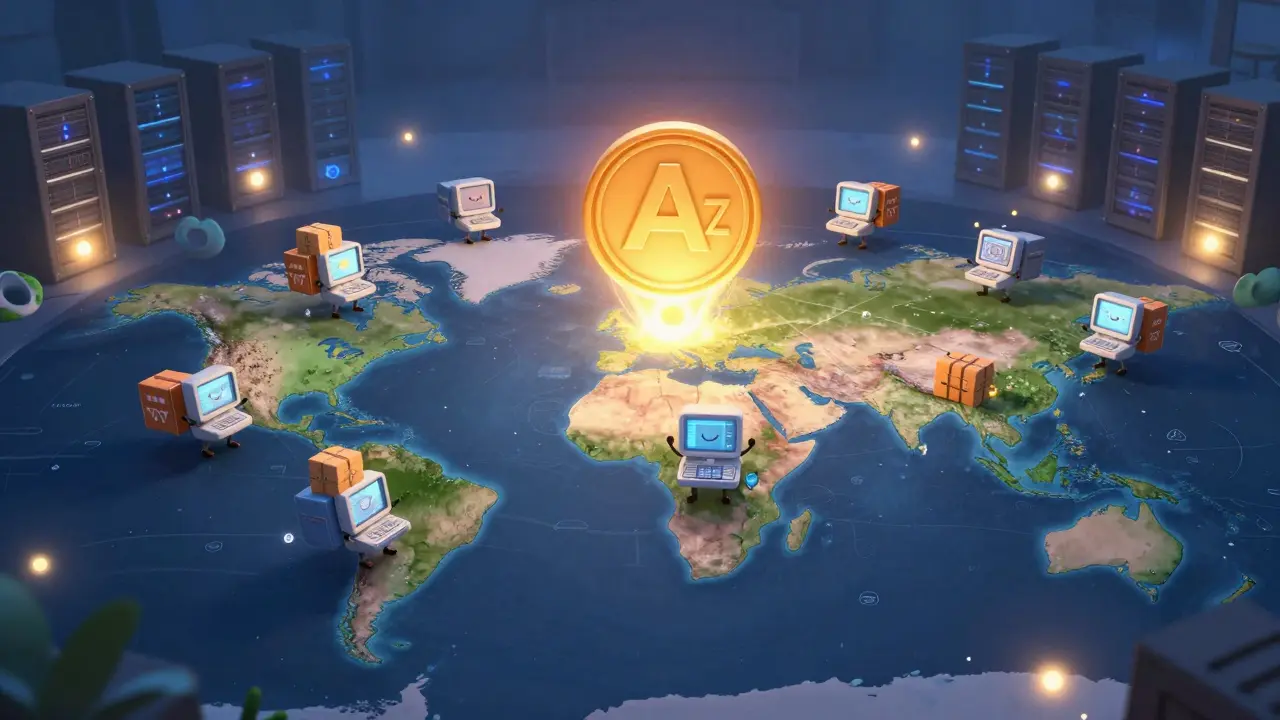
Traditional CDNs use giant server farms in data centers. These cost millions to run and are controlled by a few corporations. AIOZ flips that model. Instead of servers, it uses a global network of regular computers - your neighbor’s PC, a gamer’s rig, a small business server - all connected through the AIOZ blockchain. These machines, called nodes, store and deliver video files, transcode them for different devices, and even help run AI tools.
When you watch a video on a platform using AIOZ, you’re not pulling it from a single server. You’re getting it from the closest node in the network - maybe someone in Poland, Brazil, or right here in Auckland. That means faster loading, less buffering, and lower costs. And the people who run those nodes? They get paid in AIOZ tokens.
What Is the AIOZ Token For?
The AIOZ token is the fuel of the whole system. It’s not just a speculative asset - it has real jobs:
- Payment: Users pay in AIOZ to store files or stream content through the network.
- Rewards: Node operators earn AIOZ for sharing bandwidth, storage, and computing power.
- Staking: You can lock up your AIOZ tokens to help secure the network and earn more tokens as interest.
- Governance: Token holders vote on upgrades, fee changes, and new features - real say in how the network evolves.
This multi-use design makes AIOZ different from coins that exist only to be traded. Its value comes from actual usage, not hype.
Why AIOZ Uses Cosmos and Ethereum Together
AIOZ isn’t stuck on one blockchain. It’s built on Cosmos - known for speed and low fees - but also talks to Ethereum and Binance Smart Chain. That’s thanks to the Gravity Bridge, which lets tokens move safely between these networks. So if you own ETH or BNB, you can easily swap them for AIOZ without using a centralized exchange.
This hybrid setup means developers can build apps using familiar tools like Solidity (used on Ethereum) while still benefiting from Cosmos’s fast, cheap transactions. It’s like having the best of both worlds: the developer crowd of Ethereum and the performance of Cosmos.
DePIN: The Secret Sauce Behind AIOZ
AIOZ is part of a bigger trend called DePIN - Decentralized Physical Infrastructure Networks. These are projects that turn real-world hardware (like routers, servers, solar panels, or cell towers) into blockchain-powered services. Think of it as Airbnb for internet infrastructure.
AIOZ’s DePIN model rewards people for contributing unused resources. You don’t need to be a tech expert. Just run the AIOZ node software on your computer, and if you have spare bandwidth or GPU power, you earn tokens. It’s the same idea as mining Bitcoin, but way more energy-efficient. No giant farms. No massive electricity bills. Just your home setup helping power the internet.
Real Use Cases - Not Just Theory
AIOZ isn’t waiting for the future. It’s already being used:
- Live streaming platforms are cutting their CDN costs by 70% by switching to AIOZ.
- AI companies use the network to run machine learning models without paying cloud giants like AWS.
- Video-on-demand services store and deliver content directly from peer nodes, avoiding expensive storage fees.
- Game developers host assets on AIOZ to reduce lag for players worldwide.
One startup in Berlin used AIOZ to launch a live sports streaming app. Their hosting bill dropped from $12,000/month to under $3,000. That’s real savings - and real impact.

How to Get Involved
You don’t need to be a developer to use AIOZ. Here’s how you can participate:
- Buy AIOZ tokens on exchanges like KuCoin, Gate.io, or MEXC.
- Stake your tokens through the official AIOZ wallet or compatible wallets like MetaMask to earn passive income.
- Run a node - download the AIOZ node software, link your wallet, and start earning by sharing your internet or GPU.
- Use AIOZ-powered apps - look for services that mention AIOZ as their backend. Some are already live.
The recommended gas fee for transactions is 1,000,000,000 attoaioz (a tiny fraction of one AIOZ). That’s cheaper than most blockchains. And yes, MetaMask works with it - no need for a new wallet.
Where Does AIOZ Stand in 2026?
As of October 2025, AIOZ was ranked #158 in the crypto market with a price around $0.2946 USD and a daily trading volume near $9 million. That’s not Bitcoin-level numbers, but for a project focused on infrastructure - not speculation - it’s strong growth.
Its market cap is backed by actual usage, not just hype. The team has a clear roadmap: expanding node adoption, adding more AI tools, and connecting with more Cosmos chains like Osmosis and the Cosmos Hub via IBC. They’re not chasing pump-and-dump trends. They’re building the plumbing of the next internet.
Why This Matters
Right now, the internet is controlled by a handful of companies. They set prices, censor content, and collect all the profits. AIOZ is part of a quiet revolution - putting control back in the hands of users. If you’re tired of paying $10 a month for cloud storage or watching ads because a platform owns your data, AIOZ offers a real alternative.
This isn’t about making quick money. It’s about helping build a better internet - one where your spare bandwidth has value, where creators get paid fairly, and where no single corporation holds all the power.
Is AIOZ Network a good investment?
Whether AIOZ is a good investment depends on your goals. If you’re looking for short-term gains, it’s risky like any crypto. But if you believe in decentralized infrastructure and want to support a project with real utility - like cheaper streaming, AI compute, and file storage - then holding AIOZ makes sense. Its value grows as more people use the network, not just as more people buy the token.
Can I run an AIOZ node on my laptop?
Yes. You don’t need a server or high-end hardware. AIOZ nodes run on standard PCs with at least 4GB RAM, 100GB free storage, and a stable internet connection. If you’re not gaming or streaming 24/7, your laptop likely has spare resources. The software is lightweight and runs in the background. Many users in New Zealand and Australia are already doing this.
How do I stake AIOZ tokens?
You can stake AIOZ through the official AIOZ Wallet or MetaMask. Just connect your wallet, select the amount to stake, and confirm. Rewards are distributed automatically every few hours. There’s no lock-up period - you can unstake anytime. The current annual yield is around 8-12%, depending on network activity.
Is AIOZ compatible with MetaMask?
Yes. AIOZ Network is EVM-compatible, meaning MetaMask works out of the box. You can add the AIOZ mainnet manually using the RPC details from their official site. Once added, you can send, receive, and stake AIOZ directly from MetaMask. No special wallet needed.
What’s the difference between AIOZ and Filecoin?
Filecoin is focused only on decentralized storage. AIOZ does storage, but also video streaming, AI computation, and content delivery - all in one system. AIOZ is optimized for media and real-time use, while Filecoin is better for archiving files. AIOZ also pays out rewards faster and has lower hardware requirements for node operators.



21 Comments
Steven Dilla
This is literally the future 🚀 I’ve been running a node on my old gaming rig and I’m making more in AIOZ than my side hustle. Who needs a 9-5 when your PC can earn while you sleep? 💪🔥
Akhil Mathew
I tried this in India and honestly the latency dropped so much for my streaming app. Nodes in Mumbai and Bangalore made it way smoother than AWS. Also, the payout is instant. No waiting 30 days like other platforms. Big win.
Ramona Langthaler
So now we’re rewarding people for using their wifi? Lmao. My neighbor’s kid runs a node and thinks he’s Elon. Meanwhile my rent’s going up and this guy gets paid to leave his laptop on. America is dead
Kevin Thomas
For real though, if you’ve got a spare laptop or even a Raspberry Pi, just try it. The software is stupid simple. I set mine up in 10 mins with MetaMask. No coding. No drama. I’m earning 0.5 AIOZ a day just sitting there. That’s like $0.15. Not life-changing but passive income is passive income. Do it.
Robert Mills
YES. THIS. 🙌
Andrea Demontis
It’s fascinating how we’ve normalized the idea that infrastructure should be owned by corporations. We don’t question why our internet is a monopoly. AIOZ doesn’t just offer a better tech solution-it offers a philosophical shift. What if the internet wasn’t a commodity but a commons? What if your unused bandwidth was a public good? This isn’t just crypto-it’s a reclamation of digital space. We’re not just earning tokens; we’re rebuilding the architecture of trust.
Joseph Pietrasik
AIOZ? More like AIOZ-BOOM you got scammed. All these DePIN projects are just rebranded ponzi schemes. They got a whitepaper and a Discord and now they’re selling dreams. You think your grandma’s laptop is gonna change the world? Lol
Raju Bhagat
OMG I JUST STAKED MY LAST 5000 AIOZ AND MY PHONE DIED WHILE CONFIRMING AND NOW I THINK I LOST IT ALL 😭😭😭 SOMEONE HELP ME I’M IN TEARS
laurence watson
I’ve been running a node for 6 months now. Honestly, it’s been chill. No drama. My电费 didn’t even go up. I just let it run while I watch Netflix. The rewards are steady, and I like knowing I’m not helping Amazon get richer. Small act, big vibe.
Pamela Mainama
Real utility. Real impact. Not hype.
Tressie Trezza
It’s interesting how we keep calling it 'decentralized' when in reality, the majority of nodes are still run by people in the US and India. Is it really decentralized if the power dynamics just shifted from AWS to a few hundred early adopters with good internet? Maybe we’re just replacing one elite with another.
Mark Ganim
I’M NOT JUST A NODE OPERATOR-I’M A DIGITAL REVOLUTIONARY!!! 🌍⚡ My laptop is now a NODE OF LIBERATION! I’M NOT SLEEPING-I’M POWERING THE FUTURE!!! EVERY BYTE I SHARE IS A MIDDLE FINGER TO THE CORPORATE MACHINE!!! 🤖💥
Rob Duber
Bro, I turned my old gaming PC into a node and now I’m basically the guy who runs the internet in my apartment complex. My landlord asked me why my router is blinking like a Christmas tree. I told him I’m the new ISP. He gave me free rent. Best decision ever.
Gary Gately
i just downloaded the node and it auto installed. i didnt even read the docs. its running. i got 0.2 aiox already. this is too easy
Brandon Vaidyanathan
If you’re still using MetaMask for AIOZ you’re doing it wrong. You’re basically giving your keys to a third party. Use the official wallet. Or better yet, don’t touch this garbage. It’s a glorified adware botnet.
Gareth Fitzjohn
Interesting concept. The technical details are sound. I’ve looked into it for my small business. Lower costs, yes. But adoption is still low outside the US and India. Could be promising if they expand to Europe properly.
Katie Teresi
Why are we letting random people run infrastructure? This is why America is falling apart. You let some kid in Bangalore run a server and suddenly you think it’s 'decentralized'? Wake up. This is chaos.
Moray Wallace
I appreciate the idea, but I’m cautious. I’ve seen too many 'decentralized' projects collapse after the initial hype. I’ll wait until there’s at least 10,000 active nodes before I commit more than a few tokens.
William Hanson
Yeah right. I ran a node for two weeks. My GPU hit 90C. My electricity bill jumped $40. I earned $3 in AIOZ. You call that a win? This isn’t innovation-it’s exploitation disguised as empowerment.
Calvin Tucker
The notion that 'ownership' of digital infrastructure can be democratized through token incentives is philosophically seductive but empirically dubious. One must interrogate whether the distribution of rewards truly reflects equitable participation-or merely replicates capital accumulation under a new ontological regime.
Wayne mutunga
I’m not sure I’m ready to run a node yet. But I’m keeping an eye on it. Feels like the kind of thing that could either change everything or crash and burn. Either way, I’m glad someone’s trying.