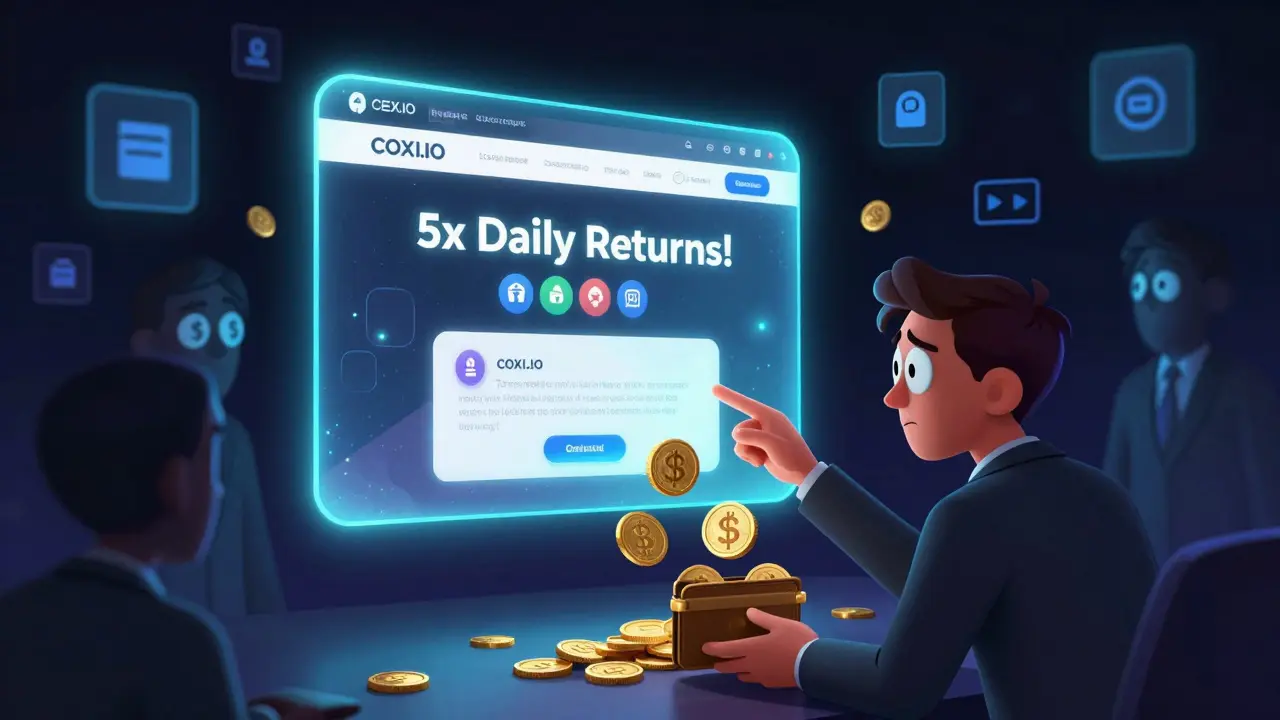
There’s no such thing as COXI.IO as a legitimate cryptocurrency exchange. If you’ve seen ads, social media posts, or YouTube videos pushing COXI.IO as a new crypto trading platform, you’re being targeted by a scam. This isn’t a case of a small, unknown exchange - it’s a fake website designed to steal your money.
Search for "COXI.IO" anywhere online - Google, Reddit, Twitter, even blockchain explorers - and you’ll find nothing legitimate. No official domain registration under that name. No verified team members. No regulatory licenses from any financial authority. No history of operations. No customer reviews on trusted platforms like Trustpilot or Reddit. The domain COXI.IO doesn’t even resolve to a functional website in most cases. When it does, it’s a cloned copy of real exchanges like CEX.IO, with fake login pages and manipulated price feeds.
Here’s how the scam works: You click on an ad promising "0% fees" or "5x daily returns" on Bitcoin. You’re directed to COXI.IO, where the interface looks professional - same fonts, same colors as real exchanges. You deposit crypto or fiat through wire transfer, PayPal, or even a crypto wallet. Then you try to withdraw. The site says "your account is under review." Or "there’s a 48-hour hold." Or "you need to pay a 5% verification fee first." You pay. Then they ask for another fee. And another. Soon, your account disappears. The site goes offline. Your money is gone.
Scammers love names like COXI.IO because they’re just one letter off from real platforms like CEX.IO. People type too fast. They misremember. They click the wrong link. That’s exactly what the fraudsters count on. There’s no record of COXI.IO ever being registered with FinCEN, the FCA, or any other global financial regulator. CEX.IO, on the other hand, has been operating since 2013, is licensed in multiple jurisdictions, and has a public team with LinkedIn profiles and verified company addresses.
Real crypto exchanges don’t hide. They publish their legal entities, physical offices, compliance officers, and audit reports. COXI.IO has none of that. No address. No phone number. No email that responds. No support tickets that get answered. The only "support" is a live chat that never connects to a real person - just automated bots repeating scripted lines.
If you’re looking for a safe place to trade crypto, stick to platforms with a proven track record. CEX.IO, Kraken, Binance (where available), and Coinbase all have years of public history, regulatory compliance, and user protection policies. They don’t need to promise unrealistic returns. They earn trust through transparency, not hype.
Some people claim they "made money" on COXI.IO. That’s a classic red flag. Those are almost always paid shills - bots or actors hired to post fake testimonials. Real users don’t brag about making 300% in a week. They talk about fees, security, and ease of use. If someone’s selling you a get-rich-quick crypto scheme, they’re not trying to help you trade - they’re trying to steal your wallet.
There’s also a growing trend of fake crypto exchanges using .io domains because they sound "techy" and international. But .io is just a domain extension - it doesn’t mean anything about legitimacy. Real exchanges use .com, .org, or country-specific domains with clear ownership records. COXI.IO’s WHOIS data is hidden behind privacy protection services, which is normal for small businesses - but a huge red flag for financial platforms.
Don’t be fooled by polished websites. Scammers spend thousands on UI design, logos, and even fake YouTube reviews. What they can’t fake is a history of operations, regulatory filings, or real customer support. If you can’t find a company’s legal name, headquarters, or licensing info in under 2 minutes of searching, walk away.
Here’s what to check before trusting any crypto exchange:
- Does the exchange have a publicly listed legal entity with a registered address?
- Is it registered with a financial regulator like FinCEN, FCA, or ASIC?
- Can you find independent user reviews on Trustpilot, Reddit, or CoinMarketCap forums?
- Does the website use HTTPS with a valid SSL certificate issued to the exact domain name?
- Are the support channels real? Try emailing [email protected] - if it bounces or replies with a template, it’s fake.
COXI.IO fails every single one.
If you’ve already sent money to COXI.IO, act fast. Report it to your bank or payment provider immediately. If you used crypto, there’s little chance of recovery - blockchain transactions are irreversible. But you can still report the scam to authorities like the FTC (U.S.), Action Fraud (UK), or the New Zealand Commerce Commission. Share your story on Reddit’s r/CryptoScams or the Bitcoin Forum. The more people know, the fewer fall for it.
There’s no such thing as a "hidden gem" crypto exchange with no history and no transparency. If it sounds too good to be true - and has a name that looks like a typo of a real platform - it is. Protect your assets. Stick to the big names. And never, ever trust a site you can’t verify.
COXI.IO isn’t a crypto exchange. It’s a digital trap.
Is COXI.IO a real crypto exchange?
No, COXI.IO is not a real crypto exchange. It has no official registration, regulatory licenses, or verifiable team. It’s a scam site designed to mimic legitimate platforms like CEX.IO and steal user funds.
Why does COXI.IO look so professional?
Scammers invest in clean design, fake testimonials, and cloned interfaces to trick users. A professional-looking website doesn’t mean it’s legitimate. Real exchanges publish legal documents, audits, and contact info - COXI.IO doesn’t.
Can I recover my money if I sent it to COXI.IO?
If you sent crypto, recovery is nearly impossible due to blockchain’s irreversible nature. If you used a bank transfer or card, contact your provider immediately to dispute the transaction. Report the scam to your local financial authority.
What’s the difference between COXI.IO and CEX.IO?
CEX.IO is a legitimate, regulated exchange since 2013 with offices in multiple countries, licensed by FinCEN, and trusted by hundreds of thousands of users. COXI.IO has no legal presence, no history, and no regulatory compliance. The names are similar on purpose - to confuse users.
Should I avoid all .io crypto exchanges?
No - .io is just a domain extension. Some real exchanges use it. But if a .io site has no verifiable info, no team, no licenses, and no reviews, treat it as suspicious. Legitimacy comes from transparency, not the domain.



24 Comments
Danyelle Ostrye
Been burned by this exact scam twice. First time I thought it was just a glitch. Second time I knew better but got greedy. Don’t be me.
Staci Armezzani
Real talk: if a platform promises 5x daily returns, it’s not crypto-it’s a Ponzi. The UI is just the bait. The real red flag? Zero transparency. No team, no licenses, no paper trail. Real exchanges don’t hide behind .io domains and bots. Stick to Kraken, Coinbase, CEX.IO. They’ve earned your trust. Don’t gamble it away on a fake site that looks like it was built in a weekend.
Jennah Grant
Let’s be clear-this isn’t just a scam, it’s a systemic exploitation of cognitive bias. The .io domain is weaponized because it signals ‘tech-forward’ to non-technical users. Combined with cloned UIs and fake testimonials, it triggers the ‘authority heuristic’-we assume professionalism = legitimacy. But blockchain is immutable, and so is the absence of regulatory filings. COXI.IO has zero FinCEN registration, zero audit logs, zero verifiable legal entity. It’s a digital ghost town with a frontend.
Even the ‘support chat’ is engineered to delay. Bots ask for ‘verification fees’ because they know you’re emotionally invested by then. The psychology is textbook. And yes, the name? A homograph attack on CEX.IO. Typo squatting at scale. This is organized crime with a Figma file.
Becky Chenier
I appreciate the breakdown, but honestly? Most people don’t care about FinCEN or WHOIS. They see a slick site, a YouTube influencer saying ‘I made $20k in 3 days,’ and boom-they’re in. The real issue isn’t the scam-it’s the culture of get-rich-quick crypto worship. People treat crypto like a lottery ticket, not an asset class. If you’re not doing your own research, you deserve to lose money. But still, this COXI.IO thing is especially brazen.
Tracey Grammer-Porter
Just wanted to say thank you for posting this. I almost signed up last week because the site looked so legit. I was about to deposit 2 BTC when I noticed the URL was slightly off-coxi.io instead of cex.io. Thank god I double-checked. I’ve been learning about crypto for a year and still got almost tricked. This is why community awareness matters so much.
sathish kumar
It is indeed a matter of grave concern that such fraudulent entities proliferate under the guise of technological innovation. The absence of verifiable legal documentation, coupled with the utilization of deceptive domain nomenclature, constitutes a clear violation of consumer protection norms globally. One must exercise due diligence, as the digital ecosystem remains largely unregulated in many jurisdictions, thereby rendering the onus of verification upon the individual investor.
Brittany Slick
Y’all know the vibe-when a site looks like it was designed by a AI that only knows ‘crypto’ from a 2021 meme? That’s the vibe. COXI.IO? Looks like a PowerPoint slide from a college kid’s side hustle. I laughed so hard I spilled my coffee. Then I cried because someone probably lost their rent money.
Andy Schichter
Oh wow, another ‘expose’ on a scam that doesn’t exist. Next you’ll tell me the moon landing was faked. I mean, if you’re this scared of crypto, maybe stick to your savings account. Or better yet, buy gold and cry into your 1980s Rolex.
Denise Paiva
Actually I think this post is overly alarmist. .io domains are perfectly legitimate. Many startups use them. And yes, CEX.IO is real-but that doesn’t mean COXI.IO is fake. Maybe it’s just a new player with private funding. You can’t dismiss something because it’s unfamiliar. Innovation always looks like fraud until it doesn’t.
Kelley Ramsey
Wait-so if it’s not on Trustpilot, it’s a scam? What about all the small, honest exchanges that don’t have marketing budgets? I’ve used platforms with zero reviews that were totally fine. Maybe COXI.IO is just… quiet? Not every good thing screams for attention.
Michael Richardson
Bro, if you think CEX.IO is safe, you’re even more naive than the people falling for COXI.IO. All exchanges are scams. They all front-run trades. They all steal your data. This post is just FUD from a CEX.IO affiliate.
Sabbra Ziro
Thank you for this. I’ve been trying to warn my cousin for weeks. She sent $8K to COXI.IO last month. She says ‘but the live chat replied in 2 minutes!’ I told her that’s how they lure you in. She still doesn’t believe me. This post is exactly what I needed to send her.
Krista Hoefle
LOL why are you all so serious? It’s crypto. It’s all a game. If you got scammed, you were dumb. Also COXI.IO might be legit, you just don’t understand the ‘private alpha’ thing. I’ve got insider info. DM me.
Emily Hipps
You’re not alone. I lost $3K to a fake exchange last year. I felt so stupid. But here’s the thing-don’t beat yourself up. Scammers are professionals. They have teams. They A/B test their landing pages. They hire actors for fake YouTube reviews. You didn’t get fooled-you got targeted. Now you’re wiser. And you’re helping others by speaking up. That’s powerful.
Natalie Kershaw
Just did a quick WHOIS check on COXI.IO-registered via Namecheap Privacy Protection, last updated 3 days ago. No DNS records pointing to anything stable. Zero GitHub commits. Zero LinkedIn profiles tied to the domain. And the SSL cert? Issued to *.coxi.io, but the site’s served from a cloudflare IP that’s been flagged for phishing 17 times in the last 6 months. This isn’t just a scam-it’s a well-oiled machine.
Jacob Clark
Okay but what if… COXI.IO is a honeypot? What if it’s run by blockchain investigators who let people deposit crypto so they can trace the wallets and report them to the feds? I mean, think about it-why would someone waste money building a fake site unless they were baiting criminals? Maybe this is justice.
Jon Martín
I’ve seen this movie before. First, the fake site. Then the fake testimonials. Then the fake ‘community’ on Telegram. Then the silence. Then the FBI press release. I’ve lost money. I’ve lost friends. I’ve lost trust. But I didn’t lose hope. Keep exposing these scams. Keep sharing. Keep warning people. The internet is a jungle. But you? You’re the flashlight.
Katrina Recto
My uncle lost everything to this. He thought it was a ‘new DeFi opportunity.’ He didn’t even know what a wallet was. Now he’s too ashamed to talk about it. This post saved me from the same fate. Thank you.
Veronica Mead
The moral decay of the modern investor is evident. One abdicates responsibility in favor of algorithmic persuasion, emotional manipulation, and superficial aesthetics. The failure to conduct basic due diligence is not a vulnerability-it is a character flaw. COXI.IO is merely the symptom. The disease is the abandonment of intellectual rigor in favor of digital dopamine.
Tre Smith
Let’s not pretend CEX.IO is clean. They’ve been fined by the SEC for KYC failures. They’ve had insider trading scandals. They’ve partnered with shady VCs. So yes, COXI.IO is fake-but so is the entire crypto industry’s claim to transparency. This post is just a distraction. The real scam is believing any exchange is trustworthy.
Ritu Singh
COXI.IO is a CIA psyop. They use these fake exchanges to track crypto users. Every deposit is logged. Every wallet is mapped. The real goal isn’t stealing money-it’s building a global surveillance database. The .io domain? It’s a clue. io stands for ‘intelligence operation.’ They’ve been doing this since 2016. No one talks about it because they’re too scared.
Gideon Kavali
Look-I’m American. I love freedom. I love innovation. But I also love not getting robbed. COXI.IO is a foreign-owned scam. No American regulator has touched it. No U.S. bank will touch it. It’s built by offshore shell companies. This isn’t just fraud-it’s a betrayal of American financial sovereignty. We need to ban .io domains used for crypto. This isn’t a free speech issue. It’s a national security issue.
Dennis Mbuthia
Oh my GOD, I can’t believe people still fall for this. I mean-COXI.IO?! That’s like saying ‘C3X.IO’ and thinking it’s a real bank. It’s not even clever. It’s lazy. It’s like stealing a car with the key still in it. And you know what? The people who get scammed? They’re the same ones who think ‘Bitcoin is fake’ but then buy Dogecoin because Elon tweeted it. You’re not a victim-you’re a statistic. And if you’re reading this and still thinking ‘maybe it’s legit’? Then you’re part of the problem. Wake up. Stop being a sheep. Go to CEX.IO. Or Kraken. Or even Binance if you’re brave. But don’t give your money to a website that looks like it was made in Canva by a 14-year-old in Moldova.
Jon Martín
Just saw someone reply saying COXI.IO might be a honeypot. That’s… actually kind of brilliant. Imagine if a group of white-hat devs built this to catch scammers. They let people deposit, then trace the funds to other fraud sites. They report wallets to Chainalysis. They even create fake ‘withdrawal success’ stories to lure in more victims. It’s like a digital sting operation. If that’s true? Then COXI.IO isn’t the villain-it’s the hero.
Either way, I’m not depositing. But I’m watching. And if anyone finds proof of this, please post it.