
Back in 2021, if you were active on Twitter or Telegram and followed a few crypto accounts, you probably got an email from CoinMarketCap about a free token called FEAR. It sounded simple: sign up, share a tweet, join a Discord, and get tokens for free. Thousands did. Today, that same token trades at $0.008443 - barely changed since its peak. And here’s the truth: the FEAR token airdrop didn’t change anything.
How the FEAR Airdrop Actually Worked
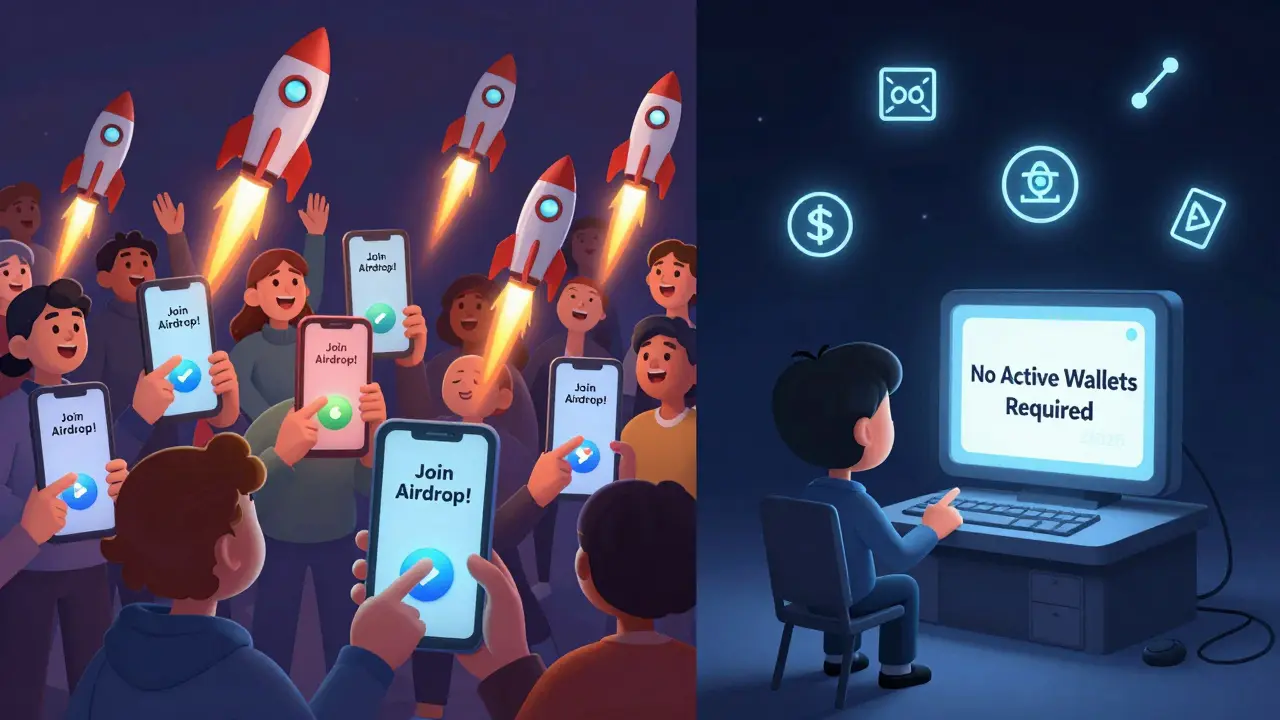
The FEAR token airdrop wasn’t some groundbreaking blockchain event. It was a basic marketing stunt. CoinMarketCap, which had over 100 million users at the time, partnered with the FEAR team to hand out tokens to anyone who clicked a button. No wallet setup. No staking. No smart contracts. Just log into your CoinMarketCap account, click "Join This Airdrop," and wait.Participants had to link their Twitter and Telegram accounts. That’s it. The whole thing was designed to grow the FEAR community fast - not to build real utility. They distributed 20,000 FEAR tokens across more than 500 winners, each getting a small slice. Some got 25 tokens through NFT tickets. Others got more. It wasn’t fair. It wasn’t complex. And it wasn’t meant to be.
At the time, this was normal. In 2021, every new gaming token tried the same playbook: social media = legitimacy. Axie Infinity, The Sandbox, even tiny projects like FEAR - they all used the same trick. Post on Twitter. Join Telegram. Get tokens. Rinse. Repeat.
Why the FEAR Airdrop Wasn’t Special
Most people think airdrops are rewards for early adopters. But FEAR’s wasn’t. It wasn’t given to users who helped build the platform, test the game, or contribute code. It was given to people who followed a link. There was zero barrier to entry. You didn’t need to own crypto. You didn’t need to understand blockchain. You just needed a social media account.Compare that to today. In 2025, airdrops like EigenLayer or LayerZero require you to:
- Restake ETH across multiple chains
- Use specific wallets for months
- Prove you’re not a bot with Soulbound Tokens
- Interact with smart contracts on Ethereum, Arbitrum, and Polygon
FEAR didn’t ask for any of that. It asked for a retweet.
That’s why FEAR faded. It didn’t create a community. It created a list of email addresses. When the price didn’t spike, when the game never launched, when the team stopped posting - the whole thing just evaporated. There was no foundation. Just hype.
What’s FEAR Worth Today?
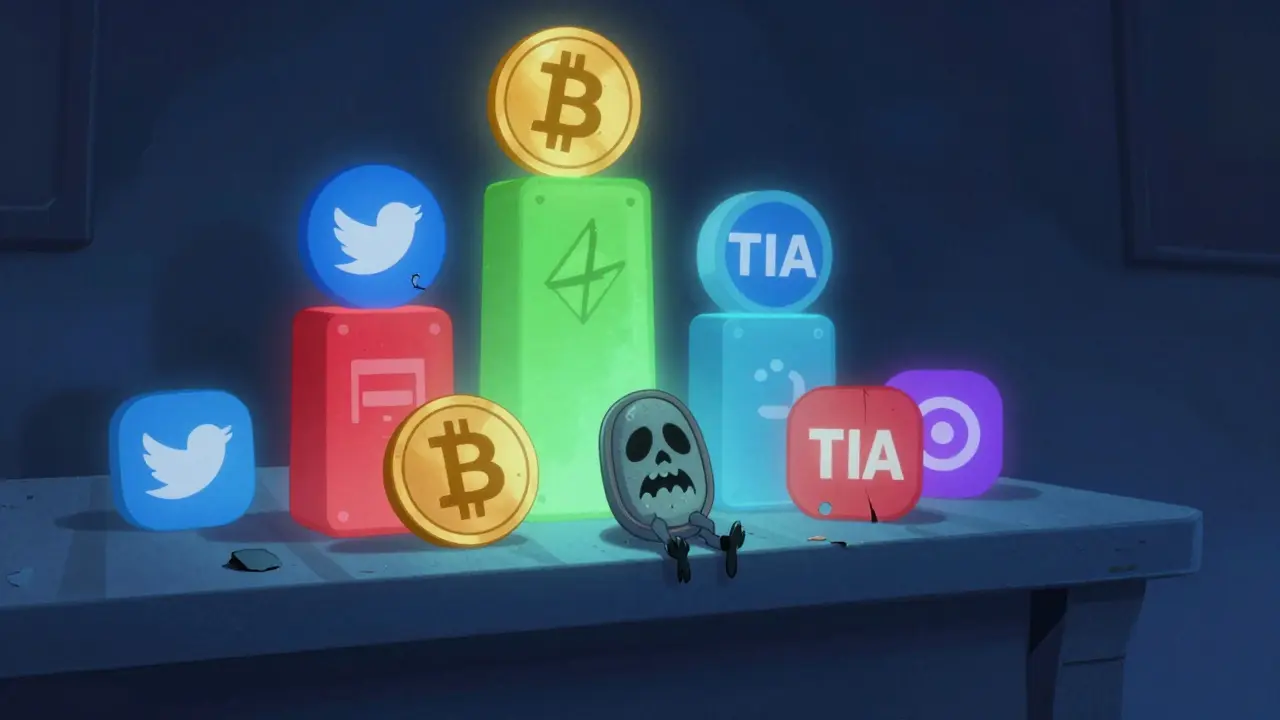
As of February 2026, FEAR trades at $0.008443. That’s almost exactly where it was in late 2025. Price models predict it might hit $0.01123 by 2028. That’s a 16% gain over two years. For context, Bitcoin went up 200% in the same period. Ethereum? Up 180%. Even low-cap tokens like $TIA or $SEI saw 5x jumps.FEAR’s value hasn’t moved because there’s no demand. No new users. No new games. No partnerships. Just a token sitting on exchanges, quietly collecting dust. The original airdrop recipients? Most sold their tokens within weeks. A few held on, hoping for a miracle. None got one.
Even the project’s own website is barely updated. The last blog post was in 2022. The Discord server has 37 active members. The Twitter account hasn’t tweeted since late 2023. This isn’t a dead project - it’s a forgotten one.
The Bigger Picture: How Airdrops Changed
The FEAR airdrop was a snapshot of crypto in 2021: wild, loose, and full of free money. Back then, you could launch a token, do a tweet campaign, and get listed on CoinMarketCap. No whitepaper needed. No audit required. Just a Discord link and a Twitter bot.Today? It’s a different world.
Projects now track:
- How long you’ve held a wallet
- How many transactions you’ve made
- Which chains you’ve used
- Whether you’ve contributed liquidity
They use on-chain data, not social media likes. They reward activity, not attention. FEAR’s model would never fly today. Regulators would shut it down. Exchanges wouldn’t list it. Wallets would flag it as spam.
Even CoinMarketCap has moved on. Their airdrop page now only features projects with real on-chain usage. No more "join Telegram and get tokens" campaigns. They’ve become a gatekeeper, not a distributor.
What You Should Do If You Still Have FEAR Tokens
If you got FEAR in 2021 and still have it - congratulations. You’ve held through a crypto winter. But holding it won’t make you rich. Here’s what to do:- Sell it - If you bought crypto in 2021, you probably have better assets now. FEAR isn’t one of them.
- Forget it - Don’t check the price every day. It won’t move. Ever.
- Learn from it - This is why most airdrops fail. They don’t build. They just broadcast.
The lesson isn’t about FEAR. It’s about how crypto airdrops have changed. The days of free tokens for retweets are over. The winners now are the projects that reward real usage - not real followers.
Why FEAR Still Matters (Even Though It’s Dead)
FEAR didn’t change the market. But it showed us what the market used to be. It’s a time capsule. A reminder of when crypto was easier. When you didn’t need to understand DeFi to get rich. When a tweet could get you 100 tokens.Now, the bar is higher. You need to know what staking is. You need to know how to use a wallet. You need to know which chains matter. The FEAR airdrop was the last gasp of the old way. Everything after it? That’s the new crypto. Real. Hard. And a lot less free.
Did the FEAR token airdrop still have value in 2025?
By 2025, the FEAR token had no real value beyond its market price of around $0.0084. It wasn’t listed on major exchanges like Binance or Coinbase, and no new projects or games were built around it. The airdrop itself was long over, and the token had no active development, community, or utility. Its price was stable but meaningless - it wasn’t gaining traction, just sitting still.
Can I still claim FEAR tokens from the original airdrop?
No. The FEAR token airdrop ended on September 24, 2021. CoinMarketCap shut down the claiming portal shortly after. Even if you were one of the 500 winners, there’s no way to retrieve tokens now. The smart contract used for distribution is inactive, and the team has not maintained any infrastructure for future claims.
Why didn’t FEAR become like Axie Infinity or The Sandbox?
Because FEAR never built a game. Axie Infinity had playable NFT battles. The Sandbox had a full virtual world. FEAR promised a Play2Earn experience but never released anything beyond a website and a token. Without gameplay, there was no reason for users to stick around. Airdrops can start a project - but they can’t sustain it.
Is FEAR token still being traded anywhere?
Yes, but only on small decentralized exchanges like PancakeSwap and Uniswap v2. Trading volume is under $5,000 per day. That’s less than 1% of what even minor tokens trade at. Most of the activity comes from people trying to sell old holdings - not new buyers. There’s no liquidity pool, no price support, and no market makers.
Could FEAR make a comeback in 2026?
Unlikely. For a token to come back, it needs a team, a product, and a community. FEAR has none. No recent updates. No new hires. No partnerships. Even its social media accounts are silent. The crypto market in 2026 rewards innovation, not nostalgia. Without a real reason to exist, FEAR will stay dead.
16 Comments
Elana Vorspan
I still have my FEAR tokens in a wallet I forgot about. Found them last week while cleaning up old crypto accounts. Laughed so hard I cried 😂. Remember when we thought free tokens meant free money? Man, those were the days. Now I just use them as paperweights. Literally. I printed one on a sticker and put it on my laptop. It’s my little reminder that not everything needs to be worth something to have meaning.
Kenneth Genodiala
The FEAR airdrop was a textbook example of how not to build a token. It wasn't even a real distribution-it was a vanity metric for a team that had no product. If you're going to tokenize attention, at least have the decency to build a functional contract. This was just a glorified email list with a blockchain label. Pathetic.
Danny Kim
So let me get this straight... we used to give away tokens for retweets, and now we require you to stake across five chains, prove you're not a bot with soulbound NFTs, and submit a notarized affidavit in triplicate? The crypto community went from 'here's a free token' to 'prove you deserve to breathe' in five years. I miss the simplicity of scammy airdrops. At least then we knew what we were getting into.
Cathy Sunshine
FEAR didn't die because it lacked utility. It died because it was a symbol of everything wrong with crypto in 2021: performative participation, hollow engagement, and the delusion that social media metrics = value. The real tragedy? We all participated willingly. We wanted to believe. And that’s the most dangerous kind of bubble-the one we willingly inflate ourselves.
Richard Cooper
I got 25 FEAR tokens. Sold them for $2. Bought a pizza. Best crypto investment I ever made.
Dee Resin
Funny how the same people who called FEAR a scam now run airdrops that require 17 steps and a notarized wallet history. The game changed. The players? Still the same.
Tanvi Atal
Why do people still care? It's 0.0084. No one cares. Move on.
Sony Sebastian
The FEAR airdrop exemplifies the ontological collapse of Web3's initial promise. By commodifying social capital without establishing on-chain sovereignty, it instantiated a parasitic economic model predicated on attention arbitrage. This is why DeFi 2.0 necessitates verifiable activity graphs and non-repudiable identity layers-without them, you're just running a bot farm with a tokenomics PowerPoint.
Brian Lemke
I’ll never forget the day I got my FEAR tokens. I was in my pajamas, eating cereal, and I thought, 'This is it-I’m rich!' Turns out, I was just another data point in someone’s marketing dashboard. But hey, I learned something valuable: real value isn’t given-it’s built. Now I’m staking on LayerZero. No retweets. Just real usage. And yeah, I’m still eating cereal. But now I’m building something.
Megan Lavery
I still check my FEAR balance once a month. Just to laugh. And cry. And then go do something real with my crypto. Like buying a shitpost NFT of a cat wearing a Bitcoin hat. That’s the real legacy of FEAR: it taught us to laugh at ourselves before the market laughs at us.
christopher luke
FEAR was the crypto version of a free sample at the mall. You take it, you forget about it, then you realize you still have it in your pocket 3 years later. Still smells weird. Still doesn't do anything. Still kinda cute? 🤷♂️
Mary Scott
They used our data. They sold it. The whole thing was a surveillance play. CoinMarketCap knew exactly who we were. We were the sheep they used to sell ads to. I'm not even mad. Just... disappointed. We were all just data points with wallets.
Shannon Holliday
I still have my FEAR NFT ticket. It's framed. Next to my first Bitcoin receipt. It's not about the money. It's about the story. We were there. We believed. We got free stuff. And then... the world changed. I'm not sad. I'm proud. We were part of the before. 🌅
Michael Rozputniy
I’ve been monitoring the FEAR contract since 2022. The team never burned tokens. Never added liquidity. Never even changed the metadata. It’s a honeypot. Someone’s waiting for a sucker to send ETH to it. I’ve reported it to Chainalysis. They didn’t respond. That’s the real story. Not the token. The silence.
Jeremy buttoncollector
The FEAR airdrop was the last gasp of crypto's innocence. After that, we all became accountants. No more free money. Just APYs, TVLs, and soulbound tokens. I miss the days when a tweet could get you rich. Now you need a PhD in Solidity just to claim airdrop. Progress? Or just a bigger cage?
Shannon Black
In India, we call this 'jugaad'-a temporary fix that becomes a cultural artifact. The FEAR airdrop was America’s jugaad. A quick win, no substance, but somehow it stuck. Now it’s a museum piece. A reminder that even in crypto, not every idea needs to scale. Sometimes, it just needs to be remembered.