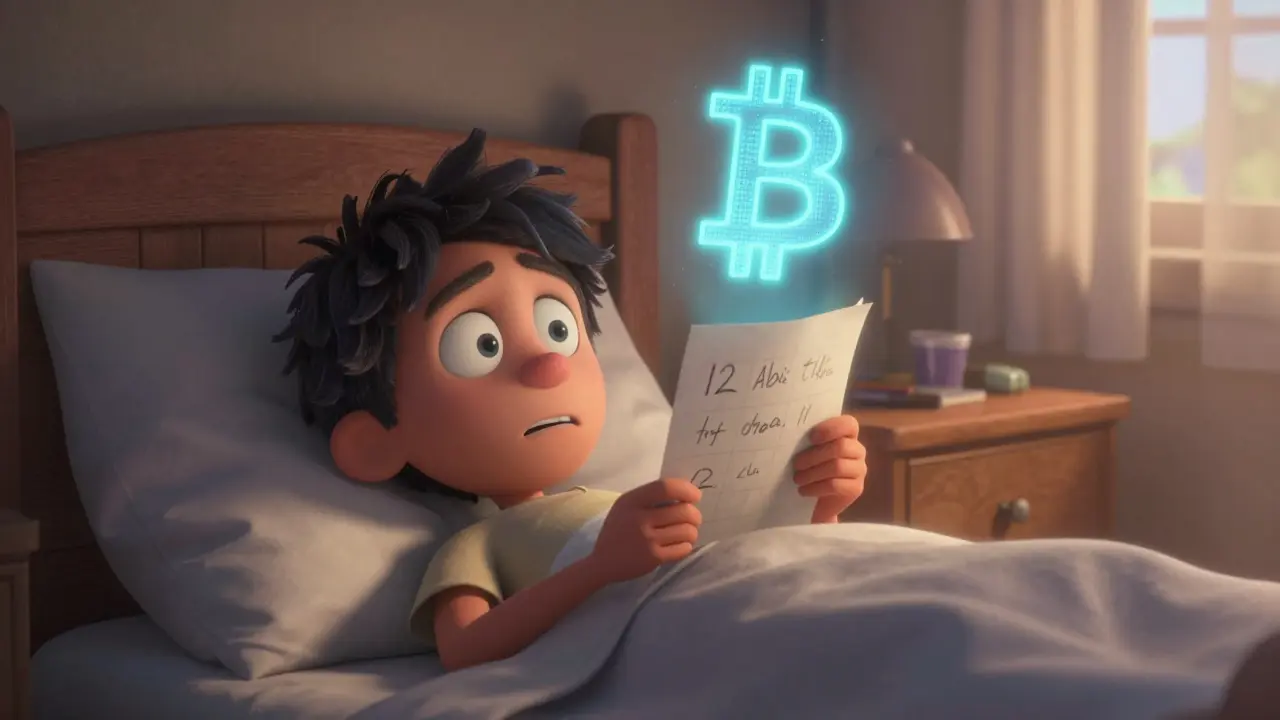
Imagine waking up one day and realizing you can’t access your Bitcoin. Not because the market crashed, not because the exchange went down-but because you lost a string of 12 words. That’s not a horror story. It’s what happens when you don’t understand private keys.
Private keys are the absolute foundation of owning cryptocurrency. They’re not passwords you reset. They’re not account numbers you call customer service about. They’re the only thing that lets you move your money. If you don’t control them, you don’t control your crypto. That’s it. No exceptions.
What Exactly Is a Private Key?
A private key is a randomly generated string of 64 hexadecimal characters-letters and numbers like a1b2c3...f9. It’s not something you make up. It’s mathematically created when you set up a wallet. Alongside it, a public key is made, which turns into your crypto address-the one you give to people to send you Bitcoin or Ethereum.
Think of it like this: your public key is your email address. Anyone can send mail to it. But your private key is the only password that unlocks your inbox. No one else can read your messages. No one else can reply as you. And if you lose it? All your emails are gone forever.
Blockchain networks use a system called elliptic curve cryptography. It’s what makes it possible to prove you own your coins without ever showing your private key. When you sign a transaction, your wallet uses the private key to create a digital signature. The network checks that signature against your public key. If it matches, the transaction goes through. No one sees your key. No one can copy it. But if you lose it, you lose everything.
Not Your Keys, Not Your Coins
This phrase isn’t a slogan. It’s a law of crypto.
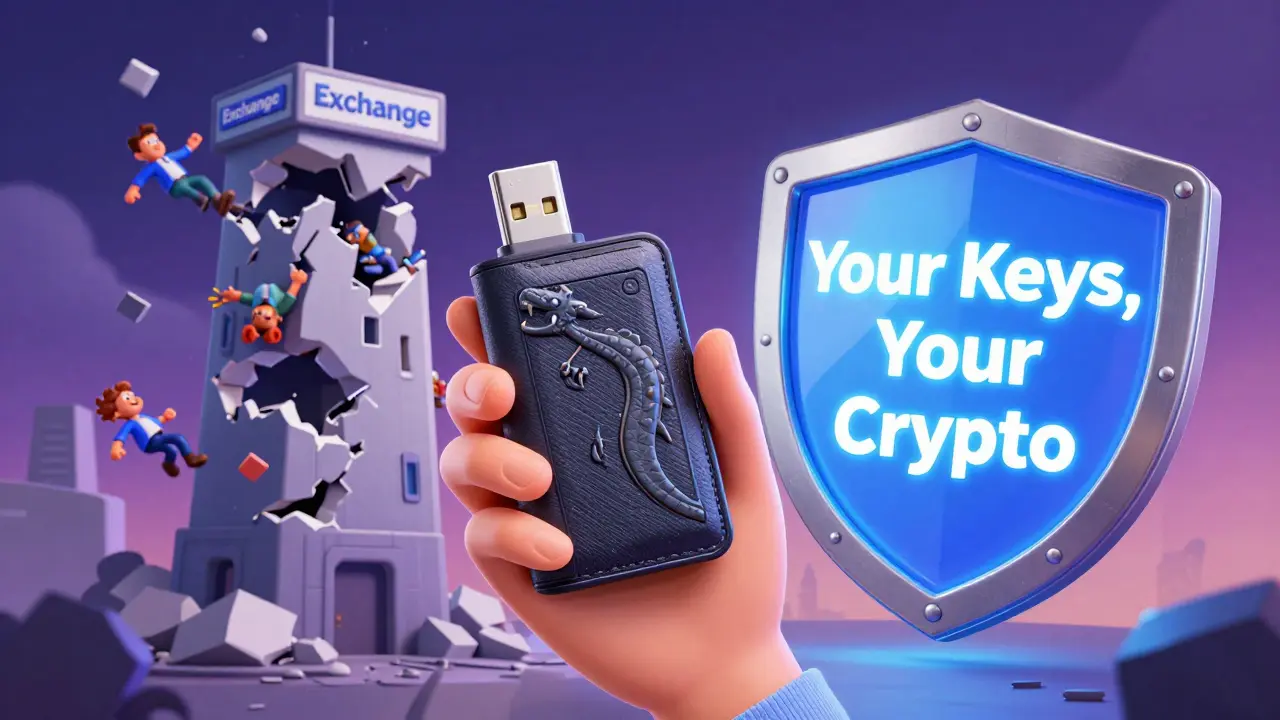
If you keep your Bitcoin on Coinbase, Binance, or any other exchange, you don’t own it. You own a claim on it. The exchange holds the private keys. They control your money. You’re trusting them not to get hacked, not to go bankrupt, not to freeze your account because of a regulatory notice.
In 2022, FTX collapsed. Thousands of users lost everything-not because their wallets were hacked, but because they never had control over the keys. Their crypto was sitting in FTX’s vaults. When the company failed, so did their access.
Compare that to someone who kept their Bitcoin in a hardware wallet. They didn’t care about FTX’s drama. Their coins were safe. Because they held the keys.
Self-custody isn’t just safer-it’s the whole point of crypto. It’s why Bitcoin was created: to remove banks, brokers, and middlemen. If you hand your keys to someone else, you’re back to the old system.
How Private Keys Actually Work
Here’s how it works in practice:
- You open a wallet app or plug in a hardware device.
- The wallet generates a random private key-trillions of trillions of possibilities. No one else can guess it.
- From that key, your public key and wallet address are derived.
- Someone sends you 0.5 ETH to that address. It shows up on the blockchain.
- When you want to send it out, you enter the recipient’s address and amount.
- Your wallet asks you to confirm. You tap ‘Sign’.
- Your private key (stored securely on your device) creates a digital signature.
- The network verifies the signature using your public key.
- The transaction is added to the blockchain. Done.
Notice something? You never typed your private key. You never sent it anywhere. That’s the magic. The key stays locked inside your device-whether it’s your phone, a USB stick, or a piece of paper.
Where to Store Your Private Keys
There are three real ways to store private keys-and only two are safe for anything more than pocket change.
1. Software Wallets (Hot Wallets)
These are apps on your phone or computer-MetaMask, Trust Wallet, Exodus. They’re convenient. You can send and receive crypto in seconds. But they’re connected to the internet. That means they’re vulnerable to malware, phishing, and remote hacks.
Only use these for small amounts you’re actively trading. Never store your life savings here.
2. Hardware Wallets (Cold Wallets)
This is the gold standard. Devices like Ledger, Trezor, or OneKey look like USB drives. They store your private keys offline. No internet. No hackers can reach them.
To send crypto, you connect the device to your computer, enter your PIN, and confirm the transaction on the device’s screen. Even if your computer is infected, the private key never leaves the hardware wallet.
Most people who’ve lost crypto did it through software wallets. People who use hardware wallets? They sleep fine at night.
3. Paper Wallets
Print your private key and public address on paper. Fold it up. Put it in a safe. Simple. Cheap. Effective.
But it’s risky. Paper burns. Paper gets wet. Paper gets thrown out by accident. If you go this route, make three copies. Store them in three different places. And never scan the QR code on an internet-connected device.
Most people don’t use paper wallets anymore. Hardware wallets are easier and safer.
The Real Danger: You
The biggest threat to your crypto isn’t hackers. It’s you.
People forget seed phrases. They write them on sticky notes and leave them on their desks. They screenshot them and upload them to cloud storage. They lose their hardware wallets and never backed up the recovery phrase.
There’s no customer service line to call. No ‘forgot password’ button. If you lose your key or your seed phrase, your coins are gone. Forever.
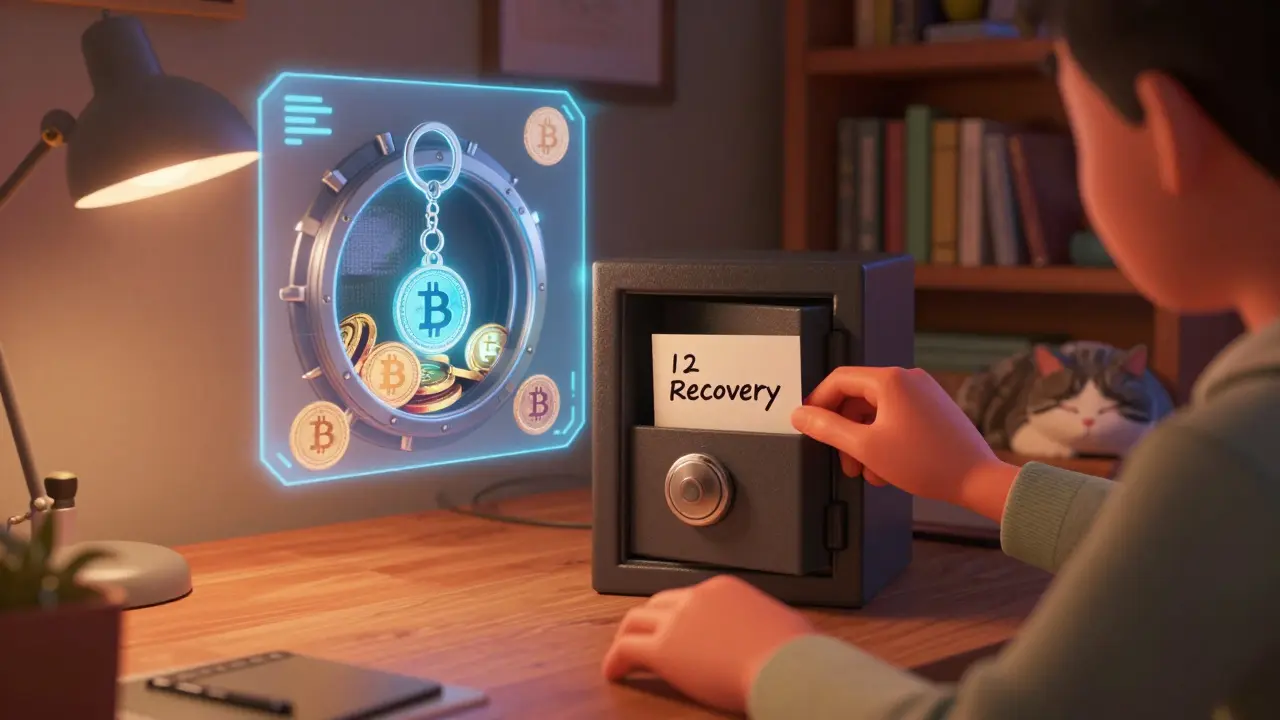
That’s why backup is non-negotiable. Every wallet gives you a 12- or 24-word recovery phrase. Write it down. On paper. No digital copies. Store it in a fireproof safe. Tell one trusted person where it is-so they can help if something happens to you.
Test your backup. Send $10 to your wallet. Then use your seed phrase to restore it on a different device. Make sure it works. Do this once a year.
Why Self-Custody Is the Future
The crypto wallet market hit $7.3 billion in 2023. Sales of hardware wallets jumped 300-500% after major exchange failures. Why? Because people learned the hard way.
Companies like MicroStrategy now hold billions in Bitcoin-using enterprise-grade private key systems. They don’t trust banks. They don’t trust exchanges. They trust math.
Regulators are starting to catch up. The EU and U.S. are drafting rules that treat custodial services like banks-with stricter audits and insurance. But non-custodial wallets? They’re left alone. Why? Because they don’t pose systemic risk. You’re not putting your money in a bank. You’re holding it yourself.
The trend is clear: as crypto matures, more people will take control. Not because it’s trendy. Because it’s the only way to actually own something.
What About Quantum Computers?
You’ve probably heard: ‘Quantum computers will break crypto.’
That’s not true-not yet, and not soon.
Current quantum computers can’t crack 256-bit encryption. Even the most optimistic estimates say it’ll take 10-30 years before they can. And by then, the crypto world will have moved to quantum-resistant algorithms. Projects are already testing them.
Don’t let fear of sci-fi threats stop you from securing your keys today. The real danger isn’t tomorrow’s computers. It’s today’s carelessness.
Start Here: Your 3-Step Plan
Here’s what you do right now:
- Get a hardware wallet. Spend $50-$100. It’s the best investment you’ll make in crypto.
- Write down your recovery phrase. On paper. No exceptions. Store it in a safe. Don’t take a photo. Don’t email it. Don’t store it in Notes.
- Send a small test transaction. Send $5 worth of crypto to your new wallet. Then restore it using your recovery phrase on a different device. Confirm it works.
That’s it. You’re now in control. No one else can touch your money. No exchange can freeze it. No government can seize it. You own it. Because you hold the keys.
Everything else-market cycles, news, memes-is noise. The only thing that matters is this: do you control your private keys? If not, you’re not owning crypto. You’re just renting it.
Can I recover my crypto if I lose my private key?
No. Private keys are mathematically irreplaceable. If you lose your key and don’t have the recovery phrase, your crypto is permanently inaccessible. There is no backdoor, no reset button, and no customer service that can help. This is by design-it’s what makes crypto secure.
Is it safe to store private keys on my phone?
Only for small amounts you’re actively using. Phones are connected to the internet, vulnerable to malware, phishing, and remote access. If you store more than a few hundred dollars’ worth of crypto on your phone, you’re taking unnecessary risk. Use a hardware wallet for anything significant.
What’s the difference between a private key and a seed phrase?
Your seed phrase (usually 12 or 24 words) is a human-readable backup of your private key. It can regenerate all your keys and addresses. The private key is the actual cryptographic string used to sign transactions. You should never see or type your private key-just your seed phrase. Always back up the seed phrase, not the private key.
Why do exchanges say I own my crypto if I don’t control the keys?
They’re using language to make you feel safe. But legally and technically, you own an IOU, not the actual cryptocurrency. Your coins are stored in the exchange’s cold wallets under their control. If they get hacked, go bankrupt, or get shut down by regulators, your access disappears. True ownership means you hold the keys.
Should I use a multi-signature wallet?
For most people, no. Multi-sig wallets require multiple private keys to authorize a transaction, which adds security but also complexity. They’re useful for businesses or large holdings, but for individuals, a single hardware wallet with a properly backed-up seed phrase is simpler and just as secure. Don’t overcomplicate it until you need to.

25 Comments
vaibhav pushilkar
Just started with crypto last month and this post literally saved me. I was about to dump all my ETH into Binance because it was ‘easy.’ Now I’ve got a Ledger Nano S on order. Thanks for the clarity.
Brian Martitsch
Ugh. Still using software wallets? 😒 You’re one phishing link away from bankruptcy. Get a hardware wallet or GTFO.
Sophia Wade
The tragedy of crypto isn’t theft-it’s the quiet, unacknowledged surrender of autonomy. We trade sovereignty for convenience, mistaking custody for ownership. The private key isn’t a tool; it’s a covenant with freedom. To relinquish it is to kneel before the altar of centralized illusion.
Bitcoin was never meant to be a speculative asset. It was a declaration: that the individual, armed with mathematics and solitude, could stand outside the machinery of control. The wallet isn’t a vault-it’s a temple. And most of us treat it like a vending machine.
When you delegate your keys, you don’t outsource security-you outsource your agency. The exchange doesn’t ‘hold’ your coins; it holds you. And when the system cracks, it’s not the blockchain that fails-it’s your faith in someone else’s integrity.
There’s a profound loneliness in self-custody. No one to blame. No one to call. Just you, your seed phrase, and the silence of a decentralized ledger. That’s not a bug. That’s the point.
We romanticize decentralization while clinging to the comfort of intermediaries. We want the power without the responsibility. But crypto doesn’t care about your comfort. It only cares about your discipline.
Hardware wallets aren’t luxury items. They’re the modern equivalent of a lock on your front door. If you leave your house unlocked because ‘it’s safe in the neighborhood,’ you’re not living in a free society-you’re living in denial.
The real risk isn’t quantum computing or hacks. It’s the erosion of personal sovereignty through passive acceptance. We’ve forgotten that ownership isn’t a feature. It’s a practice. A daily, quiet, uncompromising act of self-reliance.
So yes-buy the Ledger. Write down the words. Test the backup. But more than that-reclaim the mindset. You are not a customer. You are a steward. And stewardship requires vigilance, not just tools.
SHEFFIN ANTONY
Hardware wallets? LOL. I’ve been holding my keys in a text file on Google Drive since 2017. And guess what? Still got my BTC. You people are paranoid.
Vyas Koduvayur
Let me break this down for the 17-year-olds in the comments. Private keys are 256-bit elliptic curve cryptographic signatures derived from entropy pools generated by hardware RNGs. The seed phrase is a BIP39-encoded mnemonic representation of that entropy, using a 2048-word dictionary with checksum validation. If you’re storing your keys on your phone, you’re not just at risk-you’re statistically guaranteed to lose them within 18 months. And no, ‘I have a strong password’ doesn’t matter. Malware doesn’t care about your password. It cares about your clipboard, your browser extensions, and your unpatched OS. Also, if you’re using MetaMask without a hardware wallet, you’re basically handing your keys to every ad network that loads on CoinMarketCap. I’ve seen it. Hundreds of times. And yes, I’ve recovered wallets from people who screenshot their seed phrases and uploaded them to Imgur. Don’t be that guy.
Lloyd Yang
I remember when I first got into crypto-I thought I was smart because I had a password manager with all my keys. Then I got phished. Lost $8k in 30 seconds. That night, I burned my laptop’s SSD and bought a Trezor. I didn’t cry. I didn’t rage. I just sat there and realized: this isn’t about money. It’s about responsibility. Now I teach my nieces and nephews how to write down seed phrases on paper. I tell them: ‘If you can’t lose it, you don’t own it.’ It’s not a tech lesson. It’s a life lesson. You can’t outsource your power. Not to banks. Not to apps. Not even to your best friend. The only person who should ever touch your keys… is you. And even then, only if you’re alone. No witnesses. No screenshots. No backups in the cloud. Just you, a pen, and silence.
Jake Mepham
STOP SCROLLING. START SECURING. 🚀
Hardware wallet: $70.
Time to backup: 5 minutes.
Peace of mind: priceless.
You’re not too busy. You’re just not serious yet.
Craig Fraser
Why are we all pretending this is new? I’ve been saying this since 2014. People still don’t get it. It’s not about crypto. It’s about human nature. We’re all just one click away from disaster. And we love it that way.
Sybille Wernheim
Finally someone says it like it is. I used to think exchanges were ‘safe’ because they had ‘insurance.’ Then I watched FTX collapse. Insurance doesn’t mean anything if they’re lying about your balance. Now I keep everything in cold storage. No drama. No stress. Just peace.
Cathy Bounchareune
My grandmother just got her first hardware wallet. She’s 78. She writes her seed phrase on three pieces of paper, puts them in envelopes, and hides them in her baking tins. She calls it ‘my secret recipe.’ I love her so much.
Jordan Renaud
There’s something deeply spiritual about holding your own keys. It’s not just security-it’s identity. You’re not just owning Bitcoin. You’re owning your right to exist outside the system. That’s why so many people avoid it. It’s easier to blame the market than to face the fact that you’re afraid of freedom.
Dan Dellechiaie
Bro, you’re all acting like this is rocket science. It’s not. You write 12 words on paper. Put it in a drawer. Done. Stop overcomplicating it. The real problem? You all think you’re special. You’re not. You’re just lazy.
Charles Freitas
Hardware wallets are for people who don’t understand decentralization. If your keys are on a device made in China, are you really in control? Or are you just trusting a different middleman?
Sarah Glaser
The most dangerous thing about crypto isn’t the technology-it’s the illusion of simplicity. People think ‘just backup your seed’ is enough. But backup is a process, not a moment. It’s discipline. It’s ritual. It’s the quiet act of showing up for yourself every day, even when no one’s watching.
Rachel McDonald
OMG I just realized I saved my seed phrase in a Google Doc labeled ‘Crypto Notes’ 😭😭😭
Grace Simmons
Why are Americans so obsessed with owning things? In my country, we trust institutions. If you can’t rely on a regulated exchange, what’s the point of crypto? You’re just creating chaos.
Collin Crawford
Let me correct your terminology. A private key is not a ‘64-character hexadecimal string.’ It is a 256-bit integer, typically represented in hexadecimal notation as 64 characters, but it is not the string itself-it is the underlying scalar value. The seed phrase is a BIP39 mnemonic encoding that entropy, not a ‘backup’ of the key. You are conflating representation with substance. Also, elliptic curve cryptography is not ‘used to prove ownership’-it is used to generate digital signatures via the Schnorr or ECDSA algorithm. Your post is dangerously imprecise.
Aaron Heaps
Hardware wallets are a scam. They’re just USB devices with a screen. If your computer is compromised, they can still be manipulated. You’re not safe-you’re deluded.
Megan O'Brien
So… you’re saying I need to buy a $100 device just to not lose my dogecoin? Cool. I’ll just keep it on Binance. At least I get a 2FA email.
Helen Pieracacos
Wow. Someone actually wrote something useful. Rare. Thanks.
Dustin Bright
bro i just put my seed phrase in my notes app with a password 🤞🤞🤞
Melissa Black
Self-custody is not a technical challenge. It is a psychological one. The mind resists autonomy because autonomy demands accountability. We prefer the comfort of blame. The exchange did it. The market crashed. The government seized it. But when you hold the keys, there is no ‘they.’ Only ‘I.’ And that is terrifying. So we choose ignorance. We choose convenience. We choose to rent. And then we wonder why we feel powerless.
chris yusunas
Man I just keep mine on a flash drive in my sock drawer. Been fine for 5 years. No drama. No stress. Just chill.
Naman Modi
Why do people even care? Crypto is dead. Only losers hold it. I made my money on memecoins and cashed out. You’re all still playing with toys.
Jordan Renaud
That’s the thing-most people don’t lose their keys to hackers. They lose them to themselves. A misplaced sticky note. A forgotten drawer. A broken phone. A divorce. A death. Crypto doesn’t care about your story. It only cares if you have the words. So write them down. Not for you. For the person who finds your body one day and wonders why you left so much behind.