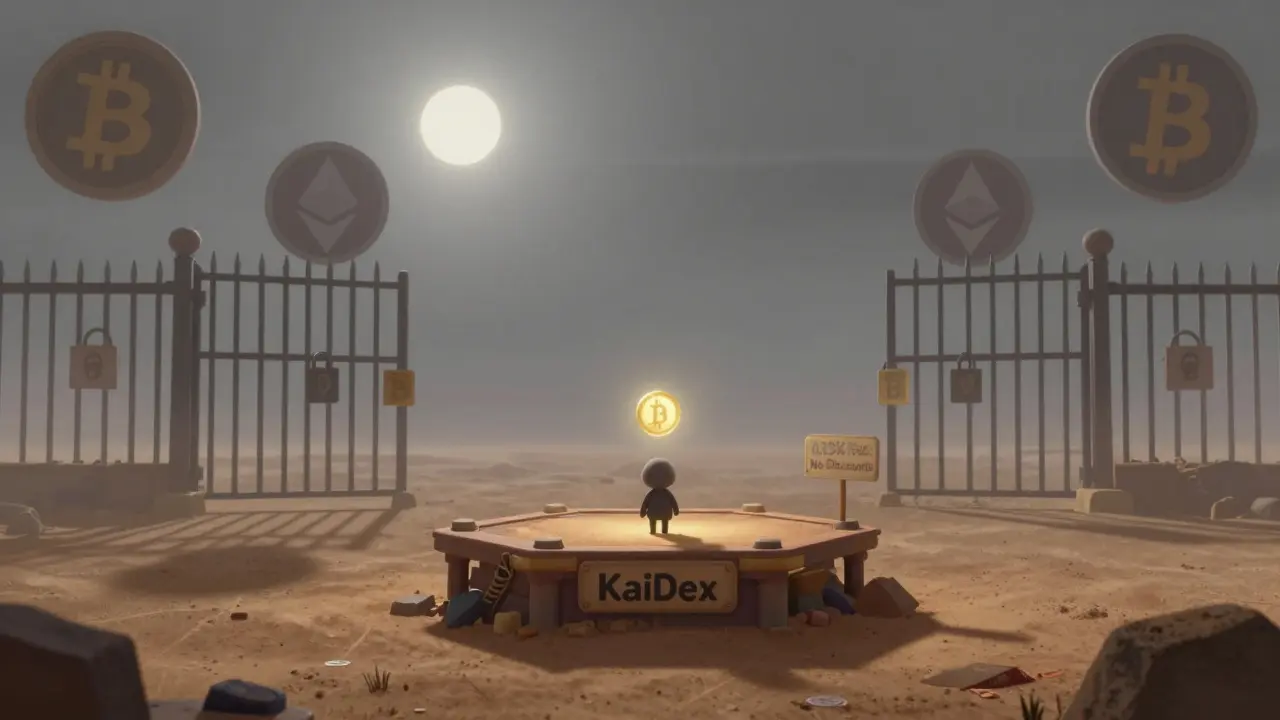
When you’re looking for a new crypto exchange, you want options, low fees, and some level of trust. KaiDex doesn’t give you any of those. It’s a tiny exchange based in Vietnam, launched in 2021, and still stuck with just one cryptocurrency and one trading pair. That’s not a niche-it’s a limitation. If you’re trying to trade Bitcoin, Ethereum, or even a popular meme coin, KaiDex won’t help you. You’ll be stuck with whatever single token they support, and you’ll pay 0.25% every single time you trade.
What You Can Actually Trade on KaiDex
As of late 2025, KaiDex lists only one cryptocurrency. No Bitcoin. No Ethereum. No Solana. No BNB. Nothing else. You can’t even choose between different tokens to swap. You get one asset, and you trade it against one other-likely a stablecoin like USDT or a native platform token. That’s it. There’s no way to buy altcoins, stake, or even deposit most major cryptos. This isn’t a platform for active traders. It’s not even really for beginners who want to dip their toes in. It’s for someone who already owns that one specific token and needs a place to trade it-maybe because no other exchange supports it locally.
Compare that to exchanges like Coinbase, which supports over 350 coins, or even smaller ones like SushiSwap, which offers dozens of tokens across multiple blockchains. KaiDex doesn’t just lag behind-it’s in a completely different league. If you’re looking to diversify, build a portfolio, or even just buy your first crypto, KaiDex is not an option.
Fees Are Stiff for What You Get
KaiDex charges a flat 0.25% fee on every trade. No maker-taker split. No volume discounts. No loyalty tiers. Just 0.25%, every time. That’s high. Even small centralized exchanges like Kraken charge as low as 0.00% for high-volume traders. Decentralized platforms like SushiSwap charge 0.30%, but they offer hundreds of trading pairs and multi-chain support. KaiDex charges nearly as much as SushiSwap but gives you a fraction of the utility.
Think about this: if you trade $1,000 worth of crypto on KaiDex, you pay $2.50 in fees. On Binance, you’d pay $1.00 or less if you use BNB for fee discounts. On Kraken, you could pay nothing at all if you’re a maker. KaiDex doesn’t even give you the option to reduce fees. You’re locked in.
No Margin, No Futures, No Advanced Tools
If you’re serious about trading-whether you’re day trading, arbitraging, or hedging-KaiDex won’t help. There’s no margin trading. No futures contracts. No stop-loss orders. No limit orders beyond basic buy/sell. No API access for bots. No charting tools worth mentioning. The interface looks like it was built in 2018 and never updated. You can’t even find a decent price chart on the site. It’s not just basic-it’s outdated.
For context, even small DeFi platforms like BakerySwap or Raydium offer multiple trading pairs, liquidity pools, and basic charting. KaiDex doesn’t even meet that baseline. It’s not a trading platform. It’s a token swap tool with no features.
Low Traffic, Low Trust
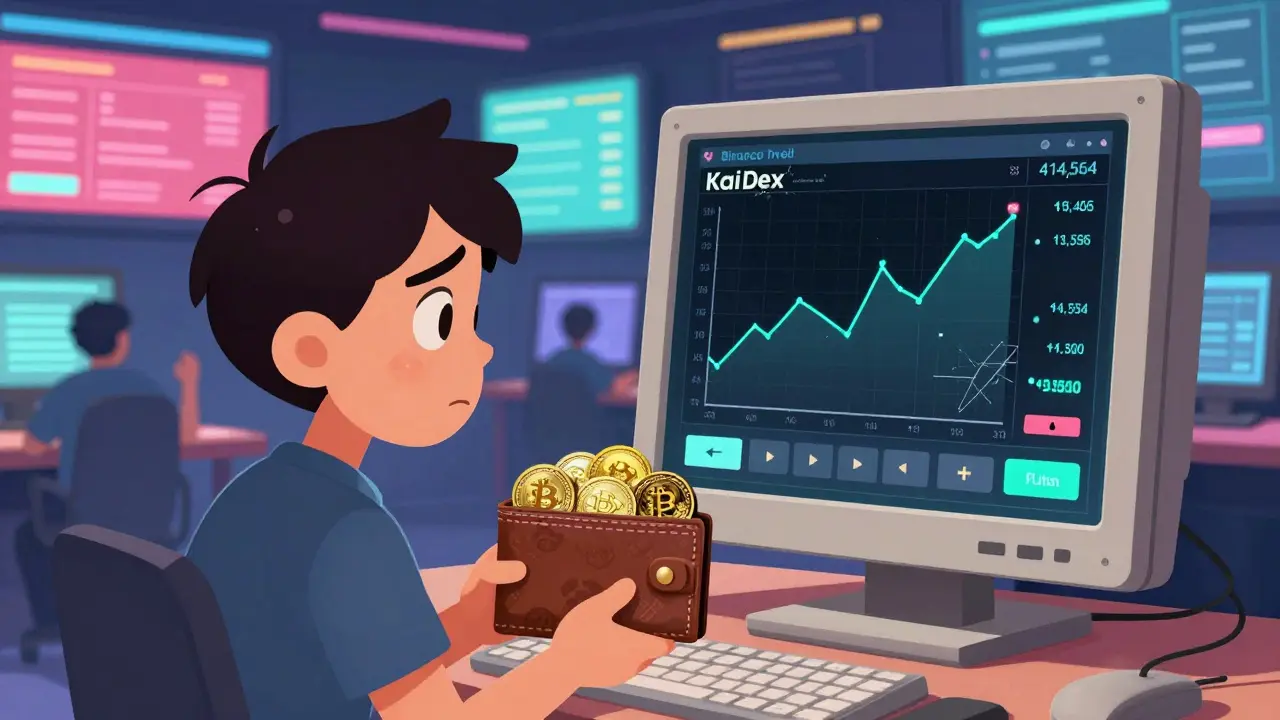
KaiDex ranks #414,564 on Alexa. That means it gets less traffic than a small local blog in New Zealand or a niche recipe site in Brazil. Major exchanges like Binance or Coinbase get billions of visits per month. KaiDex? Probably a few thousand. That’s not just small-it’s invisible.
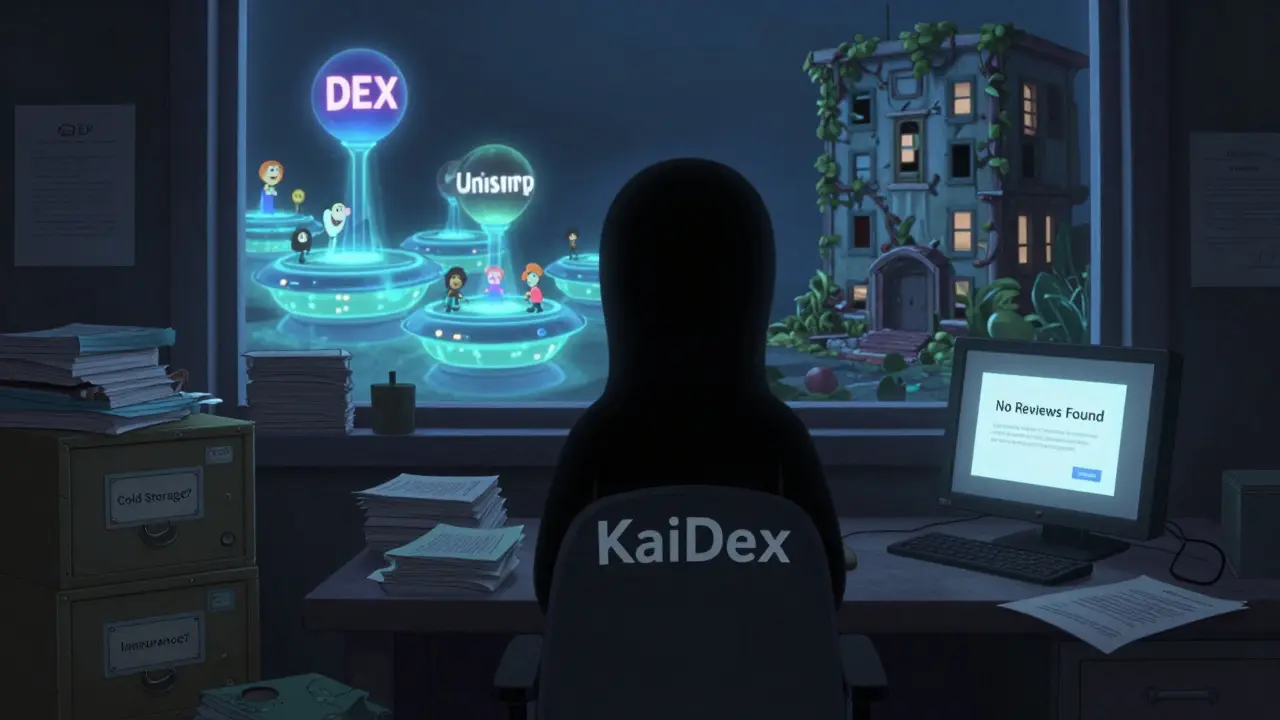
And here’s the real problem: there’s almost no user feedback. No Reddit threads. No Trustpilot reviews. No Twitter discussions. No YouTube tutorials. No Medium articles breaking down its security. You can’t find a single honest review from a real user. That’s not because it’s perfect-it’s because almost no one uses it. If a platform has zero online chatter, that’s a red flag. People talk about exchanges when they have problems. They also talk about them when they love them. KaiDex? Silence.
Security? Unknown
Does KaiDex use cold storage? Do they have insurance? Are they KYC-compliant? Do they undergo audits? There’s no public information. No security whitepaper. No transparency report. No mention of any third-party audits. For a crypto exchange, this is dangerous. You’re handing over your private keys or funds to a platform that won’t tell you how it protects them.
Compare that to even mid-tier exchanges like KuCoin or Gate.io-they publish regular security updates, have bug bounties, and disclose wallet addresses. KaiDex says nothing. That’s not privacy. That’s secrecy. And in crypto, secrecy equals risk.
Who Is KaiDex Even For?
There’s one possible use case: if you’re in Vietnam and you hold a token that’s only listed on KaiDex-maybe a local project that never got listed elsewhere-you might have no choice. But even then, you’re stuck with high fees and zero liquidity. If you try to sell, you might not find a buyer. If you try to buy more, the price could swing wildly because there’s so little trading volume.
For everyone else? KaiDex is a dead end. It doesn’t offer anything you can’t get elsewhere, and it makes it harder and more expensive to do it. There are better alternatives for every type of user:
- If you want simplicity: Coinbase has a clean app, low fees for beginners, and 24/7 support.
- If you want low fees: Kraken offers 0.00% maker fees and hundreds of coins.
- If you want DeFi: SushiSwap or Uniswap give you access to hundreds of tokens across Ethereum and Polygon.
- If you’re in Southeast Asia: Binance and Bybit have local support, Vietnamese language options, and way more liquidity.
The Bottom Line
KaiDex isn’t a bad exchange because it’s new. It’s bad because it’s stuck. Four years after launch, it still offers one coin, one pair, one fee, and zero transparency. There’s no sign of growth, no roadmap, no community. It doesn’t feel like a company trying to build something-it feels like a project that got abandoned.
If you’re looking to trade crypto in 2025, don’t waste your time on KaiDex. The fees are too high, the options are too few, and the trust is too low. There are dozens of better exchanges out there that actually care about their users. Pick one of those instead.
Is KaiDex safe to use?
There’s no public evidence that KaiDex is safe. It doesn’t publish security audits, doesn’t disclose its wallet storage methods, and has no track record of handling large withdrawals. Without transparency, you’re taking a risk. Most experts recommend avoiding exchanges that don’t share basic security details.
Can I buy Bitcoin on KaiDex?
No. As of 2025, KaiDex supports only one cryptocurrency and one trading pair. Bitcoin is not among them. If you want to buy Bitcoin, use a platform like Coinbase, Kraken, or Binance.
Why does KaiDex have such high fees?
KaiDex charges a flat 0.25% fee on all trades with no discounts or tiers. This is high compared to industry standards, where many exchanges offer 0.1% or lower for active traders. The high fee likely reflects low volume-without enough users, they need to charge more to cover costs. But it’s still a bad deal for you.
Is KaiDex a decentralized exchange (DEX)?
It’s unclear. KaiDex is based in Vietnam and appears to be centralized, but it’s sometimes grouped with DeFi platforms like SushiSwap because of its limited offerings. However, it doesn’t run on a public blockchain like Ethereum, and it doesn’t offer wallet integration or liquidity pools. Most signs point to it being a centralized exchange with minimal features.
Are there any better alternatives to KaiDex?
Yes-many. For beginners: Coinbase. For low fees: Kraken. For DeFi: Uniswap or SushiSwap. For Southeast Asian users: Binance or Bybit. All of these offer more coins, lower fees, better security, and real customer support. KaiDex doesn’t compete on any level.

25 Comments
Janet Combs
bro why is this even a thing?? one coin?? like... what even is the point??
roxanne nott
0.25% fee for one coin? that’s not high, that’s robbery with a side of delusion. even my grandma’s crypto app charges less. this isn’t a platform, it’s a digital ghost town with a payment gateway.
Ellen Sales
lol imagine being so niche you can’t even list btc. i’m not mad, i’m just impressed. like, you built an exchange so small it’s basically a crypto vending machine that only takes one type of token. congrats, you invented the world’s most useless atm.
Vijay n
the real conspiracy here is that this exchange was created by a government agency to test how long people will keep using something with zero utility. i’ve seen better interfaces on my toaster. the silence around this platform? that’s not absence of feedback, that’s mass trauma.
Alison Fenske
my cousin in hanoi tried using this last year. said the site loaded slower than her dial-up connection from 2005. she gave up after three tries. now she uses binance and just sends money via western union. honestly? smarter move.
Megan O'Brien
the fee structure is a classic liquidity trap. low volume → high fees → lower volume → higher fees → death spiral. this isn’t a business model, it’s a textbook case study in how not to run a crypto exchange. also, no api? no charting? you’re not a platform, you’re a static html page with a wallet.
Rachel McDonald
how is this still alive?? 😭 i’m crying for the devs who worked on this. they must’ve had dreams. now they’re just staring at a single token with no buyers. i feel it in my soul.
vaibhav pushilkar
if you’re in vietnam and need to trade this one token, maybe it’s worth it. but for everyone else? go to binance. it’s cheaper, faster, and actually works. no drama.
Vyas Koduvayur
let me break this down like i’m explaining to my 80-year-old aunt: you pay 25 cents for every 100 dollars you trade, and you can only trade one thing. imagine going to a grocery store that sells only pickles and charges $2.50 per jar. you’d leave. you’d scream. you’d write a Yelp review in all caps. this is the same thing. just with blockchain.
Jake Mepham
the silence around kaidex is louder than any review. if nobody’s talking about it, it’s not because it’s perfect-it’s because it’s irrelevant. crypto thrives on community, transparency, and liquidity. this has none of it. it’s a crypto museum exhibit labeled 'early 2020s delusion.'
Sybille Wernheim
i love how people still try to justify this. it’s not about being new-it’s about being lazy. you don’t build a platform and then forget to add features. you build a platform to serve people. this doesn’t serve anyone. it’s just... there. like a broken vending machine in a basement.
Cathy Bounchareune
the interface probably looks like a microsoft word doc from 2007 with a few emojis slapped on. no wonder no one uses it. if your website looks like it was made by a high schooler with a free template, people assume you’re also stealing their crypto.
Jayakanth Kesan
i’m from india, and even our smallest local exchanges have 50+ coins. this feels like a side project that got stuck in development hell. someone probably started it to help a friend trade a local token, then forgot to add anything else. it’s not evil, it’s just... unfinished.
Earlene Dollie
the fact that you can’t even find a single youtube tutorial on this thing... it’s like it exists in a parallel universe where no one has google. i’m not judging, i’m just... sad for the future of crypto.
Dusty Rogers
my friend used this once to trade a token he mined in his garage. said the trade took 47 minutes. he still has the screenshot. it’s his trophy. he says it’s the only thing that’s ever made him feel like a crypto pioneer. i don’t know whether to laugh or cry.
Melissa Black
the absence of a roadmap, audit reports, or even a changelog indicates a fundamental failure in governance. a crypto exchange without transparency is not a financial instrument-it’s a liability wrapped in a domain name. this is not innovation. this is negligence dressed as decentralization.
SHEFFIN ANTONY
they probably just wanted to make a token and then sell it. the exchange is a front. the real plan was pump and dump. now they’re just pretending it’s a real platform. the silence? that’s the sound of the team cashing out and moving to thailand.
Dan Dellechiaie
the real tragedy isn’t the fees or the one token-it’s that someone actually thought this was a good idea. like, you had the bandwidth to build a website, but not enough to add a second coin? you had access to blockchain tools, but not to common sense? this isn’t crypto. this is a digital art installation titled 'capitalism in a coma.'
Collin Crawford
the lack of regulatory compliance is a red flag of catastrophic proportions. without KYC, without audit trails, without any public documentation, this platform operates in a legal gray zone that could collapse at any moment. users are not investors-they are test subjects in an unregulated experiment.
Sheila Ayu
wait-so if i own this one token, i have to use kaidex? what if i don’t want to? what if i just want to hold it? do i have to pay 0.25% just to look at it? this is worse than a tax. this is emotional blackmail.
Kevin Karpiak
usa and india have better crypto options than this. why is vietnam even letting this exist? it’s embarrassing. this isn’t innovation, it’s a national shame. we should be building global platforms, not one-token ghosts.
Sarah Glaser
every exchange starts small. but growth requires vision. kaidex doesn’t just lack features-it lacks ambition. it doesn’t want to be better. it just wants to exist. and in crypto, existing isn’t enough. you either scale or vanish. kaidex chose vanish.
Radha Reddy
as someone from india, i appreciate local initiatives. but this lacks the fundamentals: liquidity, transparency, and scalability. a platform that cannot evolve is not a platform-it is a relic. better to redirect energy toward projects with a clear path forward.
Lloyd Yang
there’s something haunting about this. it’s not malicious-it’s just forgotten. like a toy left in a closet after a child outgrew it. someone believed in this. maybe they still do. but the world moved on. and now, this little exchange just sits there, waiting for a buyer who will never come.
Jake Mepham
if you’re reading this and you’re thinking ‘maybe i’ll try it’-don’t. go to binance. go to kraken. go to uniswap. they’re free, fast, and actually care. kaidex is the crypto equivalent of a dial-up modem in 2025. you don’t need to hate it. you just need to ignore it.