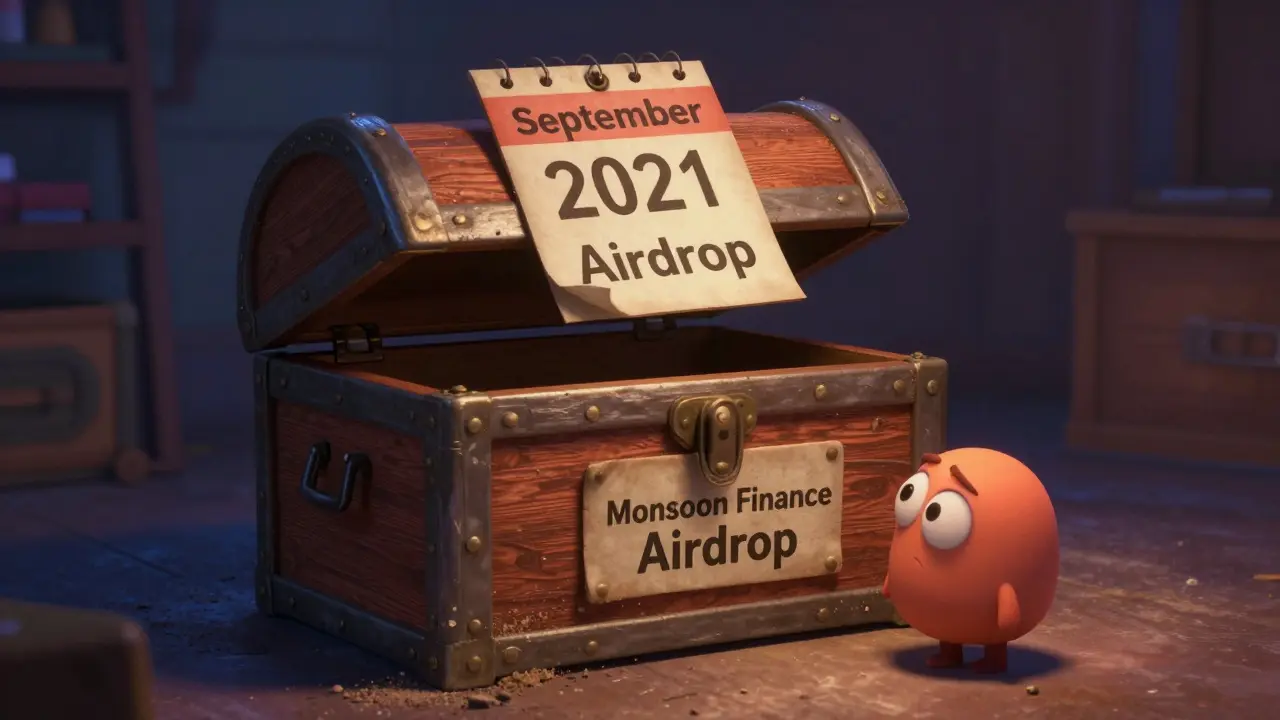
Did you miss the Monsoon Finance airdrop? If you're hunting for free tokens, the short answer is that the traditional airdrop window closed years ago. The project launched its Token Generation Event (TGE) on September 30, 2021. That was the main distribution moment. Today, in May 2026, you won't find a simple "click-to-claim" link floating around social media.
However, that doesn't mean there are no ways to earn MCASH. The project uses a system called "Anonymity Mining." Instead of giving away tokens for free based on wallet history, Monsoon Finance rewards users who actively use their privacy protocols. This guide breaks down exactly what happened during the launch, how the current earning mechanism works, and what the current market reality looks like for this cross-chain privacy solution.
The Reality of the Monsoon Finance Airdrop
When people search for "Monsoon Finance airdrop," they are usually looking for retroactive rewards. In the crypto world, retroactive airdrops happen when a new project gives tokens to early users of a different protocol. Monsoon Finance did not operate this way at launch. Their primary distribution method was through sales and vesting schedules, not community giveaways.
The September 30, 2021 launch date marks the end of the initial distribution phase. At that time, the team released 50% of allocated tokens immediately. The rest were distributed monthly. If you weren't part of the private sale, IDO, or IEO phases back in 2021, you missed the direct allocation. There have been no major secondary airdrop campaigns reported since then.
This is a crucial distinction. Many projects promise "future airdrops" to keep hype alive. Monsoon Finance's approach has been more technical. They focused on building their cross-chain privacy protocol rather than marketing free tokens. This means your focus should shift from "how do I claim" to "how do I participate in the ecosystem."">
How Anonymity Mining Works
If you want MCASH tokens now, you need to understand Anonymity Mining. This is the core mechanism for acquiring the governance token post-launch. It is not passive income. You don't just stake tokens and wait. You have to use the network.
Anonymity Mining rewards users for engaging with Monsoon Finance's privacy services. Here is how it typically functions:
- Active Usage: You must deposit assets into the protocol's privacy pools.
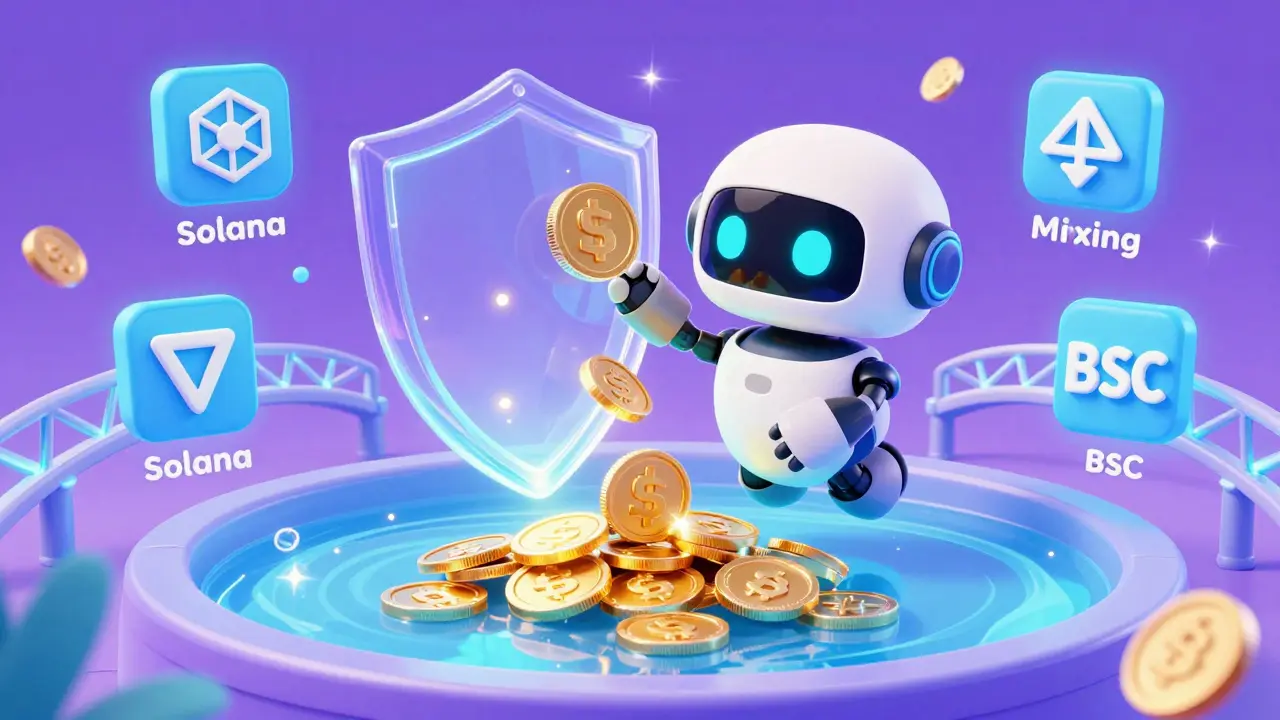
- Cross-Chain Transactions: The protocol supports multiple blockchains including Solana, Moonbeam, BSC, Polygon, and Fantom.
- Privacy Shielding: By using these features to obscure transaction details, you contribute to the network's utility and earn MCASH as a reward.
This model aligns incentives. The protocol gets real usage data and liquidity. You get tokens. It is a usage-based reward system rather than a free distribution. To maximize earnings, you need to understand zero-knowledge proof technology and how to navigate the multi-chain bridge.
Token Distribution and Vesting Schedules
Understanding the past distribution helps explain why the token price behaves the way it does today. Monsoon Finance raised $2.29 million across six funding rounds before launch. The total supply is capped at 100 million MCASH tokens.
| Allocation Category | Percentage | Details |
|---|---|---|
| Private/Pre-Sale | 6.97% | 6.97 million tokens sold during fundraising |
| Public Sales | 0.88% | 875,000 tokens available to general public |
| TGE Immediate Release | 50% | Half of allocated tokens released at launch |
| Vesting Schedule | Varies | Remaining tokens released monthly or over 270 days |
The vesting schedules varied by platform. For example, BullPerks implemented an 8% release at TGE followed by 10% distributions every 30 days for 270 days. Other platforms had different timelines. These schedules meant that tokens continued to enter the market long after the launch, creating sell pressure that affected the price.
As of 2026, the circulating supply is reported at approximately 2.1 million MCASH. This low number relative to the total supply suggests that many tokens may still be locked or burned, or that trading activity is extremely low. Always verify current supply data on live blockchain explorers, as self-reported numbers can sometimes lag behind actual on-chain activity.
Market Performance and Current Status
Let's look at the hard numbers. The MCASH token launched with a fully diluted valuation of $20 million. Early investors in the seed round bought in at $0.08 per token. Private round participants paid $0.153. The IDO and IEO prices were set at $0.200.
Today, the token trades around $0.000295 USD. This represents a significant decline from all entry points. Most early rounds show returns of -99.8% to -99.6%. The all-time high ROI was roughly 4.29x for seed investors, but that peak is long gone. Current market capitalization ranks Monsoon Finance at #9309 globally, indicating very low liquidity and limited trading volume.
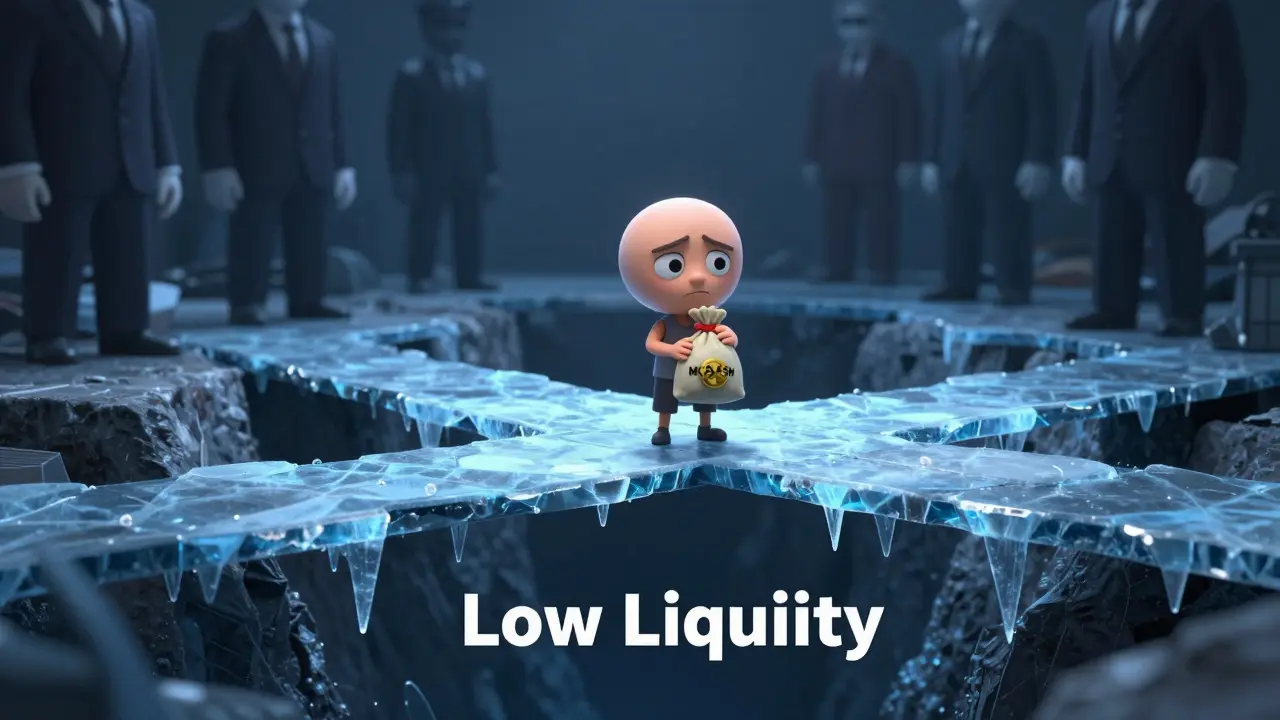
Trading volume often hits zero in 24-hour periods on major exchanges like Binance. This is a red flag for anyone looking to trade heavily. Low liquidity means large buys or sells can cause massive price slippage. If you hold MCASH, exiting your position might be difficult without significantly dropping the price.
Technical Foundation: Privacy Across Chains
Despite the poor market performance, the technology remains interesting. Monsoon Finance addresses a real gap: transaction privacy across smart contract blockchains. Most privacy coins exist on their own chains. Monsoon allows you to deposit assets on one chain and privately withdraw them on another.
The security relies on zkSNARKs (Zero-Knowledge Succinct Non-Interactive Arguments of Knowledge). The project held a trusted setup ceremony with 1,114 contributions. As long as at least one participant was honest, the cryptographic security holds. This is a strong technical foundation.
The protocol supports:
- Solana
- Moonbeam
- BSC
- Polygon
- Fantom
This multi-chain capability is unique. However, adoption has been slow. Regulatory scrutiny on financial privacy tools has increased globally, which may have dampened user enthusiasm. Without widespread usage, the "Anonymity Mining" rewards pool remains small.
Risks and Considerations for New Users
If you are considering entering the Monsoon Finance ecosystem, you need to weigh several risks. First, the learning curve is steep. You need to understand zero-knowledge proofs and cross-chain bridging mechanics. This is not a "set and forget" investment.
Second, the liquidity risk is high. With minimal trading volume, you could find yourself unable to sell your tokens at a fair price. Third, the regulatory environment for privacy coins is tightening. Projects like Monsoon Finance operate in a gray area in many jurisdictions. Future regulations could impact the protocol's ability to operate on certain chains.
Finally, the opportunity cost. There are many other DeFi projects offering more robust yields or clearer utility. Monsoon Finance's niche is specific: cross-chain privacy. Unless you specifically need this feature, the rewards from Anonymity Mining may not justify the effort and risk.
How to Access MCASH Tokens
If you decide to proceed, here is how you access the tokens. You cannot buy MCASH easily on centralized exchanges due to delistings or low volume. Your options are limited to decentralized exchanges (DEXs) on the supported networks.
- Set up a Wallet: Ensure you have wallets compatible with Solana, Polygon, BSC, etc.
- Acquire Base Assets: Buy SOL, MATIC, BNB, or ETH depending on the chain you want to use.
- Connect to DEX: Use platforms like Raydium (Solana), QuickSwap (Polygon), or PancakeSwap (BSC).
- Swap for MCASH: Find the MCASH trading pair. Be aware of high slippage settings.
- Participate in Anonymity Mining: Deposit your assets into the Monsoon Finance protocol to start earning rewards.
Always double-check contract addresses. Scammers often create fake MCASH tokens on various chains. Verify the official address from the Monsoon Finance website or reputable tracking sites like CoinGecko or CoinMarketCap.
Is there still a Monsoon Finance airdrop available?
No, the traditional airdrop period ended with the Token Generation Event (TGE) on September 30, 2021. There are no active retroactive airdrop campaigns. Users must now earn tokens through "Anonymity Mining" by using the protocol's privacy features.
What is the current price of MCASH token?
As of May 2026, the MCASH token trades around $0.000295 USD. However, liquidity is extremely low, and prices can vary significantly between different decentralized exchanges. Always check live data before trading.
How does Anonymity Mining work?
Anonymity Mining rewards users who actively use Monsoon Finance's cross-chain privacy bridges. You deposit assets on one blockchain and privately withdraw them on another. The more you use the privacy shield, the more MCASH tokens you earn as a governance incentive.
Which blockchains does Monsoon Finance support?
Monsoon Finance operates across five major networks: Solana, Moonbeam, BSC (Binance Smart Chain), Polygon, and Fantom. This multi-chain approach allows users to move assets privately between different ecosystems.
Is Monsoon Finance safe to use?
Technically, yes. The protocol uses zkSNARKs with a trusted setup ceremony involving 1,114 contributors, ensuring strong cryptographic security. However, market risks are high due to low liquidity and potential regulatory challenges for privacy-focused cryptocurrencies.

14 Comments
Jerry CUNNINGHAM SR
It is quite fascinating to observe how the narrative around Monsoon Finance has shifted from simple airdrop hunting to a more complex engagement with privacy protocols. The distinction between the initial TGE distribution and the current Anonymity Mining model is crucial for anyone looking to participate today. One must understand that the era of passive rewards based solely on wallet history has largely passed for this specific project. Instead, the focus has moved toward active utility and cross-chain privacy shielding. This approach aligns incentives in a way that benefits both the protocol's liquidity and the user's potential earnings. It requires a deeper understanding of zero-knowledge proofs and multi-chain bridging mechanics than most casual investors might expect. However, for those willing to engage with the technology, there are still opportunities to earn MCASH tokens through legitimate usage. The key is to shift one's mindset from claiming free tokens to participating in the ecosystem's growth.
Ruben Michel
The notion that one can simply 'earn' meaningful returns through such a convoluted mechanism is rather laughable when one considers the fundamental market realities at play here. The token price has collapsed to a fraction of its initial valuation, rendering any theoretical gains from mining practically irrelevant in real terms. Those who participated in the early rounds have suffered catastrophic losses, and new entrants are merely adding to the liquidity problem rather than solving it. The so-called 'Anonymity Mining' is nothing more than a desperate attempt to generate activity for a protocol that lacks genuine adoption or utility beyond its own closed loop. It is a classic example of misaligned incentives where the protocol benefits from the appearance of usage while the user bears all the risk of illiquidity and regulatory scrutiny.
Gavin Wonnacott
You really think people care about your technical breakdown? I've been watching this dump since day one and it's pathetic. The whole 'privacy' angle is just a buzzword to hide the fact that the team sold out early. Don't pretend this is some noble cause for financial freedom. It's a scam wrapped in zkSNARKs. Wake up sheeple.
Bronwen Butler
actually the tech is sound its just the market hates privacy coins right now because regulators are breathing down their necks
Gavin Wonnacott
Sound tech means nothing if you cant sell the tokens without crashing the price by 50%. That's not an investment that's a donation to the developers.
Pauline Larocco71
I feel like everyone is being so harsh but i get why they are upset tho. Its hard to watch something you believed in drop so much. Maybe if we focused on the actual utility of the cross chain bridges it would be different? I mean the idea of moving assets privately between solana and polygon is pretty cool even if the price sucks right now. Just hope they dont give up on it completely because that would be sad for the community.
beti macedo
It is important to remain optimistic despite the challenging market conditions we are currently witnessing. The development team has consistently delivered on their technical roadmap, which demonstrates a strong commitment to the project's long-term vision. While short-term price fluctuations are inevitable in any volatile market, the underlying value proposition of cross-chain privacy remains robust and necessary. We should encourage continued participation in the Anonymity Mining program as it helps secure the network and provides valuable data for future improvements. Every small contribution counts towards building a resilient ecosystem that can withstand external pressures and regulatory challenges.
Michelle Bonahoom
stop pretending this is safe its not. the regs are coming for all these privacy coins and monsoon is sitting duck. nobody wants to use this garbage anyway
Matt Davis
The sheer audacity of suggesting this protocol has any merit is breathtaking. You are ignoring the blatant red flags that have been waving since the launch. The low liquidity is not a temporary glitch; it is a structural failure of the tokenomics design. The vesting schedules were clearly engineered to allow insiders to exit while retail holders were left holding the bag. To call this a 'niche' is to ignore the fact that it is a dead end. Anyone investing here is either willfully blind or actively seeking to lose money. The drama surrounding this project is self-inflicted and entirely predictable.
Albert Lee
I know it feels overwhelming to see those numbers drop, but remember that every journey has its ups and downs. The fact that the team maintained the trusted setup ceremony shows they care about security above all else. Let's focus on what we can control: our own learning and participation. If you take the time to understand the zkSNARK technology, you might find a sense of empowerment that goes beyond just the token price. We are in this together, and supporting each other through these tough times is what builds true community strength. Keep your head up and keep learning!
Ankush Pokarana
when we look at the broader philosophical implications of privacy in a digital age we must consider that the suppression of such tools is often a precursor to greater surveillance states the fact that monsoon finance exists is a testament to human ingenuity even if the market does not reward it immediately the act of using the protocol is a political statement in itself a refusal to be transparent to systems that demand total visibility therefore the value is not just in the token but in the principle of resistance against centralized control over personal financial data
Bianca Vilas Boas Lourenço
Oh wow, another day another crypto disaster story 🙄 I love how everyone acts like they're experts when they probably lost half their portfolio already 😂 The 'Anonymity Mining' sounds like a great place to hide your losses honestly 💀 Just don't forget to check your gas fees before you cry about slippage again 👻
Yash Lodha
Have you considered that the entire collapse was orchestrated by shadowy figures within the banking consortium to eliminate decentralized privacy threats? The sudden loss of liquidity is not random; it is a coordinated attack designed to flush out weak hands and consolidate power among the elite. The 'regulatory scrutiny' is merely a smokescreen for a deeper conspiracy involving central bank digital currencies. By continuing to use the protocol, you are not just earning tokens; you are engaging in a silent war against the globalist agenda that seeks to erase financial autonomy. Trust no one, especially those who claim to understand the 'market reality.'
Jesse Alston
If you are actually interested in trying this out, make sure you double-check the contract addresses on CoinGecko before doing anything. There are so many fake tokens out there right now. Start with a small amount on Polygon or BSC since the fees are lower. Use PancakeSwap or QuickSwap and set your slippage tolerance high enough to avoid failed transactions. Remember that the main goal is to learn how the bridge works, not necessarily to get rich quick. Stay safe and verify everything twice! 🛡️🔍