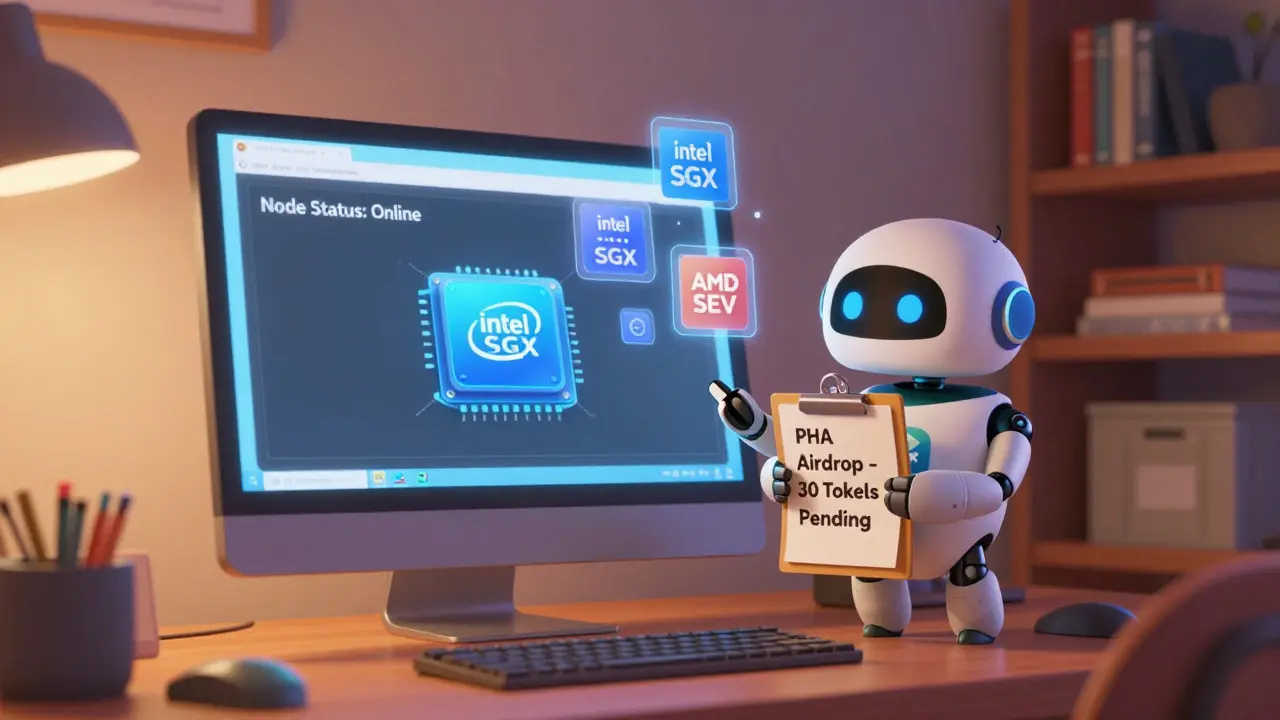
If you’ve heard about the PHA airdrop from Phala Network, you’re not alone. But unlike most crypto airdrops that ask you to follow a Twitter account or connect your wallet, this one demands something real: you need to run a mining node. And if you’re not sure whether it’s worth the effort, here’s what actually happens - no fluff, no hype, just the facts as of February 2026.
What Is the PHA Airdrop?
The PHA airdrop isn’t a giveaway. It’s a reward for helping build Phala Network’s privacy layer. Phala Network is a blockchain that lets smart contracts run in secret. While most blockchains expose every transaction, Phala uses Trusted Execution Environments (TEEs) - special hardware chips - to keep data private while still verifying it’s valid. This matters for things like private DeFi, confidential voting, or secure enterprise data sharing. To kickstart the network, Phala launched a token distribution where participants who run miner nodes get exactly 30 PHA tokens. At current prices ($0.1029 per PHA), that’s about $3.09. It’s not life-changing money, but it’s real value for actual work. And unlike airdrops that give away tokens to anyone who signs up, Phala filters for people who are technically capable and genuinely interested in the protocol.How to Qualify for the PHA Airdrop
You can’t just claim this. You have to earn it. Here’s the exact process:- Download the official Phala miner software from the Phala Network website (no third-party links).
- Ensure your hardware supports Trusted Computing. This means Intel SGX or AMD SEV - not all CPUs have it. Check your processor model on Intel’s or AMD’s site.
- Install the software and run the setup command in your terminal. The process takes about 30 minutes on a modern machine.
- Once the node is live, you’ll see confirmation in the terminal. Take a screenshot of the running node with the status showing “Online” or “Active.”
- Submit the screenshot via the official Phala Airdrop Portal.
- Wait. Rewards are locked until the pre-mainnet launch called “Darth Vader” goes live.
Why the Delay? The Darth Vader Launch
Here’s the catch: you won’t get your 30 PHA tokens right away. Phala hasn’t set a date for the “Darth Vader” pre-mainnet launch. It’s been delayed multiple times since 2020. The network is waiting to finalize its transition from Polkadot to Ethereum Layer 2 - a major shift that could redefine how Phala operates. The team says the airdrop rewards will be distributed only after “Darth Vader” goes live. That means even if you’ve been running your node since 2024, you’re still waiting. There’s no timeline. No countdown. Just updates on their official Discord and GitHub. This uncertainty frustrates many participants. Some have been running nodes for over two years. Others quit after realizing they’d be waiting indefinitely. If you’re in it for quick gains, this isn’t for you. But if you believe in privacy-preserving blockchains, this is a long-term bet.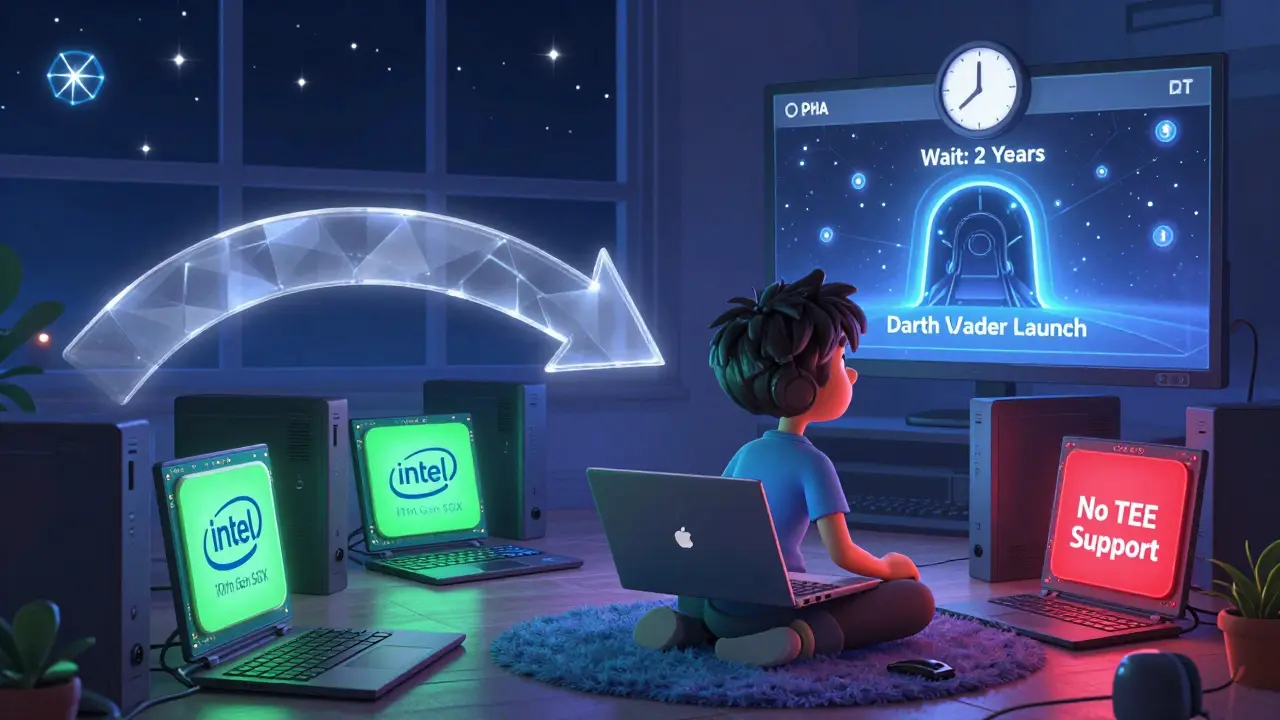
Hardware Requirements: Not Everyone Can Join
Most airdrops work on any laptop. Phala doesn’t. You need a CPU with Intel SGX or AMD SEV. Here’s what that means:- Intel CPUs: Must be 6th generation (Skylake) or newer. Most i5, i7, and i9 chips from 2015 onward support it. Check Intel’s official list.
- AMD CPUs: Only Ryzen 3000 series and newer with SEV support. Ryzen 5 3600 and up are fine. Older Ryzen or Athlon chips won’t work.
- Laptops: Many business laptops (Dell Latitude, Lenovo ThinkPad) have it. Consumer models often don’t. Check your device specs.
- Cloud servers: AWS, Azure, and Google Cloud don’t allow TEEs on their public VMs. You can’t fake this with a cloud instance.
Current Market Context: PHA in 2026
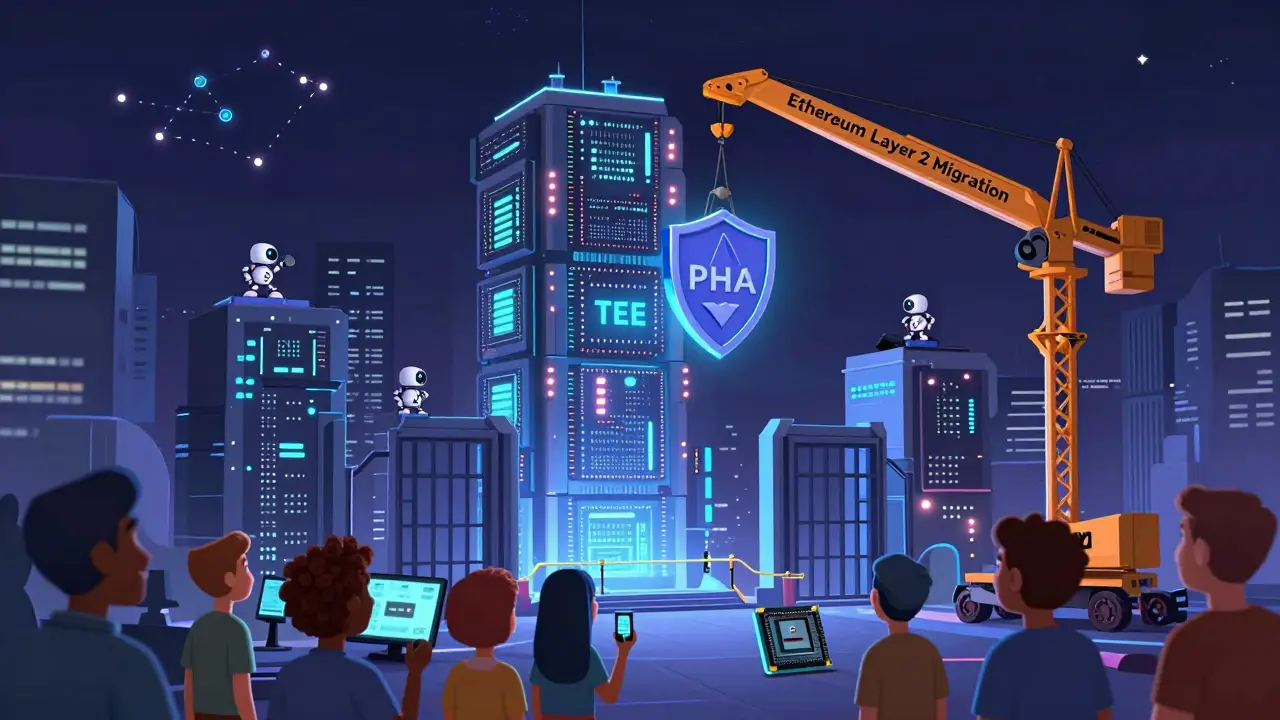
As of February 2026, PHA trades at $0.1029. Daily volume sits at over $16 million. It’s ranked #424 on CoinMarketCap. Not a top-tier coin, but it’s stable. Phala’s market cap is $76.98 million - small compared to privacy-focused rivals like Monero ($2.1B) or Oasis Network ($320M). But Phala isn’t trying to be a currency. It’s trying to be infrastructure. Its value comes from how many private smart contracts it runs, not how many people hold the token. The big question is the Ethereum Layer 2 migration. Phala launched its rollup in January 2025. By November 2025, its Polkadot parachain slot expires. After that, PHA will live entirely on Ethereum. That could mean:- More liquidity (Ethereum has deeper markets)
- Better developer tools (Ethereum’s ecosystem is larger)
- Higher adoption (more wallets, more dApps)
Who Should Try This Airdrop?
This isn’t for everyone. Ask yourself:- Do you have a compatible CPU? (Check before downloading)
- Are you okay waiting 6-18 months for rewards?
- Do you understand basic terminal commands?
- Do you believe in privacy as a core blockchain feature?
How It Compares to Other Privacy Airdrops
Here’s how Phala stacks up against similar projects:| Project | Token | Airdrop Reward | Hardware Required | Wait Time |
|---|---|---|---|---|
| Phala Network | PHA | 30 PHA ($3.09) | Intel SGX / AMD SEV | Indefinite (post-Darth Vader) |
| Oasis Network | ROSE | 100-500 ROSE ($5-$25) | None | 1-3 months |
| Akash Network | AKT | 20-100 AKT ($1-$5) | Cloud server | 1-2 months |
| The Graph | GRT | 50-200 GRT ($2-$8) | None | Immediate |
What Happens After the Airdrop?
If “Darth Vader” launches and your node is active, you’ll get your PHA. But that’s just the start. The real value comes from:- Running your node long-term - you’ll earn more PHA as a validator
- Staking your airdropped tokens - Phala offers staking rewards on its Layer 2
- Using privacy dApps built on Phala - if adoption grows, PHA’s utility grows
Final Thoughts
The PHA airdrop isn’t a lottery. It’s a test. Can you set up a node? Can you wait? Do you believe in privacy as a feature, not a marketing buzzword? If yes - go ahead. Install the software. Run the command. Submit your screenshot. Then wait. It’s not glamorous. It’s not fast. But in a world where most crypto projects are built on hype, this one asks you to build something real.Can I run the Phala miner on a virtual machine or cloud server?
No. Most cloud providers like AWS, Azure, and Google Cloud don’t allow Trusted Execution Environment (TEE) access on their public virtual machines. Phala’s security model requires physical hardware isolation. You must run the miner on a personal computer with Intel SGX or AMD SEV support.
What if my CPU doesn’t support Intel SGX or AMD SEV?
You cannot participate in the airdrop. There is no software workaround. Phala’s privacy guarantees rely on hardware-level isolation. If your CPU doesn’t support TEE, you’ll need to upgrade your hardware or skip this airdrop.
When will I receive my 30 PHA tokens?
You will receive your tokens only after the “Darth Vader” pre-mainnet launch. As of February 2026, there is no confirmed date. The team has tied reward distribution to this milestone, which is delayed pending the full transition to Ethereum Layer 2. Monitor official Phala Network channels for updates.
Is the PHA airdrop still active in 2026?
Yes. The airdrop portal remains open, and new participants can still install the miner software and submit their node verification. However, rewards are frozen until “Darth Vader” launches. No new participants are being prioritized over older ones - all are treated equally once the network activates.
Can I run multiple nodes to get more PHA?
No. Each participant is limited to one node. Running multiple nodes from the same IP or hardware wallet will result in disqualification. The system detects duplicate identities and removes them during verification.
What happens if Phala fails to launch “Darth Vader”?
If “Darth Vader” never launches, the airdrop rewards may never be distributed. This is a known risk. The team has not committed to a fallback plan. Participants should treat this as a speculative effort, not a guaranteed reward.
Will PHA still be valuable after the Ethereum migration?
Its value depends on adoption. If developers build privacy-preserving dApps on Phala’s Ethereum Layer 2, PHA will be needed to pay for confidential computation. If adoption stalls, it may remain a low-cap token. The migration increases its potential - but doesn’t guarantee success.



16 Comments
perry jody
Just ran the miner on my ThinkPad. Took like 40 mins but it’s live now. 🤞 Hope Darth Vader drops soon. This is the first airdrop that actually feels like I’m doing something real. Not just retweeting for free tokens.
Brendan Conway
bro i just wanna get free money why do i need a special cpu like its a secret club
Katie Haywood
Oh sweet, so I’m not the only one who’s been running this since 2023? 😅 My laptop’s fan sounds like a jet engine now but hey, at least my CPU is doing something useful instead of just heating my desk. Also, ‘Darth Vader’? Who named this? A 14-year-old with a Star Wars obsession?
Matt Smith
LMAO this is the most pretentious airdrop ever. You need a $1000 CPU to earn $3? And you’re calling this ‘infrastructure’? Bro, you’re basically paying for the privilege of running a glorified screensaver. If this is the future of crypto, I’m moving to Web2 where I can just scroll TikTok and get paid.
orville matibag
I’m from the Philippines and my old laptop doesn’t have SGX. But I found a local shop that sells refurbished Dell Latitude with it. Paid $80, installed the miner, and now it’s humming away. Not rich, but I feel like I’m part of something. 🌏
Reda Adaou
For anyone wondering if it’s worth it: if you’ve got the hardware, go for it. It’s not about the $3. It’s about being one of the few who actually helped build something private. Most people just want to cash out. You? You’re building the foundation.
Ajay Singh
I did it. Node up. Screenshot sent. Waiting. No drama. No hype. Just code running. That’s all you need. 30 PHA or not, I won’t regret this.
sabeer ibrahim
USA and India both have people running this? Meanwhile in my basement, I got 3 machines going. Intel and AMD. All active. And you know what? I’m not even gonna claim the PHA. I’m just here to prove that decentralized privacy works. Let the others fight over $3.
Taybah Jacobs
I appreciate the thorough breakdown. The documentation is clear, the requirements are transparent, and the long-term vision is compelling. While the immediate reward is modest, the structural contribution is substantial. I commend the Phala team for prioritizing integrity over viral engagement.
Mrs. Miller
So… Darth Vader? Really? 😒 I mean, I get the meme. But if you’re building serious privacy infrastructure, maybe don’t name your mainnet after a space fascist? Just saying. Also, my Ryzen 5 5600 is running fine. Took 22 minutes. No tears. No drama. Just Linux and silence.
Paul Gariepy
I’ve been running this since last July. I’ve updated the software 7 times. I’ve reinstalled because of kernel updates. I’ve had my router crash twice because of the miner’s network traffic. And yes, I still believe in it. This isn’t a get-rich-quick scheme. It’s a quiet revolution. And if you’re not part of it, you’re just watching from the sidelines.
Jim Laurie
Dude. I didn’t even know what SGX was 3 months ago. Now I’m reading Intel’s whitepapers like it’s a novel. My wife thinks I’ve gone full nerd. I told her: ‘Honey, I’m not mining crypto. I’m mining privacy.’ She laughed. But she’s the one who reminded me to check if my laptop had it. So… thanks, honey.
mahikshith reddy
This is why crypto is dead. You need a $1200 CPU to earn $3? And you’re calling this innovation? You’re not building a network. You’re building a cult of hardware elitism. Real privacy doesn’t require SGX. It requires code. Not silicon. You’re all just rich guys with gaming rigs pretending to be revolutionaries.
Jesse Pasichnyk
America’s got the best CPUs. That’s why we’re leading. If you don’t have SGX, go buy a new laptop. Stop complaining. This isn’t a free ride. It’s a test. And we passed. 🇺🇸
Alex Garnett
The fact that people still believe in this is hilarious. Airdrops with no timeline? A name like ‘Darth Vader’? And you’re all proud of running a node on a 2017 laptop? This isn’t Web3. This is Web1.0 with extra steps. Someone wake me up when this becomes useful.
Ryan Chandler
I remember the first time I saw my node go online. The terminal just said ‘Active’. No fireworks. No fanfare. Just a quiet green line. I sat there for 10 minutes staring at it. I didn’t cry. But I felt something. Like I was part of something that mattered. Not because of the money. But because for once, crypto asked me to build - not just buy.