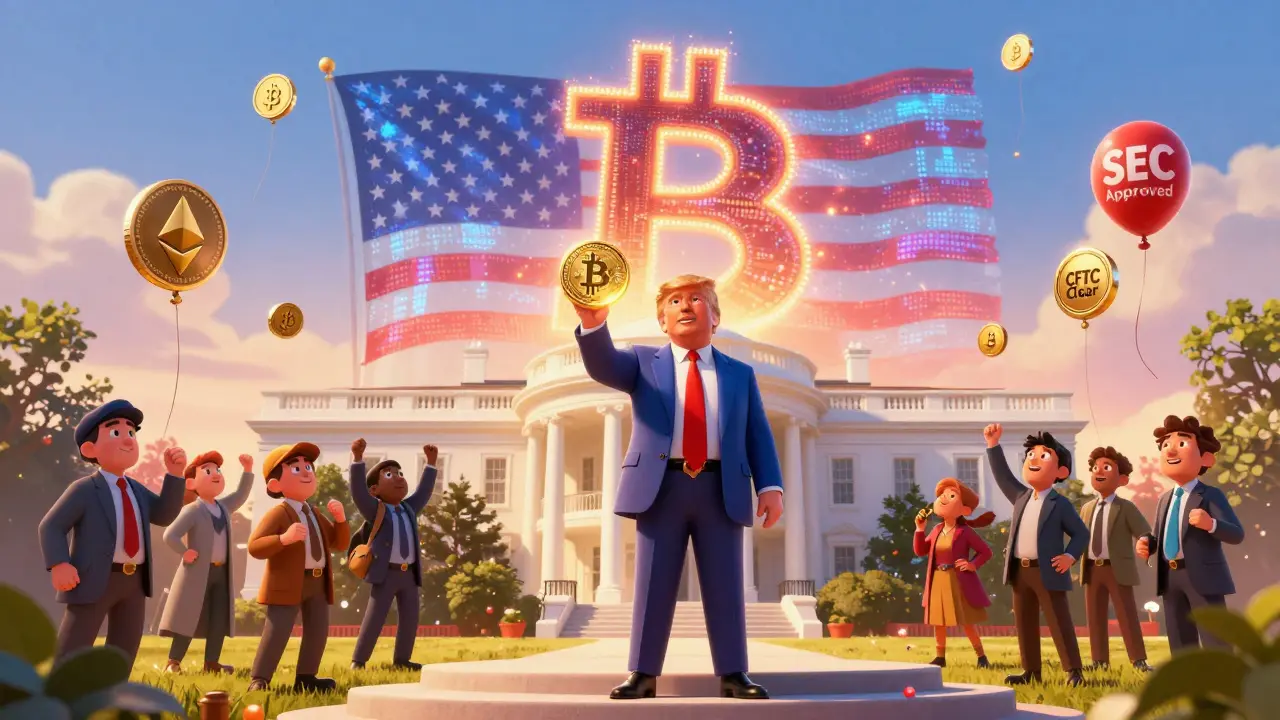
When Donald Trump returned to the White House in January 2025, he didn’t just promise change-he delivered it in record time. Within six months, the U.S. government flipped its entire approach to cryptocurrency. No more chasing down crypto companies. No more pushing for a digital dollar. Instead, the administration launched a full-throttle campaign to make America the world’s hub for digital assets. And it worked.
The January 23 Executive Order: A New Mandate
On January 23, 2025, President Trump signed Executive Order 14120: Strengthening American Leadership in Digital Financial Technology. It didn’t just tweak rules-it erased the old playbook. The Biden administration’s enforcement-heavy strategy, led by the SEC under Gary Gensler, was officially shelved. No more targeting DeFi platforms or suing token issuers for being “unregistered securities.” Instead, the order created the President’s Working Group on Digital Asset Markets, chaired by venture capitalist David Sacks. This group had 12 members, including the heads of the SEC, CFTC, Treasury, and Justice Department. Their mission? Build a clear, unified framework for crypto in just 180 days.
They delivered on schedule. By July 30, 2025, the group handed in a 160-page report that became the blueprint for everything that followed. It didn’t just recommend changes-it laid out exact timelines for every federal agency. The SEC had to finalize stablecoin rules by January 15, 2026. The CFTC had to clarify rules for crypto derivatives by March 30, 2026. No more delays. No more ambiguity.
The Strategic Bitcoin Reserve: A First in U.S. History
On March 6, 2025, the administration dropped its boldest move: the Strategic Bitcoin Reserve. This wasn’t a theoretical idea. It was real money. The U.S. Treasury would now hold Bitcoin-not bought with taxpayer dollars, but seized from criminals. Hackers, drug cartels, ransomware operators-anyone caught with BTC had their coins forfeited. Those coins were now the official reserve of the United States.
The rules were strict: No sales. No trading. No liquidation. The Bitcoin was locked in as a long-term strategic asset. As of March 31, 2025, the reserve held 214,000 BTC, worth $14.2 billion. By September 2025, the Treasury had added another 12,500 BTC through smarter seizure protocols, all without spending a single cent from the federal budget. The goal? To signal to the world that Bitcoin wasn’t just a speculative asset-it was a legitimate store of value, worthy of being held by the U.S. government.
Meanwhile, the U.S. Digital Asset Stockpile was created for all other seized crypto-Ethereum, Solana, stablecoins, you name it. Unlike Bitcoin, those assets could be sold if the Treasury Secretary decided it was in the national interest. But even that power came with limits: no new purchases allowed. The stockpile was meant to be a cleanup operation, not an investment fund.
The GENIUS Act: Law, Not Just Policy
By July 2025, the White House didn’t just want executive orders-it wanted laws. That’s when the GENIUS Act (Government Efficiency, National Innovation, and U.S. Sovereignty Act) became law. Trump called it “pure genius.” Critics called it rushed. But the numbers spoke louder.
The act did three big things:
- It gave clear legal status to Bitcoin and other major cryptocurrencies as property, not securities-unless they functioned like investment contracts.
- It required the SEC and CFTC to co-regulate stablecoins, splitting oversight based on whether they were backed by cash, commodities, or other assets.
- It created a 5-year tax holiday for U.S.-based crypto startups that created more than 50 new jobs, effectively turning Silicon Valley into a magnet for blockchain talent.
According to Nelson Mullins’ July 2025 analysis, the GENIUS Act was the most significant crypto legislation since Wyoming’s 2014 blockchain laws. It didn’t just reduce red tape-it removed entire categories of regulation that had scared off investors.

What Changed in the Market?
The numbers don’t lie. Between January and June 2025, the total value of crypto held in the U.S. jumped from $1.2 trillion to $2.7 trillion-a 125% surge. Institutional investors poured in. Hedge funds, pension funds, even family offices started allocating capital to crypto for the first time.
According to CoinGecko, U.S. crypto trading volume rose 214% in that same period. And 63% of that growth came from institutions. Why? Because the rules were finally clear. No more guessing if a token was a security. No more fear of sudden enforcement raids. Companies like Coinbase, Kraken, and Fidelity Digital Assets announced major expansions. Over 1,200 new crypto firms registered in the U.S. between February and October 2025.
Job postings in blockchain and crypto-related roles spiked 189% year-over-year. The average salary for a blockchain engineer in San Francisco jumped to $285,000. Startups raised $84 billion in the first half of 2025-triple the previous record.
Who Won? Who Lost?
Bitcoin lovers celebrated. The Strategic Bitcoin Reserve sent BTC’s price up 18% in 24 hours after the March 6 announcement. Reddit threads lit up with traders saying, “This is institutional adoption we’ve been waiting for.”
But not everyone cheered. Ethereum developers raised alarms. The GENIUS Act focused almost entirely on Bitcoin and stablecoins. Ethereum, Solana, and other smart contract platforms were left in a gray zone. Vlad Zamfir of the Ethereum Foundation warned that without explicit recognition, these ecosystems could be treated as unregulated securities-creating legal risk for developers.
Also, the 180-day timeline scared smaller firms. A BHFS legal survey found that 32% of crypto startups had to hire external compliance consultants just to understand the new rules. The speed of change, while impressive, was overwhelming for teams without deep legal resources.

The Global Impact
The U.S. wasn’t just changing its own rules-it was shifting the global balance of power. Before 2025, Singapore and Switzerland captured 37% of global crypto venture funding. Now, the U.S. is pulling ahead. By October 2025, U.S.-based crypto firms raised 41% of all global venture capital in the sector.
China’s crypto crackdown became even more isolated. The EU’s MiCA regulations looked cautious by comparison. Even Saudi Arabia and the UAE started revising their own policies, citing the U.S. model as a benchmark.
And then there’s the Bitcoin Reserve. No other country holds its national Bitcoin in a permanent, non-sellable vault. The move sent a signal: Bitcoin is now a sovereign asset. Countries with large reserves-like Poland, El Salvador, and even Japan-began exploring similar moves.
What Comes Next?
The administration isn’t stopping. The Treasury is already testing “seizure optimization protocols” to recover more crypto from darknet markets. The SEC is preparing its first stablecoin rulebook, due January 15, 2026. The CFTC will release its derivatives guidance by March 30, 2026.
But challenges remain. The Congressional Budget Office warned in September 2025 that if the Strategic Bitcoin Reserve grows beyond 500,000 BTC, it could distort the market-since that’s 2.4% of all Bitcoin ever mined. And while the prohibition on selling BTC is politically popular, it could become a problem if the government needs cash during a recession.
Still, the direction is clear. The U.S. isn’t just regulating crypto anymore-it’s betting on it. And for the first time in history, the world’s largest economy is treating Bitcoin not as a threat, but as a strategic tool.



18 Comments
Ryan Chandler
Bro. This isn’t policy. This is mythology. The Strategic Bitcoin Reserve? Locked forever? You think some future president won’t crack that vault when the debt hits $40 trillion? I’ve seen this movie before - gold reserves got seized in ’33. History doesn’t care about your executive orders.
And don’t get me started on ‘Bitcoin as property.’ That’s just legal semantics to avoid the SEC’s jurisdiction. They’re still gonna come for you if you’re mining in your basement and don’t file Form 8949.
But hey… if this is what it takes to get Coinbase stock to $1000, I’m all in. Just don’t cry when the Feds show up with a subpoena and a SWAT team.
Ajay Singh
USA finally woke up
China scared. EU confused.
Bitcoin is money now
Stop overthinking
Mendy H
How charming. A billionaire’s fantasy dressed as economic policy. The ‘Strategic Bitcoin Reserve’ is just a PR stunt to inflate asset prices while avoiding actual fiscal responsibility.
And let’s not pretend this isn’t a giveaway to venture capital insiders. David Sacks? The same guy who helped build Y Combinator’s crypto bubble? This isn’t innovation - it’s regulatory capture with a MAGA hat.
Also, ‘5-year tax holiday’? That’s not a stimulus. It’s a subsidy for overpaid engineers in SF who already make $300K. The real economy - the one with nurses and teachers - gets nothing. Again.
sabeer ibrahim
USA thinks they can own Bitcoin like they own the moon. LOL. Bitcoin is decentralized by design. You can’t ‘reserve’ it. You can only seize it from criminals. But then you hold it like a sacred relic? That’s not strategy. That’s idolatry.
Also GENIUS Act? More like GENIUS-101: How to confuse 90% of developers while making billionaires richer.
Ethereum devs are right. This is a Bitcoin-only love letter. And we all know who funded that campaign.
Deeksha Sharma
This is actually beautiful. For the first time, a government didn’t try to control crypto - it let it breathe. The Strategic Bitcoin Reserve? It’s not about money. It’s about symbolism. The U.S. is saying: ‘We believe in this.’ Not as a currency. Not as a tech. But as a new kind of national asset.
Think about it. Gold was the reserve for a century. Now? Bitcoin. It’s not about price. It’s about trust. And if this opens the door for billions of unbanked people to access real value - that’s the real win.
I don’t care if it’s rushed or messy. This is the first time the system didn’t try to kill innovation. That’s worth celebrating.
Freddie Palmer
Wait - so the SEC and CFTC are now co-regulating stablecoins? But only if they’re backed by cash, commodities, or other assets? What defines ‘other assets’? Are they talking about treasury bills? Corporate bonds? Dogecoin? And if a stablecoin is backed by a basket of crypto, does that make it a security? Or not? And what if it’s 60% USDC and 40% ETH? Does that trigger a different rule? And who decides?
Also, the 5-year tax holiday - does that apply to contractors? To remote workers? To devs in Ohio? Or just VC-backed startups in SF? And what counts as ‘50 new jobs’? Does a part-time dev count? What about a QA tester? This is so vague I’m starting to think the whole thing was written by an intern who got lost in ChatGPT.
Taybah Jacobs
While I appreciate the structural clarity introduced by the GENIUS Act and the executive directives, I must express concern regarding the potential moral hazard inherent in institutionalizing seized digital assets as sovereign holdings. The precedent set by the Strategic Bitcoin Reserve, while fiscally prudent in the short term, may inadvertently incentivize law enforcement agencies to prioritize crypto seizures over traditional asset forfeiture mechanisms - thereby distorting prosecutorial priorities.
Furthermore, the absence of a transparent audit trail for the reserve’s holdings raises legitimate governance concerns. I would respectfully urge the administration to publish quarterly attestation reports from an independent third-party auditor to preserve public trust.
Alisha Arora
So let me get this straight - you’re telling me the U.S. government is now holding $14 billion in Bitcoin… but won’t sell it? Even if the economy crashes? Even if they need cash to pay Social Security? You’re telling me they’re gonna let a bunch of digital coins sit there like a statue while people starve?
And then they give tax breaks to crypto startups? While schools are falling apart? This isn’t innovation. It’s delusion with a budget.
Also, who approved this? Was there a vote? Did anyone ask the American people? Or did Trump just sign it and say ‘trust me bro’?
Mrs. Miller
Oh wow. The U.S. government just turned Bitcoin into a national totem. Next thing you know, they’ll start holding NFTs of the Declaration of Independence as ‘cultural assets.’
And let’s be real - this whole ‘Strategic Bitcoin Reserve’ is just a way to inflate the price without spending a dime. They’re not buying. They’re hoarding. And they’re hoping the world thinks this is wisdom when it’s just gambling with other people’s confiscated coins.
Also - ‘Bitcoin is property’? Cool. So if I mine 1 BTC and don’t report it, is that theft? Or just… property? Because now the government owns it… but only if they seize it? I’m dizzy.
Reda Adaou
Look. I’m not a crypto bro. I don’t even own any. But I work with startups. And I’ve seen what happens when regulators scream ‘SECURITY!’ for five years - talent leaves. Funding dries up. Innovation dies.
This? This is the opposite. Clear rules. No more guesswork. Companies are hiring. Engineers are moving back from Europe. That’s real. That’s not hype.
Yeah, it’s messy. Yeah, Ethereum got left out. But sometimes progress isn’t pretty. Sometimes you have to pick one thing to win first - and Bitcoin was the obvious door to kick open.
Let’s not ruin this by overthinking it.
Jim Laurie
Y’all ain’t gettin’ it. This ain’t about crypto. This is about power. The U.S. government just said: ‘We don’t need the Fed to be the middleman anymore.’ Bitcoin? It’s the new gold - but digital. And they’re not just holding it - they’re *performing* it. Like a ritual. The reserve? It’s a signal. To China. To the EU. To every central bank that’s been scared to move.
And yeah - it’s wild. The SEC? CFTC? All on the same page? For once? That’s like seeing cats and dogs cuddle.
Also - 285K for a blockchain dev? Bro. I’m quitting my job. I’m moving to Austin. I’m buying a Tesla. And I’m buying 0.5 BTC. With cash. From a guy in a hoodie. And I ain’t gonna report it. 😎
Udit Pandey
India is not America. We have 1.4 billion people. We have poverty. We have corruption. We have no luxury to gamble on Bitcoin reserves. This is a rich man’s game.
While the U.S. hoards BTC, Indian farmers are still waiting for digital rupee rollout. Meanwhile, your ‘GENIUS Act’ is just another tax break for Silicon Valley billionaires.
Do you think the world cares about your crypto fantasy? We care about food. Water. Electricity. Not your digital gold.
Sharon Lois
MARKET MANIPULATION. FULL STOP.
This isn’t policy. It’s a pump. The ‘seized BTC’? Probably from darknet markets that were already under surveillance. The ‘reserve’? A front for the Fed to quietly buy BTC without buying BTC.
And the ‘tax holiday’? That’s just the CIA funneling money to crypto firms that feed intel back to the DoD.
Wake up. This is all a psyop. The real goal? To make Bitcoin a tool for global financial control. And you’re all cheering like it’s freedom.
It’s not. It’s the next surveillance state. And you’re the data.
mahikshith reddy
Bitcoin is the people’s money. The government just admitted it. No more lies.
Ethereum? Weak. Smart contracts? Overrated.
USA = WINNER.
China? Scared.
EU? Still writing PDFs.
India? Still waiting for their turn.
But we know who’s winning. BTC 100K by 2026. I’m not even asking. I’m telling.
Brendan Conway
Look. I don’t know if this is genius or dumb. But I do know this - last year I had to pay $12K in taxes on crypto gains I never cashed out. Now? I’m just sitting on it. No stress.
And I saw a guy in a coffee shop yesterday who said he got hired by a crypto firm because he had a GitHub repo with 3 smart contracts. He was 19. No degree. Just built something.
That’s the real win. Not the reserve. Not the law. It’s that kid. He didn’t need permission. He just did it.
And now? The system finally let him.
Katie Haywood
Okay, I’ll be the weirdo who says: this is kinda hot.
Not because I’m bullish on BTC. But because the U.S. finally stopped treating crypto like a crime scene. For once, the rules were made *with* the industry, not *against* it.
And the fact that they didn’t sell the seized coins? That’s wild. It’s like saying: ‘We don’t need to cash in. We believe in this enough to hold it.’
Even if it’s dumb - it’s brave. And sometimes, that’s all you need.
Matt Smith
LOL at the ‘Strategic Bitcoin Reserve.’
So you’re telling me the U.S. government is now holding 226,500 BTC… and won’t sell it… even if the dollar collapses?
Meanwhile, the Fed is printing money like it’s confetti.
Y’all are literally playing Jenga with the global financial system and calling it ‘innovation.’
Also - 125% market surge? That’s not adoption. That’s a bubble with a presidential seal.
📈📉🤪
Ryan Chandler
Yeah, but imagine if the next president flips it and sells 100K BTC to fund border walls. Then the whole ‘strategic reserve’ thing becomes a meme. And we’re back to square one.
Politics > blockchain.
Always.