
Have you ever scrolled through your social media feed and seen a ticker symbol that looks like it was typed by a sleep-deprived intern? You know the ones-names that mash up two famous things together, hoping for a viral reaction. ElonDoge (EDOGE) is exactly that kind of token. It’s a cryptocurrency built on the Binance Smart Chain (BSC) that combines the name of tech billionaire Elon Musk with the internet’s favorite dog, Shiba Inu. On paper, it sounds like a recipe for massive hype. In reality, it is a cautionary tale about the darker side of meme coins.
If you are wondering what ElonDoge actually is, why its price fluctuates so wildly, or whether it’s worth your attention in 2026, you’ve come to the right place. We’re going to strip away the marketing fluff and look at the hard data. This isn’t just about buying low and selling high; it’s about understanding the mechanics of a micro-cap token that operates in the shadows of giants like Dogecoin and Shiba Inu.
The Basics: What Is ElonDoge (EDOGE)?
At its core, ElonDoge is a decentralized meme cryptocurrency token built on the Binance Smart Chain (BSC). Unlike Bitcoin, which aims to be digital gold, or Ethereum, which powers smart contracts, ElonDoge exists primarily as a community-driven experiment. It relies on "meme tokenomics"-a term used to describe projects that derive value from internet culture, humor, and speculation rather than underlying utility or technology breakthroughs.
The token launched around late 2021, riding the wave of the first major meme coin boom. It hit an all-time high of roughly $0.00000004 in November 2021. Since then, it has struggled to maintain relevance. Today, it sits as a micro-cap asset, meaning its total market value is incredibly small compared to established cryptocurrencies. The project positions itself as a platform for community participation, but in practice, most users interact with it simply as a speculative trading vehicle.
Here is the key distinction you need to make before investing any money: ElonDoge does not have a unique technological advantage. It doesn’t offer faster transactions than other BSC tokens, nor does it provide staking rewards or governance rights that add tangible value. Its value is derived entirely from how many people believe it will go up tomorrow. That makes it extremely volatile and risky.
Tokenomics and Supply: The Quadrillion Problem
One of the most confusing aspects of meme coins is their supply structure. Let’s look at the numbers for ElonDoge:
- Total Supply: 1,000,000,000,000,000 (1 Quadrillion) tokens.
- Circulating Supply: Approximately 548 trillion tokens.
Why such a huge number? Meme coins often use quadrillions of tokens to create the illusion of affordability. When you see a price like $0.000000003, it feels cheap. You might think, "If this goes up to $0.01, I’ll be rich!" But here is the math problem: For ElonDoge to reach $0.01, its market capitalization would need to exceed $10 trillion. To put that in perspective, that is more than the entire global economy of some large countries and far higher than Bitcoin’s peak market cap.
This massive supply also dilutes ownership. Even if you own millions of EDOGE tokens, your percentage share of the total pie is microscopic. This is a common tactic in meme coin design to attract retail investors who focus on unit bias-the psychological preference for owning a larger number of units rather than considering the actual value.
Price Performance and Volatility in 2026
Let’s talk about the money. Or rather, the lack of it. As of mid-2026, ElonDoge is trading significantly below its peak. Here is where things get tricky: different platforms show different prices. This is a red flag for liquidity issues.
| Metric | Value | Context |
|---|---|---|
| Current Price Range | $0.00000000243 - $0.00000000386 | Varies by exchange due to low volume |
| Market Cap | ~$1.3 Million | Micro-cap status; highly susceptible to manipulation |
| 24-Hour Volume | $0 - $1.20 | Extremely low liquidity; difficult to enter/exit large positions |
| All-Time High | $0.00000004 | Reached in Nov 2021; currently down ~93% |
| Ranking | #6643+ | Low visibility among thousands of crypto assets |
The disparity in pricing between platforms like CoinMarketCap, CoinLore, and Coinbase highlights a critical issue: fragmentation. Because there is so little trading activity (sometimes less than $2 in a day), a single buy or sell order can drastically swing the price. This means the price you see might not be the price you get when you try to trade.
Technical indicators paint a mixed picture. The Relative Strength Index (RSI) often hovers in neutral territory, suggesting no strong momentum in either direction. Some algorithmic predictors suggest short-term gains based on pattern recognition, but these are statistical guesses, not fundamental truths. In a market with $1 daily volume, technical analysis is nearly useless because there isn’t enough data to form reliable trends.

How to Buy and Hold ElonDoge (EDOGE)
If you still decide to take the plunge, you need to know how the plumbing works. ElonDoge is a BEP-20 token, which means it lives on the Binance Smart Chain. You cannot hold it in a standard Bitcoin wallet. Here is the step-by-step process:
- Get a Compatible Wallet: Download MetaMask, Trust Wallet, or another BSC-compatible wallet. Make sure you understand how to manage private keys securely.
- Acquire BNB: You need Binance Coin (BNB) to pay for transaction fees on the BSC network. Buy BNB on a major exchange like Binance or Coinbase.
- Transfer BNB to Your Wallet: Send the BNB from the exchange to your personal wallet address. Double-check the network-it must be BSC (BEP-20).
- Use a Decentralized Exchange (DEX): Connect your wallet to PancakeSwap, the primary DEX for BSC tokens. Search for the EDOGE contract address. Warning: Always verify the contract address from official sources to avoid fake tokens.
- Swap for EDOGE: Swap your BNB for EDOGE. Set your slippage tolerance appropriately (often 5-10% for low-liquidity tokens) to ensure the trade executes despite price volatility.
Notice that centralized exchanges like Coinbase may list the token but often have poor liquidity or high fees for such micro-caps. Most trading happens on decentralized platforms, which adds complexity and risk for beginners.
Risks and Red Flags: Why Caution Is Essential
We need to be brutally honest here. Investing in ElonDoge carries significant risks that go beyond normal market fluctuations. Here are the specific dangers you face:
- Liquidity Trap: With daily volumes sometimes under $2, you might buy EDOGE easily but find yourself unable to sell it later without crashing the price. If you try to sell a large amount, the lack of buyers means you could lose most of your investment instantly.
- No Utility: Unlike Ethereum or Solana, EDOGE doesn’t power apps, games, or financial services. Its value is purely speculative. If the community loses interest, the price goes to zero.
- Concentration Risk: In micro-cap meme coins, a small group of holders (whales) often control a large percentage of the supply. They can dump their holdings at any time, causing a flash crash.
- Regulatory Uncertainty: As governments worldwide tighten regulations on cryptocurrencies, meme coins with no clear utility are often the first targets for scrutiny or bans.
- Scam Potential: The name "ElonDoge" plays on celebrity association. There is no evidence Elon Musk endorses this token. Relying on celebrity names is a common tactic in rug pulls and pump-and-dump schemes.
The Fear & Greed Index often reflects broader market sentiment, but for individual tokens like EDOGE, sentiment is fragile. A single negative tweet or a developer abandoning the project can wipe out years of potential growth overnight.
ElonDoge vs. Major Meme Coins
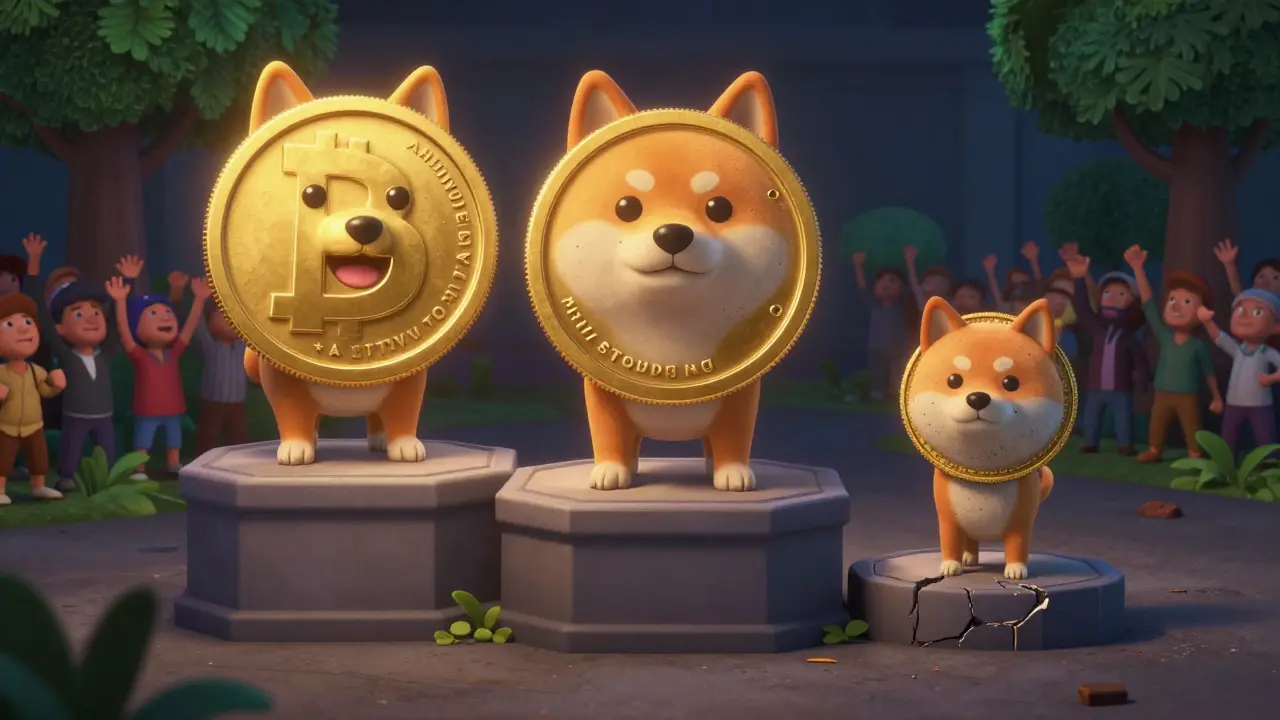
To understand where ElonDoge stands, we need to compare it to the heavyweights. Here is how it stacks up against Dogecoin (DOGE) and Shiba Inu (SHIB):
| Feature | Dogecoin (DOGE) | Shiba Inu (SHIB) | ElonDoge (EDOGE) |
|---|---|---|---|
| Blockchain | Dogecoin (PoW) | Ethereum (ERC-20) | Binance Smart Chain (BEP-20) |
| Market Cap | Billions | Billions | Millions (~$1.3M) |
| Liquidity | High (Easy to trade) | High (Easy to trade) | Very Low (Hard to trade) |
| Utility/Ecosystem | Payments, Brand Recognition | Shibarium L2, NFTs, Charity | None identified |
| Risk Level | Medium | Medium-High | Extreme |
Dogecoin and Shiba Inu have survived multiple bear markets because they built communities, brands, and ecosystems. ElonDoge lacks these foundations. It is a copycat token that entered the market late and failed to capture significant attention. While DOGE and SHIB have institutional interest and payment integrations, EDOGE remains a niche curiosity with minimal adoption.
Future Outlook: Is There Hope?
Can ElonDoge bounce back? Technically, yes. Meme coins are known for unpredictable rallies. If a viral trend emerges, or if a major influencer mentions it, the price could spike 100% or more in hours. However, this is gambling, not investing.
For sustained growth, ElonDoge needs catalysts that it currently lacks:
- Development Activity: Regular updates, new features, or partnerships.
- Community Growth: Active social media channels with genuine engagement, not bots.
- Exchange Listings: Getting listed on larger centralized exchanges to improve liquidity.
As of 2026, none of these are visible. The project appears dormant. Without active development or marketing, the likelihood of significant appreciation is low. Most similar tokens from the 2021 cycle have faded into obscurity, serving as reminders of the speculative frenzy that once was.
If you are looking for exposure to the meme coin sector, consider sticking to the top-tier projects with proven resilience. ElonDoge serves better as a case study in risk management than as a viable investment opportunity. Remember, in crypto, preserving your capital is often more important than chasing moonshots.
Is ElonDoge (EDOGE) a scam?
There is no definitive proof that ElonDoge is a fraudulent scam in the legal sense, as it is a publicly traded token on the Binance Smart Chain. However, it exhibits many characteristics of high-risk speculative assets, including lack of utility, extreme illiquidity, and reliance on celebrity name association without endorsement. These factors make it vulnerable to manipulation and sudden value loss, which effectively functions similarly to a scam for uninformed investors.
Where can I buy ElonDoge (EDOGE)?
You can buy ElonDoge on decentralized exchanges (DEXs) like PancakeSwap using the Binance Smart Chain. You will need a compatible wallet (like MetaMask) and BNB for transaction fees. Some centralized exchanges like Coinbase may list it, but liquidity is often very poor, leading to wide price discrepancies and high slippage.
What is the minimum investment for ElonDoge?
Due to the extremely low price per token (fractions of a cent), you can technically invest very small amounts. However, you must account for gas fees on the BSC network and slippage fees on DEXs. Practically, investing less than $50-$100 may result in fees consuming a large portion of your capital, making it inefficient.
Does Elon Musk endorse ElonDoge?
No. There is no public record or statement from Elon Musk endorsing the ElonDoge (EDOGE) token. The project uses his name for marketing purposes, which is a common tactic in meme coins but does not imply affiliation or support.
Why is the price of EDOGE different on different websites?
The price discrepancies are caused by extremely low liquidity and fragmented trading volume. With daily trades sometimes totaling only a few dollars, each platform’s order book is isolated. A buy order on one exchange doesn’t immediately affect the price on another, leading to significant variations in reported values.


Write a comment