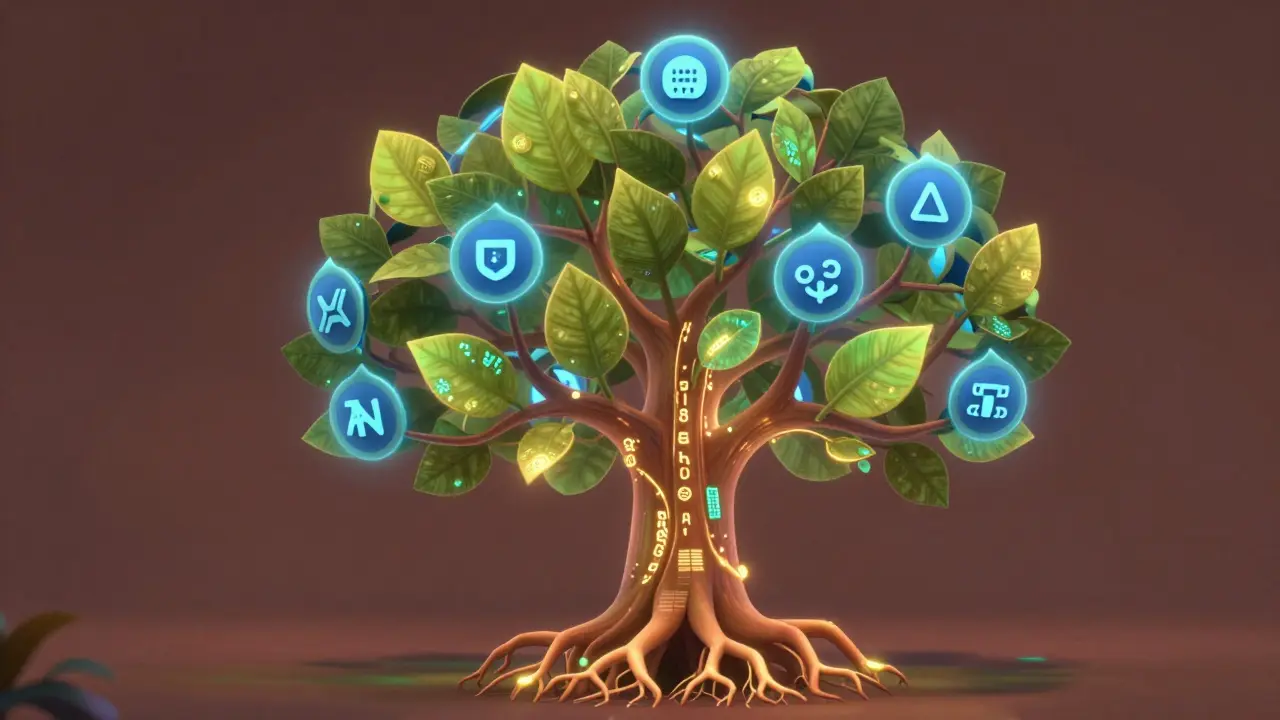
When you hear "crypto coin," you probably think of Bitcoin or Ethereum. But there’s a quieter, more efficient player in the space that’s gaining traction: Xahau (XAH). It’s not just another altcoin. Xahau is a smart contract sidechain built directly on the same code as the XRP Ledger (XRPL), designed to make blockchain development faster, cheaper, and greener. If you’ve ever wondered how blockchains can handle smart contracts without using massive amounts of energy, Xahau offers a real answer.
What Makes Xahau Different?
Most blockchains that support smart contracts - like Ethereum - rely on proof-of-work or proof-of-stake systems that require thousands of computers running nonstop. That uses a lot of electricity. Xahau doesn’t do that. It’s built on the same federated consensus system as the XRP Ledger. That means instead of miners or stakers, a group of trusted validator servers (run by independent organizations) agree on transactions. No mining. No energy waste. Transactions settle in about 4 seconds, and each one costs less than a penny in fees. The big twist? Xahau added smart contracts - but not the way you’d expect.Hooks: Smart Contracts That Don’t Need a New Language
If you’ve tried coding on Ethereum, you know Solidity. It’s powerful, but it’s a whole new language to learn. Xahau’s solution? Hooks. Hooks are tiny programs attached directly to user accounts. Think of them like automated rules: "If someone sends me XAH, automatically send 5% to this wallet." Or: "Only allow transfers after 3 confirmations from my phone." Unlike Ethereum’s contract addresses, Hooks live on accounts. That means you don’t need to deploy a separate contract. You just write the rule, attach it to your account, and it starts working. Developers can write Hooks in C right now, with JavaScript support coming soon. That’s huge. Millions of developers already know JavaScript. No need to learn a niche language. This makes Xahau one of the few blockchains trying to lower the barrier to entry for everyday developers - not just crypto experts.How Does XAH Work as a Token?
XAH is the native token of the Xahau network. It’s not meant to replace XRP. XRP still powers the XRP Ledger. XAH powers Xahau. Here’s how it’s used:- Transaction fees: Every action on the network costs a tiny amount of XAH. Normal transfers? Less than 0.0001 XAH. Interacting with a Hook? A bit more.
- Account reserve: To open an account or store data on the ledger, you need to lock up a small amount of XAH. This stops spam - you can’t flood the network with fake accounts.
- Monthly rewards: Here’s the unusual part: every account gets a 4% monthly boost in XAH balance just by being active. It’s not mining. It’s not staking. It’s built into the protocol. If you hold 1,000 XAH, you’ll get 40 more each month. This isn’t inflation meant to devalue - it’s designed to encourage participation.
The Built-In Decentralized Exchange
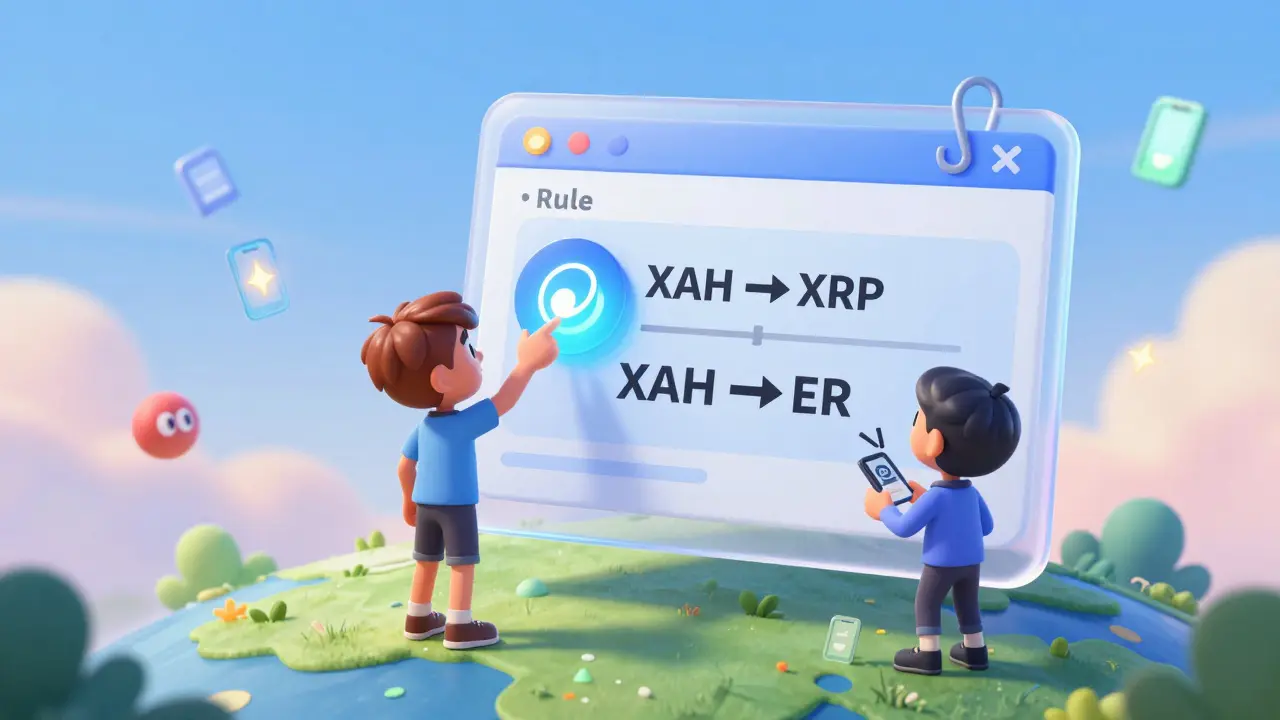
Xahau didn’t just add smart contracts - it kept the XRP Ledger’s most powerful feature: a native decentralized exchange (DEX). You don’t need a third-party app like Uniswap. The DEX is part of the ledger itself. Here’s how it works:- You create a buy or sell order for any asset - XAH, USD, even custom tokens.
- The system automatically matches your order with others on the ledger.
- If you want to trade from XAH to EUR, the system finds the best path: XAH → XRP → EUR, for example.
- Trade happens instantly. No deposit. No withdrawal. No middleman.
NFTs Done Differently
Most blockchains use standards like ERC-721 or XLS-20 for NFTs. Xahau uses something called URITokens. Instead of grouping NFTs into "pages" on the ledger, each one is its own unique object with its own permanent address. That means:- Ownership changes don’t break the token’s identity.
- Metadata stays linked even if the NFT moves.
- It’s easier to verify authenticity.
Is Xahau Green?
Yes. And it’s not marketing. The XRP Ledger and Xahau use a consensus system that requires far less energy than Bitcoin or Ethereum. One transaction on Xahau uses about as much power as charging your phone for 10 seconds. That’s why environmental groups and institutions are starting to pay attention.
Who’s Using Xahau?
Right now, Xahau is still young. But early adopters include:- Developers building DeFi tools without high gas fees.
- Token issuers who want to create stablecoins or loyalty points with built-in rules.
- Organizations needing fast, low-cost cross-border payments with programmable conditions.
Price and Performance (as of March 21, 2026)
As of today:- Price: $0.023666 USD
- 24-hour trading volume: ~$9.5 million
- Weekly change: +16.17%
- Yearly change: -69.61%
What’s Next for Xahau?
The team is working on:- Support for Python and Rust for Hooks.
- Improved tooling for developers - IDE plugins, templates, testing frameworks.
- Integration with traditional financial systems for tokenized assets.
Xahau isn’t trying to be the biggest blockchain. It’s trying to be the smartest. For developers who want to build without the noise, for users who want fast, cheap, green transactions, and for traders who want real decentralization - Xahau offers something different. It’s not flashy. But it just might work.
Is XAH the same as XRP?
No. XRP is the native token of the XRP Ledger, used mainly for fast cross-border payments and liquidity. XAH is the native token of the Xahau sidechain, used to pay for smart contract interactions, account reserves, and as a reward mechanism. They run on separate networks with different purposes.
Can I use XAH to buy things online?
Right now, very few merchants accept XAH directly. Its main use is within the Xahau ecosystem - paying fees, interacting with smart contracts, and trading on its built-in decentralized exchange. It’s not yet a payment coin like Bitcoin or Litecoin. Its value lies in its functionality as a utility token for developers and users of the network.
How do I get XAH tokens?
You can buy XAH on decentralized exchanges that support the Xahau network, such as XRPL-based DEXs or compatible wallets like Xahau Bridge or Trust Wallet. You’ll need a wallet that supports the Xahau ledger, and you’ll need to transfer XAH from an exchange to your wallet address. You can also earn XAH passively by holding it - accounts receive a 4% monthly increase just by being active.
Is Xahau safe?
Yes, as far as blockchain security goes. Xahau uses the same federated consensus system as the XRP Ledger, which has been running since 2012 with no major breaches. The code is open-source and has been audited. However, like any new blockchain, smart contract bugs or user errors can lead to losses. Always test with small amounts first and never share your private keys.
Why does XAH have a 4% monthly reward?
The 4% monthly reward is designed to encourage participation and network growth. It’s not a yield farming scheme - it’s built into the protocol to give users a reason to hold and use XAH without needing to stake or lock funds. The reward comes from the protocol’s inflation mechanism, not from new mining. It’s meant to be fair and automatic: every account gets it, regardless of size.
Can I build a dApp on Xahau?
Yes. Xahau is built for developers. You can write Hooks in C today, and JavaScript support is coming soon. There are already tools and documentation to help you deploy account-based smart contracts, create tokens, and interact with the built-in DEX. You don’t need to learn Solidity. If you know JavaScript or C, you can start building.



22 Comments
YANG YUE
Xahau is wild because it’s not trying to be Ethereum 2.0. It’s like someone took the clean, quiet efficiency of the XRP Ledger and said, 'Let’s make smart contracts actually usable.' No bloated gas fees. No 12-hour confirmations. Just... work. And that 4% monthly boost? Genius. It’s not gambling. It’s incentivizing presence. People forget that blockchains need users, not just speculators.
Misty Williams
This is just another crypto scam wrapped in greenwashing. 4% monthly? That’s a pyramid scheme with a whitepaper. And 'federated consensus'? Sounds like a cartel of corporations deciding who gets to transact. Wake up, people. This isn’t innovation. It’s centralization with a fancy name.
Mansoor ahamed
Hook system is brilliant. No Solidity needed. If you know C or JS, you're already 80% there. Xahau is for builders, not degens.
Jeannie LaCroix
I JUST BOUGHT MY FIRST XAH AND I’M SO EXCITED!!! THIS IS THE FUTURE!!! 🚀🔥 The DEX is seamless, the fees are NOTHING, and the 4% reward? I’m literally watching my balance grow while I sleep. This isn’t crypto - this is magic.
Brad Zenner
The real win here is the native DEX. No need for liquidity pools or impermanent loss. Just direct order matching on-chain. It’s elegant. I’ve used Uniswap. This is cleaner.
Tony Phillips
If you’re a dev who hates learning new languages just to deploy a contract - Xahau’s Hooks are your new best friend. I built a simple auto-transfer rule in 20 minutes. No tutorials. No forums. Just worked. That’s rare.
Abhishek Thakur
XAH tokenomics are fundamentally sound. Reserve requirement prevents sybil attacks. Monthly reward incentivizes retention. Cap at 100B ensures scarcity. This is not a meme coin. It's infrastructure.
Jackie Crusenberry
I read the whole thing. Still don’t get why anyone would use this over Ethereum. It’s just… quiet. And quiet doesn’t make you rich.
Anna Lee
I tried setting up a Hook last night and it was so easy I cried. I’m not a dev. I’m a teacher. But I made a rule that sends 10% of every incoming XAH to my niece’s wallet. She’s 8. She thinks it’s a video game. I think it’s beautiful.
Shana Brown
The URITokens thing? Game changer. NFTs finally make sense. No more broken links. No more 'this NFT disappeared' drama. Each one has its own permanent ID. That’s how it should’ve always been. 🙌
Marie Mapilar
I’ve been watching Xahau for months. The governance game is the most interesting part. No VC-controlled treasury. No dev fund locked for 5 years. Just people voting on upgrades. Feels… human. Like a neighborhood meeting but on blockchain.
Shelley Dunbrook
One must acknowledge the irony: a blockchain built on a consensus mechanism that avoids proof-of-work, now being marketed as 'green' by those who previously dismissed XRPL as 'not decentralized enough.' The narrative shifts faster than the ledger state.
Aman Kulshreshtha
In India, we’re seeing small remittance startups testing Xahau. No need for SWIFT. No intermediaries. Just send money across borders with a Hook that auto-converts to INR on receipt. It’s not hype. It’s solving real problems.
Leona Fowler
If you’re new to this, start with the Xahau Bridge. It’s simple. Don’t try to dive into Hooks yet. Get a wallet, send 1 XAH, see the 4% reward hit next month. Then ask questions. Baby steps.
Anand Makawana
The integration potential with traditional financial systems is immense. Imagine a corporate payroll system that auto-distributes XAH to employees, with Hooks enforcing tax withholdings and savings allocations - all on-chain, auditable, immutable. This isn’t speculative. It’s systemic.
Mohammed Tahseen Shaikh
Ethereum devs are still stuck in 2017. Xahau doesn’t need you to learn Solidity. It doesn’t need you to buy $10k in ETH to pay gas. It doesn’t need you to be a crypto bro. It needs you to be a human with a wallet. That’s revolutionary.
Sarah Terry
I’ve been in crypto since 2015. This is the first time I’ve seen a chain that doesn’t feel like a casino. The 4% reward isn’t a yield farm. It’s a dividend for participation. That’s different. And I like it.
Shayne Cokerdem
All this 'green blockchain' nonsense is just woke capitalism. Bitcoin miners use energy. So what? The grid’s still powered by coal. Stop pretending this is moral. It’s just cheaper.
John Alde
Let me break this down. The XRP Ledger’s federated consensus has been running for over a decade. Xahau inherits that. That means it’s not just 'theoretically' secure - it’s proven. The Hooks system? It’s like having macros in Excel, but for money. You don’t need a smart contract address. You just attach logic to your account. That’s like building a house without needing a separate blueprint room. It’s intuitive. And that’s why it’ll win. Not because it’s flashy. Because it’s frictionless. Most blockchains add complexity. Xahau removes it. That’s why developers are quietly moving over. No hype. No airdrops. Just better tooling. And the DEX? Built-in. No need to trust a third-party app. No front-end hacks. No rug pulls. Just ledger-native order books. It’s the most elegant financial infrastructure I’ve seen since Bitcoin. And yeah, the 4% monthly? It’s not inflation. It’s a nudge. A tiny nudge to keep you engaged. Not to get rich. To stay part of the network. That’s the quiet genius.
manoj kumar
This is just another altcoin with a gimmick. 4% monthly? That’s unsustainable. Anyone who buys this is going to get burned when the rewards stop. And Hooks? You think C and JS are easy? Try debugging a Hook that auto-transfers when it shouldn’t. You’ll be begging for Solidity.
Jenni Moss
I just sent my first XAH to a friend in Mexico. No fees. Instant. And I didn’t even need to think about gas. It felt like texting. That’s the future. Not crypto bros yelling 'TO THE MOON.' Just… smooth. Beautiful.
vu phung
The real edge is the account-based smart contracts. No contract address means no risk of deploying to a wrong address. No front-running. No reentrancy attacks. It’s not just efficient - it’s inherently safer. This isn’t a sidechain. It’s a redesign.