
You’ve probably heard the hype. Artificial intelligence and blockchain are two of the most powerful technologies of the 21st century. It makes sense to think that combining them would create something unstoppable-smart contracts that learn, decentralized AI models, or unbreakable data verification. But if you’ve tried to build anything at this intersection, you know the reality is messy. The marriage of AI-blockchain integration isn’t just a technical puzzle; it’s a fundamental clash of philosophies.
AI needs speed, massive data, and constant updates. Blockchain demands consensus, immutability, and transparency. When you force these two together without addressing their core incompatibilities, things break. Or they become prohibitively expensive. In this article, we’ll look past the buzzwords and examine the real-world hurdles developers face when trying to merge these systems.
The Scalability Wall: Speed vs. Consensus
The biggest immediate problem is throughput. AI models, especially those used for real-time analytics or image recognition, need to process thousands of data points per second. Blockchain networks simply cannot keep up. Take Bitcoin, for example. It processes about 7 transactions per second (TPS). Ethereum handles roughly 15 to 30 TPS, depending on network congestion. These numbers sound fine for sending money, but they are useless for high-frequency AI tasks.
Imagine an autonomous vehicle using AI to make split-second decisions. If every decision had to be recorded on a blockchain via a smart contract, the car would crash before the transaction confirmed. This latency creates a bottleneck that stops many practical applications dead in their tracks. The computational demand of training large language models or deep learning networks requires immense power. Running these calculations directly "on-chain" is currently impossible because every node in the network would have to verify every step of the calculation. That energy cost and time delay would grind the system to a halt.
Developers often try to solve this by moving computation off-chain. They use the blockchain only for final verification or result storage. While this helps, it introduces new risks. If the heavy lifting happens off-chain, how do you trust the result? You’re relying on centralized servers again, which defeats the purpose of decentralization. This tension between performance and trust is the first major hurdle.
Data Storage Costs and the Big Data Problem
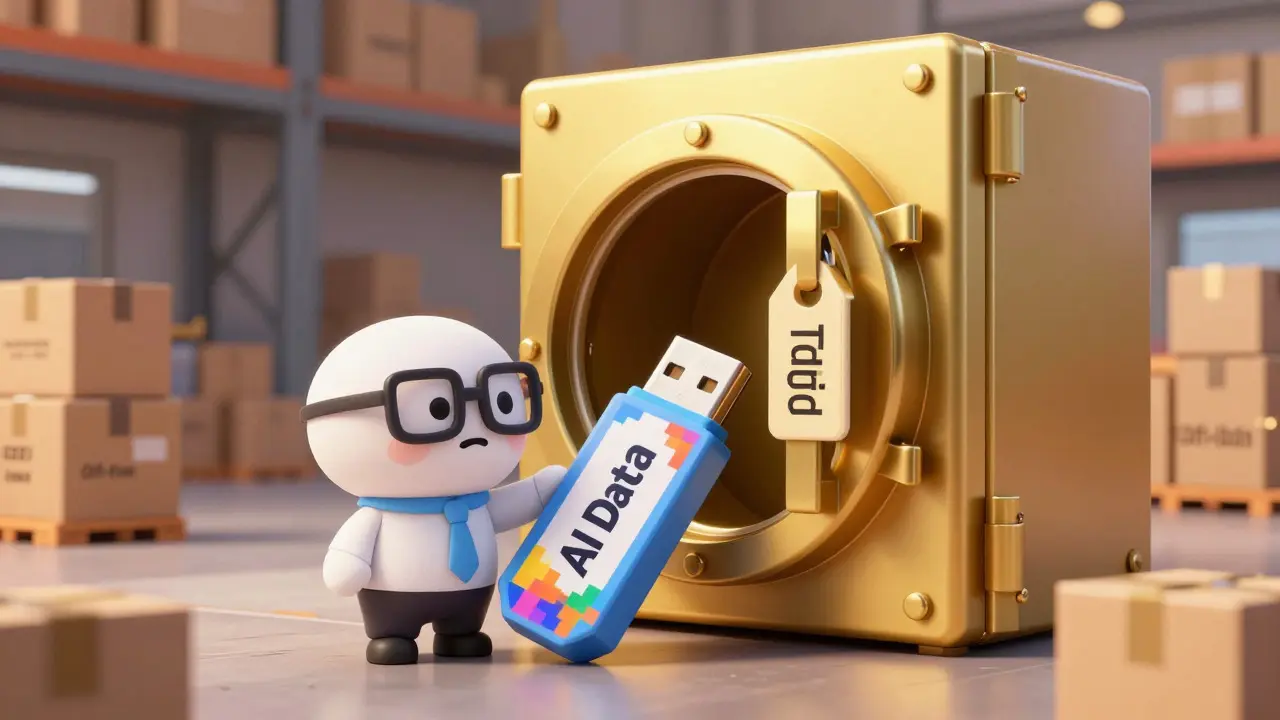
AI thrives on big data. Machine learning models require vast datasets-often terabytes of images, text, or sensor readings-to train effectively. Blockchain, on the other hand, is terrible at storing big data. It is designed to store small, critical pieces of information like transaction hashes or ownership records.
Storing even 1GB of data on Ethereum can cost thousands of dollars in gas fees. For an AI project that needs petabytes of data, this is economically unviable. Most current implementations end up storing pointers to off-chain data rather than the data itself. But this leads to another issue: data integrity. If the off-chain server goes down or changes the data, the pointer on the blockchain becomes useless or misleading.
Furthermore, blockchain data is immutable. Once written, it cannot be changed. AI models, however, often require iterative updates. If a dataset contains errors, correcting them on a blockchain is difficult. You can’t just delete the bad row. You have to append a correction, which clutters the chain and complicates the training process. This mismatch between AI’s need for flexible, mutable data and blockchain’s rigid permanence is a significant architectural conflict.
Privacy Risks and Regulatory Nightmares
Transparency is blockchain’s selling point, but it’s AI’s nightmare when it comes to privacy. Many AI applications rely on personal data-health records, financial histories, or user behavior patterns. Under regulations like GDPR in Europe, individuals have the "right to be forgotten." Blockchain’s immutability directly contradicts this right. If you put personal data on a public ledger, you can’t easily erase it later.
Even if you anonymize the data, advanced AI techniques can often re-identify individuals by cross-referencing multiple data points. This creates a legal minefield. Companies integrating AI with blockchain risk violating data protection laws unless they use complex privacy-preserving technologies like zero-knowledge proofs or homomorphic encryption. These technologies allow computations on encrypted data without revealing the underlying values, but they are computationally expensive and not yet widely adopted.
There’s also the issue of accountability. If an AI-driven smart contract makes a wrong decision-say, denying a loan based on flawed training data-who is responsible? The developer? The node operators? The algorithm itself? Current legal frameworks haven’t caught up with these hybrid systems, leaving businesses exposed to liability.
Interoperability Gaps and Standardization Issues
The tech landscape is fragmented. There are hundreds of blockchain platforms, each with its own consensus mechanism, programming language, and data structure. Similarly, AI tools vary wildly in framework and architecture. Trying to connect them is like trying to plug a USB-C cable into a vintage radio jack without an adapter.
Without universal standards, developers must write custom bridges for each integration. This slows down adoption and increases the chance of bugs. For instance, an AI model trained on data from one blockchain might not recognize the format of data from another. Smart contracts need standardized interfaces to interact with AI APIs reliably. Until industry-wide protocols emerge, every AI-blockchain project will likely be a bespoke solution, making scaling difficult.
The Skills Gap and Talent Shortage
Building these systems requires a rare combination of skills. You need experts in machine learning, distributed systems, cryptography, and smart contract development. Finding one person who excels in all these areas is nearly impossible. Most teams have to hire specialists from different fields and hope they can communicate effectively.
This talent shortage drives up costs and extends timelines. Junior developers often struggle to grasp both the probabilistic nature of AI and the deterministic requirements of blockchain. As a result, projects may suffer from poor implementation, leading to security vulnerabilities or inefficient code. Organizations investing in this space need to budget heavily for training or recruitment, which adds another layer of friction to adoption.

Energy Consumption and Environmental Concerns
Both AI and blockchain have been criticized for their energy footprints. Training large AI models consumes megawatts of electricity. Meanwhile, proof-of-work blockchains like Bitcoin use as much energy as some small countries. Combining them multiplies this impact. If you run intensive AI computations on a proof-of-work chain, the environmental cost becomes unsustainable for many enterprises aiming for green credentials.
While newer consensus mechanisms like proof-of-stake reduce energy usage significantly, they don’t eliminate the computational overhead entirely. The combined load still strains infrastructure. For companies prioritizing ESG (Environmental, Social, and Governance) goals, this integration poses a reputational risk unless they carefully select energy-efficient layers and hardware.
| Challenge Area | Core Issue | Impact on Implementation |
|---|---|---|
| Scalability | Low TPS limits real-time processing | Requires off-chain solutions, reducing decentralization |
| Data Storage | High cost per GB on-chain | Forces reliance on external databases, risking data integrity |
| Privacy | Immutable ledgers clash with GDPR | Necessitates complex encryption methods like ZK-proofs |
| Interoperability | Lack of unified standards | Increases development time and compatibility errors |
| Talent | Shortage of dual-skilled developers | Rises in labor costs and project delays |
Navigating the Path Forward: Hybrid Architectures
So, is AI-blockchain integration doomed? Not necessarily. The most successful projects today use hybrid architectures. They treat blockchain as a secure, immutable ledger for critical events and use off-chain cloud computing for heavy AI processing. Layer-2 solutions, such as sharding or sidechains, help alleviate some scalability issues by handling transactions faster than the main chain.
For example, in supply chain management, sensors might collect data via AI algorithms off-chain. Only the verified results-like "shipment arrived at port X"-are written to the blockchain. This approach balances efficiency with trust. However, it requires careful design to ensure that the off-chain components aren’t compromised. Security audits must cover both the smart contracts and the AI models feeding them.
As standards evolve and regulatory clarity improves, these challenges will lessen. But for now, developers must proceed with caution. Don’t put everything on-chain. Use blockchain where its properties add unique value-transparency, auditability, and decentralization-and let AI handle the heavy lifting elsewhere. Understanding these limitations is the first step toward building robust, scalable systems.
Why is storing AI data on blockchain so expensive?
Blockchain networks charge fees based on the amount of data stored and the computational resources required to validate it. Since AI datasets are often gigabytes or terabytes in size, storing them directly on chains like Ethereum would cost thousands of dollars per gigabyte. Most developers instead store data off-chain and only save a hash (a digital fingerprint) on the blockchain to verify integrity.
Can blockchain handle real-time AI processing?
Generally, no. Mainstream blockchains like Bitcoin and Ethereum have low transaction speeds (7-30 TPS), which causes significant latency. Real-time AI applications, such as autonomous driving or high-frequency trading, require millisecond responses. To achieve this, developers use off-chain processing or specialized high-speed blockchains, but this often sacrifices some level of decentralization.
How does GDPR affect AI-blockchain projects?
GDPR grants users the right to have their personal data deleted. Because blockchain data is immutable (cannot be changed or deleted), storing personal data on-chain violates this regulation. Projects must use privacy-preserving techniques like zero-knowledge proofs or store personal data off-chain while keeping only non-personal identifiers on the ledger.
What is a hybrid architecture in this context?
A hybrid architecture splits the workload. Heavy AI computations and large data storage happen off-chain on traditional servers or cloud platforms. The blockchain is used only for specific functions like verifying results, managing access rights, or recording immutable audit trails. This balances performance with the security benefits of decentralization.
Is there a shortage of developers for AI-blockchain integration?
Yes. The field requires expertise in both machine learning and distributed ledger technology, including cryptography and smart contract development. Few professionals possess deep knowledge in both areas, leading to higher hiring costs and longer development cycles for organizations attempting these integrations.



Write a comment