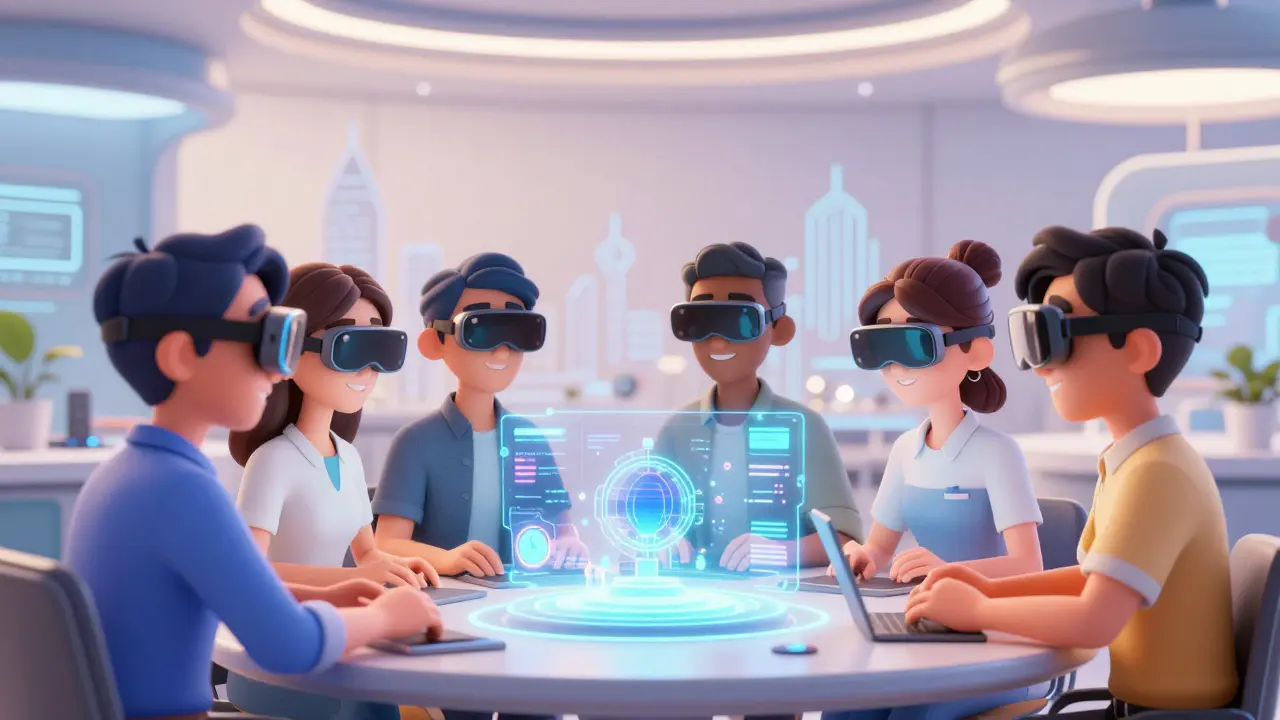
The hype cycle that once dominated headlines has finally settled into something more tangible. In 2026, the Metaverse is a persistent, shared virtual 3D space accessible through various devices, moving from speculative concept to practical business tool. It’s no longer just about buying a pixelated plot of land or attending a concert with a cartoon avatar. The focus has shifted entirely to utility. Companies are now asking: does this solve a real problem? Does it save time? Does it make money?
If you’re looking at the future of this technology, you have to look past the flashy demos. The real story is happening under the hood. It’s about how blockchain secures your digital identity, how artificial intelligence makes virtual worlds feel alive, and how hardware is finally becoming comfortable enough to wear all day. We are seeing a transition from a consumer-driven fantasy to an industry-driven infrastructure.
The Seven Pillars Holding Up the Virtual World
You can’t build a stable metaverse on just one piece of tech. It requires a complex stack of technologies working together. Think of it like building a city. You need roads, power grids, laws, and buildings. In the digital realm, these are the seven critical components defining the landscape in 2026:
- Blockchain and Cryptocurrency: This is the backbone for trust. It handles secure transactions and verifies who owns what. Without it, digital assets are just code that can be copied infinitely.
- Augmented Reality (AR) and Virtual Reality (VR): These are the interfaces. VR immerses you completely in a digital world, while AR overlays digital info onto your physical surroundings. Together, they bridge the gap between here and there.
- Artificial Intelligence (AI): AI powers the brains behind the scenes. It creates realistic avatars, manages server loads, and personalizes content so the world feels responsive to you.
- 3D Reconstruction: This technology scans real-world objects and environments to create lifelike digital twins. It’s what makes a virtual car showroom look indistinguishable from the real thing.
- Internet of Things (IoT): IoT connects physical devices to the virtual world. Your smart home, your wearable health tracker, and even industrial sensors feed data into the metaverse, making it aware of the physical context.
- Edge Computing: Cloud servers are too far away for real-time interaction. Edge computing processes data closer to the device, reducing lag. This is crucial for preventing motion sickness in VR.
- 5G Technology: High-speed, low-latency connectivity is non-negotiable. 5G ensures that when you move your hand in the metaverse, the avatar moves instantly, not seconds later.
Each of these pillars supports the others. If the blockchain is slow, transactions fail. If the 5G network drops, immersion breaks. The future depends on these systems maturing simultaneously.
Why Blockchain Is the Non-Negotiable Layer
In the early days, people thought the metaverse was just about gaming. But as businesses entered the space, a major problem emerged: ownership. Who really owns that digital jacket you bought? Who controls your reputation score across different platforms? This is where Blockchain becomes the decentralized ledger technology that ensures secure, transparent, and immutable records of transactions and asset ownership.
Without blockchain, you are renting your existence in the metaverse. A centralized company could delete your account, ban your avatar, or change the rules of engagement overnight. With blockchain, your assets-represented as Non-Fungible Tokens (NFTs) are unique digital certificates of ownership stored on a blockchain, proving authenticity and scarcity of digital items.-are yours. They exist independently of any single platform.
This shift enables true interoperability. Imagine wearing a digital watch purchased in one virtual world and having it appear on your avatar in a completely different virtual environment. That’s only possible if both platforms recognize the same underlying blockchain standard. In 2026, we are seeing more protocols emerge that prioritize this cross-platform compatibility, driven by user demand for control over their digital lives.
From Clunky Headsets to Invisible Tech
Let’s be honest: the bulky VR headsets of the past were a barrier. They were heavy, isolated you from the real world, and caused sweat after twenty minutes. The future of metaverse technology relies on solving this hardware friction. The trend in 2026 is clear: we are moving toward sleeker, lighter form factors.
Manufacturers are racing to perfect Augmented Reality Glasses are lightweight eyewear that overlays digital information onto the real world, enabling seamless interaction between physical and virtual environments.. Unlike VR, which blocks out the world, AR glasses let you see your coffee cup while also seeing a holographic menu floating above it. This makes the technology usable for work, navigation, and social interaction without isolating the user.
But hardware is only half the battle. The other half is Spatial Computing is technology that understands and maps three-dimensional space, allowing digital objects to interact realistically with physical environments.. This means your phone or glasses know exactly where the floor ends and the wall begins. It allows for precise placement of virtual objects. When spatial computing matures, the distinction between "digital" and "physical" blurs significantly. You won’t feel like you’re logging into a separate app; you’ll feel like you’re interacting with an enhanced version of reality.

AI: Making Virtual Worlds Feel Alive
A static virtual world is boring. For the metaverse to retain users, it needs to react. This is where Artificial Intelligence plays a starring role. AI isn’t just a buzzword here; it’s the engine of engagement.
First, consider avatars. Early avatars were stiff and robotic. Today, AI-driven facial recognition and motion capture allow for subtle expressions. If you smile, your avatar smiles naturally. If you look confused, your avatar furrows its brow. This level of nuance is critical for human connection in virtual spaces.
Second, AI manages the complexity of the environment. With millions of users potentially in one virtual space, the system needs to optimize performance dynamically. AI algorithms decide what details to render in high resolution and what to simplify in the background, ensuring smooth frame rates without draining battery life.
Third, AI powers intelligent virtual assistants. These aren’t just chatbots. They are proactive helpers that understand context. If you’re designing a virtual store, an AI assistant might suggest layout changes based on traffic flow data from similar stores. It learns from user behavior to personalize experiences, making each visit feel unique.
Business Adoption: Beyond the Hype
So, why should a regular person care about the metaverse? Because it’s changing how we work, shop, and learn. The initial wave of investment was speculative, but the current phase is pragmatic. Businesses are adopting metaverse solutions because they offer measurable ROI.
| Feature | Traditional Web/App | Metaverse Environment |
|---|---|---|
| Interaction Style | 2D screens, clicks, taps | 3D immersion, gesture-based, voice |
| Presence | Passive consumption | Active participation, sense of "being there" |
| Asset Ownership | Licensed, non-transferable | Owned via NFTs, transferable across platforms |
| Geographic Limits | Physical presence often required for events | Global access, zero travel cost |
| Personalization | Algorithmic recommendations | Adaptive environments, custom avatars |
Retailers are building virtual showrooms where customers can try on clothes or visualize furniture in their actual living rooms using AR. Educational institutions are creating virtual labs where students can perform dangerous chemistry experiments safely. Corporate training programs use VR to simulate high-pressure scenarios, like emergency response or public speaking, providing a safe space to practice.
However, adoption isn’t uniform. Large enterprises with deep pockets are leading the charge, hiring specialized development teams to build custom solutions. Small businesses are watching closely, waiting for costs to drop and tools to become more user-friendly. The key takeaway is that the metaverse is becoming a B2B (business-to-business) powerhouse before it fully explodes in the B2C (business-to-consumer) market.
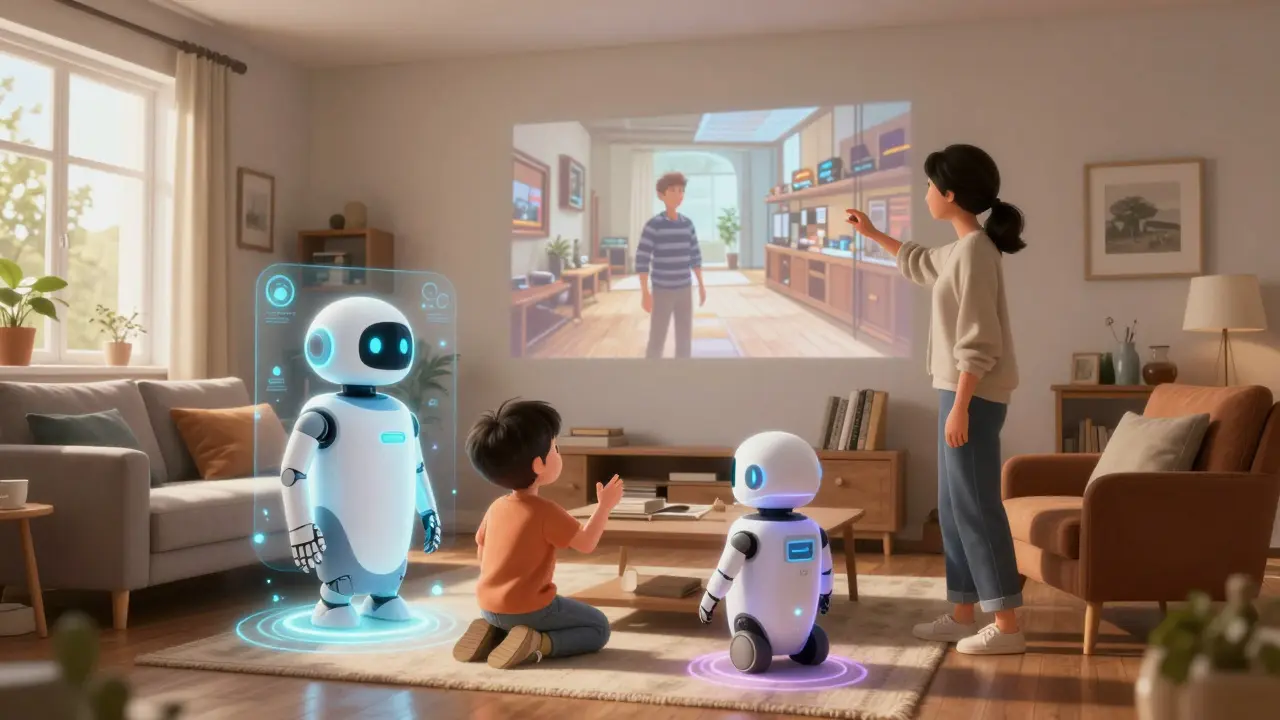
Challenges That Still Need Solving
It’s easy to get excited about the possibilities, but we must address the elephant in the room: the challenges. The metaverse is not yet ready for mass, frictionless adoption. Several hurdles remain significant.
Hardware Costs: While prices are dropping, high-quality AR/VR gear is still expensive. For widespread global adoption, devices need to be as affordable as smartphones. Until then, the metaverse remains a luxury for many.
Scalability: Hosting millions of concurrent users in a single persistent world requires immense computational power. Current infrastructure struggles with this scale. We need better edge computing networks and more efficient rendering techniques to handle peak loads without crashing.
Regulatory Uncertainty: Data privacy is a massive concern. If your brainwaves and eye movements are being tracked to enhance immersion, who owns that data? Governments are still catching up. Clear regulations around digital identity, taxation of virtual goods, and intellectual property rights are needed to protect users and encourage responsible innovation.
User Experience Friction: Many platforms still feel clunky. Navigating menus in 3D can be unintuitive. Social interactions can feel awkward without proper cues. The interface needs to become invisible, allowing users to focus on the experience rather than the mechanics of controlling it.
What Comes Next?
The future of metaverse technology isn’t about replacing the real world. It’s about enhancing it. We are moving toward a hybrid existence where digital and physical layers coexist seamlessly. The next five years will likely see niche applications dominate. Instead of one giant "metaverse," we’ll have many interconnected micro-metaverses tailored to specific industries-healthcare, manufacturing, education, entertainment.
For developers and investors, the opportunity lies in solving the fragmentation problem. Building bridges between these silos-standardizing identity, payment, and asset formats-is where the real value will be created. For users, the benefit will be convenience and connection. Imagine interviewing for a job in a virtual office that feels as real as the physical one, or visiting a museum in Paris while sitting on your couch in Auckland.
The technology is maturing. The hype is fading. What’s left is a powerful toolset for reimagining how we interact with information and each other. The question is no longer "if" the metaverse will happen, but "how" it will integrate into your daily routine. Keep an eye on hardware improvements and blockchain standards; those are the indicators that will tell you when the next big leap is coming.
Is the metaverse just a fad?
No, the metaverse is evolving from a speculative fad into a practical infrastructure layer for the internet. While the initial hype around virtual real estate cooled down, the underlying technologies-VR, AR, blockchain, and AI-are being integrated into real-world business processes for training, retail, and collaboration. It is becoming a utility rather than a novelty.
Do I need a VR headset to use the metaverse?
Not necessarily. While VR headsets provide the most immersive experience, the metaverse is accessible through smartphones, computers, and increasingly, lightweight AR glasses. Many current applications are designed to be multi-platform, allowing users to participate via 2D screens if they don’t have advanced hardware.
How does blockchain protect my digital assets?
Blockchain provides a decentralized, immutable ledger that records ownership of digital items like NFTs. This means that even if a specific platform shuts down or bans you, your assets remain verifiable and transferable to other compatible platforms. It prevents central authorities from arbitrarily seizing or altering your digital property.
What are the biggest risks of the metaverse?
Key risks include data privacy concerns, as biometric data (eye tracking, movement) may be collected; security vulnerabilities in smart contracts leading to financial loss; and psychological effects of prolonged immersion. Additionally, regulatory uncertainty poses legal risks for both users and businesses regarding jurisdiction and liability.
When will the metaverse be mainstream?
There is no single launch date. Mainstream adoption is happening gradually through niche applications. As hardware becomes cheaper and more comfortable (like AR glasses) and interoperability improves, usage will expand. Experts predict significant growth in enterprise adoption by 2027-2030, with consumer adoption following as killer apps emerge.
Can I make money in the metaverse?
Yes, opportunities exist for creators, developers, and businesses. You can earn by creating digital assets (art, fashion, virtual real estate), developing software or experiences, offering consulting services, or trading digital goods. However, success requires skill and understanding of market dynamics, and it carries financial risk similar to traditional entrepreneurship.



20 Comments
lorna erni
finally someone gets that the pixelated land craze was absolute garbage and we needed to move on. the shift to utility is what actually matters here because nobody wants to sit in a virtual room with no purpose just for the sake of it. i think the b2b angle is where the real money is going to be made before any of us regular folks even touch this stuff.
stalin brian
honestly the hardware part is still such a barrier though. like yeah ar glasses sound cool but have you tried wearing anything on your face for more than an hour? its uncomfortable af. plus the battery life on these things is terrible so im not sure how invisible tech becomes if you have to plug it in every two hours.
kamal ifrani
you people are so naive thinking blockchain fixes ownership. it doesnt fix the fact that your data is being mined by corp overlords who dont care about your privacy. the whole concept of digital identity is a surveillance nightmare waiting to happen and anyone who thinks nfts make them safe is living in a fantasy world created by tech bros trying to sell you shit they cant touch.
Craig Swanson
look kamal you gotta admit the tech has potential even if the implementation is messy right now. we need to focus on solving the interoperability issues because thats the key to making this work for everyone. its frustrating when platforms lock you in but at least were seeing some progress with open standards emerging.
Miss Masquer
i have been following the development of spatial computing for quite some time now and it is fascinating to see how rapidly the technology is evolving from clunky headsets to something that might actually blend seamlessly into our daily lives without causing physical discomfort or social isolation which was always my main concern with vr devices that completely block out the real world around you.
trisya hazriyana
sure lets pretend ai avatars will feel natural when half the population cant even look a human in the eye during a video call. the uncanny valley is not a bug its a feature designed to keep you unsettled enough to buy better graphics packs. stop buying the hype train ticket.
Debbie Lewis
i guess i am just waiting for the price point to drop significantly before i consider investing any time or money into this ecosystem. right now it feels like a solution looking for a problem rather than a necessary tool for everyday life.
Eric Grosso
does anyone else think the latency issue is gonna be the biggest deal breaker? edge computing sounds great on paper but getting that infrastructure everywhere seems like a massive logistical headache that could take decades to fully roll out properly.
Edith Mair
the regulatory uncertainty mentioned in the post is terrifying. if my eye movements and biometric data are being tracked to enhance immersion then who owns that data and how is it protected? we need clear laws before this goes mainstream otherwise users are going to get exploited badly.
Sam Dashti
imagine walking down the street and having holographic menus floating above coffee shops while your friends appear as avatars sitting at tables next to you. it sounds like sci-fi but the tech is creeping up on us faster than we expect and honestly it kind of blows my mind what we will accept as normal in five years.
Joe Clements
i appreciate the balanced view here. its easy to get excited about the shiny new toys but pointing out the challenges like hardware costs and scalability keeps feet on the ground. hopefully developers focus on user experience friction because nothing kills adoption faster than confusing interfaces.
Rosie Morris
i totally agree with the part about niche applications dominating first. healthcare and manufacturing seem like perfect use cases where the benefits outweigh the learning curve. maybe once those industries figure it out the consumer side will become more intuitive and less gimmicky.
saradee dee
oh my god the idea of virtual chemistry labs is amazing! students can explode things safely without destroying the school. this could really help kids who struggle with traditional learning methods because they can visualize concepts in 3d space instead of just reading dry textbooks.
Bill Gunn
great breakdown of the seven pillars! 🏗️ the synergy between iot and edge computing is often overlooked but crucial for real-time responsiveness. also love the emoji usage here to keep things light 😎
Dana Rapoport
the philosophical implication of blurring digital and physical reality is profound. we are essentially creating a layer of meaning over the material world which changes how we perceive existence itself. it is not just about convenience but about redefining presence.
Hadleigh Edwards
i remain optimistic that as these technologies mature they will solve many of the current pain points related to comfort and cost. history shows that early adopters always face hurdles but eventually the technology becomes ubiquitous and affordable enough for everyone to enjoy the benefits of enhanced connectivity and immersive experiences.
mark valmart
just wondering if anyone has tried the latest ar glasses yet? curious about the field of view and how well they handle bright sunlight outdoors since that was always a weak point for older models.
Crystal Davis
typical tech bro optimism ignoring the massive environmental impact of running all these servers for edge computing. the energy consumption required to sustain persistent virtual worlds is unsustainable and nobody is talking about the carbon footprint of this so-called utopia.
Christina Pearce
i think the key takeaway here is that interoperability is the holy grail. if i can take my avatar and items across different platforms then the network effect will finally kick in. until then it is just a bunch of walled gardens competing for attention.
Barclay Chantel
how quaint that you believe this technology will bring people together. it is merely another mechanism for corporate extraction of labor and attention. the elites will use it to further distance themselves from the mundane realities of the physical world while the rest of us suffer through the beta testing phase of their dystopian playground.