
Imagine a world where your car insurance claim gets paid before you even finish calling your agent. No paperwork. No back-and-forth emails. No waiting weeks for approval. That’s not science fiction - it’s happening right now, thanks to insurance data sharing on blockchain.
For decades, the insurance industry has been stuck in a cycle of slow, expensive, and error-prone processes. Every time a claim is filed, data gets passed between insurers, reinsurers, hospitals, mechanics, and regulators. Each handoff means delays, duplicate records, and opportunities for fraud. In 2023, insurance fraud alone cost the global industry over $40 billion. Meanwhile, administrative costs ate up 30-40% of premiums. Something had to change.
What Is Insurance Data Sharing on Blockchain?
At its core, insurance data sharing on blockchain means storing policy details, claims, payments, and verification records on a shared digital ledger that no single company controls. Instead of one central database - which hackers love to target - the data is copied across dozens, sometimes hundreds, of secure computers. Every time a new piece of information is added (like a claim submission or a medical report), it’s locked into a "block" and chained to the previous one. Tampering? Impossible. The system just rejects it.
This isn’t just about security. It’s about trust. When every party - from the policyholder to the reinsurer - can see the same unchangeable record, there’s no room for disputes. Did you file a claim for the same accident twice? The blockchain says no. Was your medical record altered to inflate costs? The system flags it immediately.
How It Works: The Mechanics Behind the Magic
Most insurance blockchain systems today use what’s called a consortium blockchain. Think of it like a private club where only approved players - insurers, reinsurers, claims processors - can join and contribute data. Unlike public blockchains like Bitcoin, which anyone can access, consortium networks are tightly controlled. This keeps sensitive customer data protected while still allowing seamless sharing.
Each participant has a unique digital key. If you want to view or update a claim, you need that key. No key? No access. And every action - whether it’s submitting a claim, approving a payout, or updating a policy - is recorded permanently. That’s why fraud drops sharply. You can’t fake a claim if every step is locked in place.
Smart contracts do the heavy lifting. These are self-executing programs written in code. For example, if you have travel insurance and your flight is delayed over two hours, the smart contract checks real-time flight data from an official source. If the condition is met? The payout goes straight to your digital wallet - no human approval needed. AXA’s "Fizzy" system does this in under five minutes. The industry average? 10 to 14 days.
Why This Beats Old-School Systems
Traditional insurance relies on paper files, email chains, and siloed databases. Here’s what that looks like in practice:
- Claim submitted? It gets faxed, scanned, emailed, then manually entered into three different systems.
- Discrepancies? Someone has to hunt them down - often over weeks.
- Reinsurance? That’s a 45-60 day dance between companies just to reconcile who owes what.
Compare that to blockchain:
- Data is entered once - verified and stored instantly across all authorized parties.
- Reconciliation time drops by 70-90%. AIG cut its claims processing delays from weeks to hours.
- Cost per claim? Traditional systems cost $8-$12. Blockchain brings it down to $1.50-$2.50.
And fraud? It doesn’t vanish, but it becomes far harder to pull off. In 2023, NAIC found that centralized databases caused 34% of all insurance data breaches. Blockchain? It cuts breach risk by 62% because there’s no single point to hack.
Real-World Wins: Who’s Doing It Right?
Some of the biggest names in insurance are already live on blockchain networks.
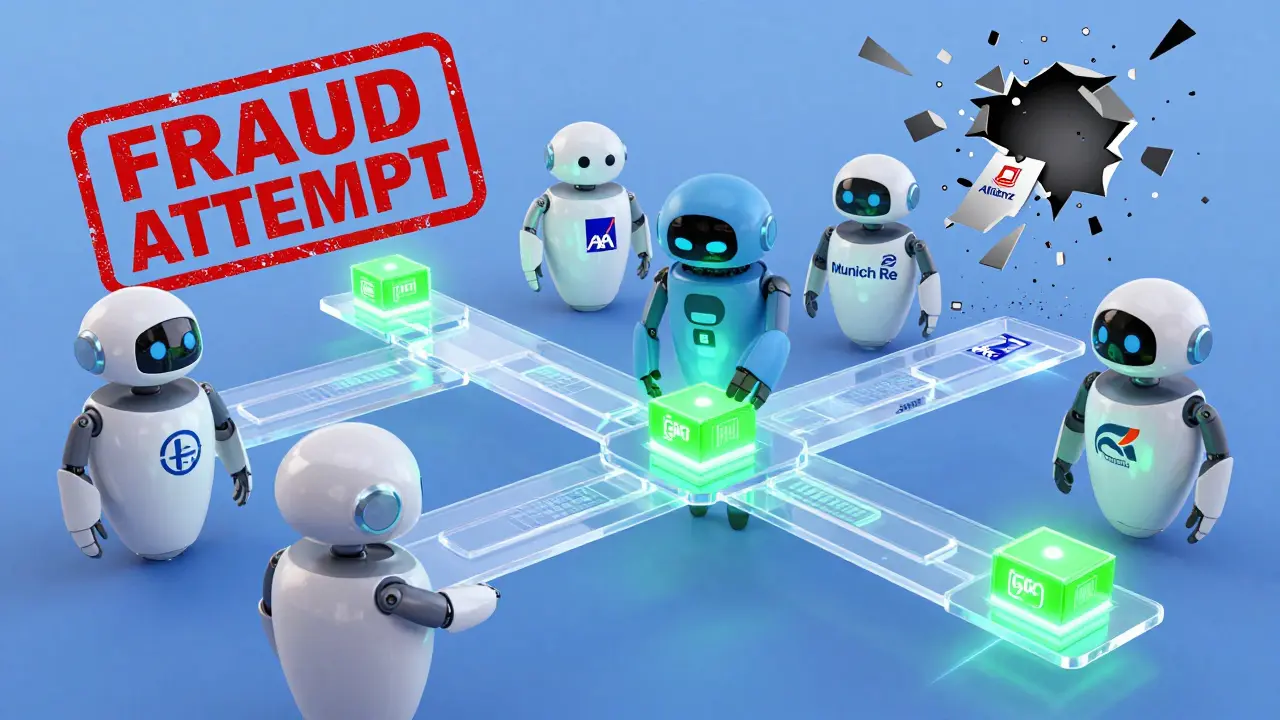
B3i - the Blockchain Insurance Industry Initiative - started in 2016 with 15 insurers like Allianz and Munich Re. Today, 47 major companies use its platform, handling $120 billion in reinsurance transactions every year. In September 2024, during Hurricane Helene, B3i’s system automatically triggered payouts to policyholders within 72 hours - something that used to take months.
AXA’s "Fizzy" isn’t just a demo. It’s been used by over 1,200 travelers. One user wrote: "My flight was delayed two hours. Compensation appeared in my wallet before I left the airport." That kind of experience builds loyalty.
Even health insurers are jumping in. Deloitte’s 2024 report showed pilot programs cutting data reconciliation errors by 40% when hospitals, insurers, and pharmacies shared records on a blockchain. No more lost medical histories. No more billing mix-ups.
The Hidden Hurdles: Why It’s Not Everywhere Yet
Don’t get it twisted - blockchain isn’t magic. It’s hard to implement.
First, legacy systems. Most insurers still run on software from the 1990s. Integrating blockchain with those systems? That’s a six- to nine-month project. One senior architect on Reddit said, "We spent eight months just getting our claims system to talk to the blockchain. Then we hit a regulatory wall in three states."
Second, regulation. In the U.S., insurance is regulated state by state. What’s legal in New York might be illegal in Texas. That’s why only 41% of U.S. insurers have moved forward - compared to 68% in Europe, where GDPR makes data sharing rules clearer.
Third, culture. Insurers are used to hoarding data. "We’ve been competitors for 100 years," said Dr. Elena Rodriguez of Munich Re. "Suddenly asking us to share everything on a shared ledger? That’s a cultural earthquake. 65% of failed pilots didn’t fail because of tech - they failed because people didn’t want to change."
And cost. Setting up a consortium blockchain costs $500,000. Building your own? That’s $2.5 million. Smaller insurers can’t afford that. Many are joining shared networks instead.

What You Need to Get Started
If you’re an insurer looking to explore this:
- Start with a consortium model. Don’t build your own blockchain. Join B3i or another existing network.
- Focus on one high-friction process first - like claims processing or reinsurance reconciliation.
- Train your team. Deloitte says insurers spend $15,000-$25,000 per employee on blockchain training. You need people who understand both insurance and smart contracts.
- Standardize your data. Only 35% of insurers use the same data formats. If your claim form looks different from your partner’s, the blockchain won’t help.
And don’t forget: blockchain isn’t replacing humans. It’s removing the busywork. Claims adjusters can now focus on complex cases instead of chasing down faxed forms.
The Future: Where This Is Headed
The global blockchain in insurance market hit $487 million in 2023. By 2028, it’s expected to hit $3.2 billion. That’s a 45.7% annual growth rate.
What’s next?
- AI + blockchain: Allianz is testing AI that predicts risk using blockchain data. Early results? 22% more accurate risk assessments.
- Tokenized policies: Imagine owning 1% of a flood insurance policy. Investors could buy fractional shares of risk - turning insurance into an asset class.
- Decentralized identity: Your ID, medical history, and driving record stored on blockchain. Onboarding a new customer? Done in 24 hours instead of a week.
By 2030, 92% of insurance executives believe blockchain will be essential infrastructure. It won’t replace every system. But for high-volume, high-friction processes - it’s already the best tool we’ve got.
Can blockchain prevent insurance fraud completely?
No - but it makes fraud much harder and far more expensive to pull off. Blockchain doesn’t stop someone from filing a fake claim. But it does stop them from submitting the same claim to multiple insurers or altering medical records after the fact. Every transaction is permanently recorded and visible to all authorized parties. That’s why insurers using blockchain report up to 40% fewer fraudulent claims.
Is blockchain only for big insurers?
Not anymore. While building your own blockchain costs millions, smaller insurers can join consortium networks like B3i. These shared platforms let small players access the same benefits - faster claims, lower fraud, reduced costs - without the upfront investment. Many mid-sized insurers are now participating through industry coalitions.
How long does it take to implement blockchain for insurance data sharing?
For a simple pilot - like automating one type of claim - it can take 6-9 months. Full enterprise integration, especially with legacy systems, often takes 12-18 months. The biggest delays come from integrating old software and navigating regulatory rules, not from the blockchain tech itself.
What’s the difference between blockchain and cloud databases like Salesforce Insurance Cloud?
Cloud databases are fast and easy to use, but they’re still centralized. That means one company controls the data, and it can be changed or deleted. Blockchain creates an immutable record - once data is added, it can’t be altered. For fraud prevention and audit trails, that’s a game-changer. Cloud systems improve efficiency. Blockchain builds trust.
Do policyholders benefit from blockchain data sharing?
Absolutely. Faster claims. Fewer errors. Lower administrative costs mean lower premiums over time. Customers also get more control - like seeing exactly what data is shared and with whom. Some platforms even let policyholders verify their own information directly on the blockchain, reducing onboarding time from days to hours.


15 Comments
Ian Plunkett
This is literally the most beautiful thing I've seen all year 🥹
Imagine not having to call 17 people just to get a claim processed. I've been in insurance for 12 years and this? This is the first time I've felt actual hope.
Blockchain isn't just tech-it's emotional labor automation. We're finally letting humans be humans again.
jennifer jean
I used Fizzy last year when my flight got delayed. Got $300 in my wallet before I even found a gate. I cried. Not because of the money-because it worked. 🥺
Sasha Wynnters
We're not just digitizing paperwork. We're dismantling the entire mythology of bureaucratic inertia. Blockchain doesn't solve fraud-it makes fraud *embarrassing*. And in capitalism, nothing kills a scam faster than social shame.
It's not a ledger. It's a mirror. And we're finally seeing our own reflection.
Rajib Hossaim
While the technological advantages are undeniable, one must not overlook the socio-organizational barriers. Legacy infrastructure, regulatory fragmentation, and entrenched institutional inertia remain formidable obstacles. The transition requires more than code-it demands epistemic humility.
Beth Erickson
USA is the only country that actually gets this. Europe? They're still arguing about who owns the data. Meanwhile we're paying claims in minutes. America wins again. 🇺🇸
Jenn Estes
You people act like this is revolutionary. I've seen this exact pitch since 2017. Every time it's "this time it's different." Spoiler: it's not. The same 3 companies keep talking to each other. Nothing changes for real people.
Geet Kulkarni
While the efficiency gains are statistically significant, one must consider the ethical implications of immutable records. What happens when a claimant's data is inaccurately recorded? There is no recourse. No appeal. No human intervention. This is not progress-it is algorithmic authoritarianism dressed in blockchain glitter.
Lauren Brookes
I think what's beautiful here is how quietly this is changing lives.
No headlines. No hype. Just a woman in Ohio getting her car fixed 3 days instead of 3 weeks. A single mom in Arizona who didn't have to beg for a payout.
It's not about the tech. It's about the dignity.
And that? That's worth everything.
Chris Thomas
Let’s be real-this is just distributed ledger tech repackaged as a fintech unicorn. The real innovation? Marketing. Everyone’s slapping "blockchain" on their PowerPoint and raising Series B. Meanwhile, the 200k claims still go through fax machines because integration costs > ROI.
It’s vaporware with a whitepaper.
James Breithaupt
In India, we're seeing something wild-farmers using micro-insurance on blockchain to hedge against monsoon failures. No middlemen. No corruption. Just a phone, a smart contract, and a weather API.
This isn't just insurance. It's economic liberation in rural pockets. And it's happening *because* of this tech.
Alex Williams
If you're an insurer thinking about this, don't overcomplicate it.
Start with one claim type. Pick a consortium. Train your team. Standardize your fields.
Don't try to build a blockchain. Join one.
And for god's sake, stop asking your devs to "make it Web3." It's not a trend. It's infrastructure.
Sarah Shergold
So like... blockchain = instant money? Sounds like a scam. I'm just saying. I saw a guy on TikTok say this was a crypto pump. I'm not falling for it lol
Andrew Edmark
I work in claims. I used to spend 6 hours a day chasing faxes.
Now? I handle 3x the volume. And I get to help people instead of chasing ghosts.
Thank you to whoever built this. You changed my job. You changed my life.
Charrie VanVleet
I love how this is quietly fixing things without needing a CEO speech or a TED Talk.
You don't need to convince anyone. You just build it. And then one day, someone gets paid on time-and they don't even know why.
That's the quietest revolution.
Scott McCrossan
Oh great. Another tech bro fantasy. You think fraud drops because of a ledger? Fraud just moves. People will still fake injuries, fake accidents, fake deaths. This just makes them smarter. And guess who pays? The rest of us. This isn't progress. It's a shell game with more servers.