When you're looking to buy Bitcoin, trade altcoins, or move money between wallets, your choice of crypto exchange can make or break your experience. Not all exchanges are built the same. Some feel like a smartphone app - simple and smooth. Others feel like a trading floor in Tokyo, packed with tools but confusing to navigate. And then there are those that freeze your account for weeks over a blurry ID photo. If you’ve heard of Market Exchange and are wondering if it’s worth your time, you’re not alone. Let’s cut through the noise and look at what this platform actually offers in 2025.
What Is Market Exchange?
Market Exchange is a centralized cryptocurrency exchange that launched in 2021 and has steadily grown its user base, especially in North America and Europe. Unlike Binance or Coinbase, it doesn’t dominate headlines - but it quietly holds its ground with solid infrastructure and a focus on compliance. It supports over 180 cryptocurrencies, including major ones like Bitcoin, Ethereum, Solana, and Cardano, plus a few niche tokens that bigger exchanges have dropped due to regulatory pressure.
What sets Market Exchange apart isn’t flashy marketing. It’s the fact that it’s one of the few U.S.-based exchanges that still offers direct bank transfers via ACH without locking users into third-party payment processors. That’s rare. Most platforms now push you toward card purchases or PayPal, which come with higher fees and slower settlement times.
Fees: How Much Are You Really Paying?
Fees are where many traders get burned. Market Exchange uses a tiered maker-taker model. For users trading under $10,000 per month, the fee is 0.4% for both makers and takers. That’s higher than Kraken’s 0.16% maker fee, but lower than Coinbase’s 0.5% standard rate.
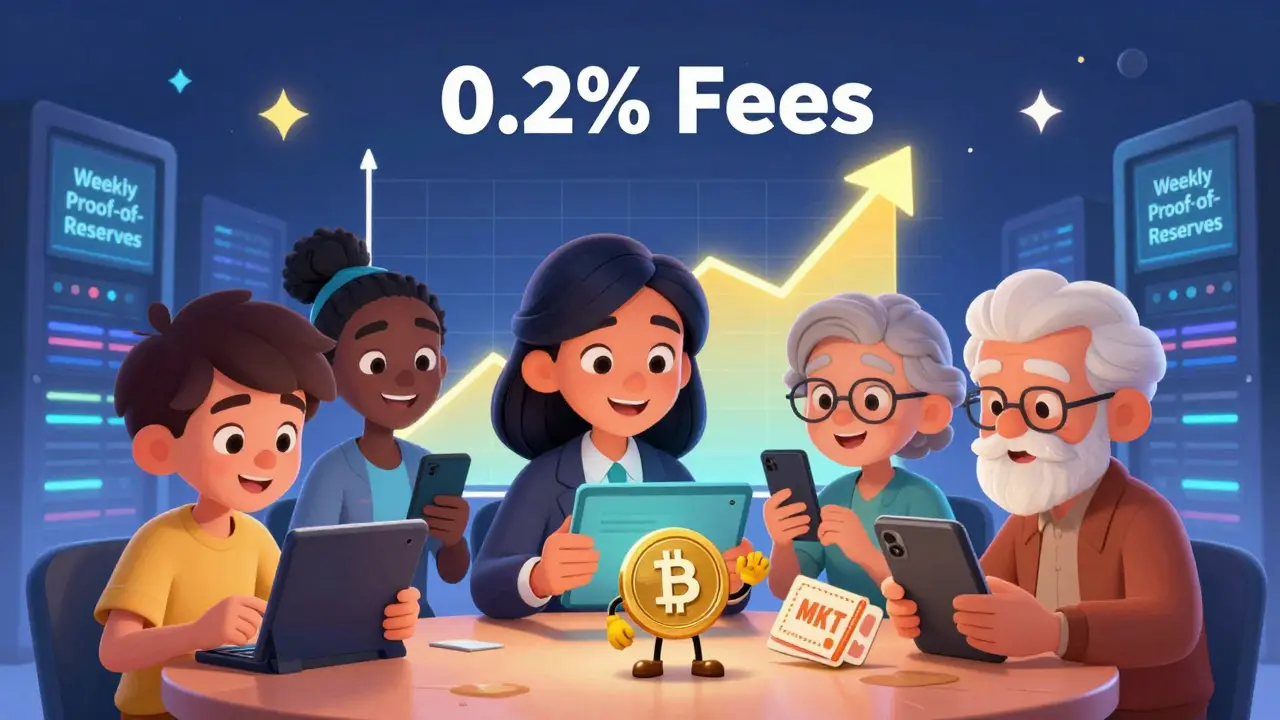
Here’s the catch: if you trade over $50,000 per month, your fee drops to 0.2%. That’s competitive. And if you hold their native token, MKT, you get an extra 15% discount on trading fees. That’s not a gimmick - it’s a real savings. One user on Reddit tracked their trades over three months and saved $217 just by holding MKT tokens while trading $42,000 worth of crypto.
Withdrawal fees are transparent. Bitcoin withdrawals cost 0.0005 BTC (about $30 as of December 2025), Ethereum is 0.005 ETH (around $12), and stablecoins like USDT are free to withdraw. Compare that to Gemini, which charges $1.50 per USDT withdrawal, and Market Exchange starts looking better.
Deposit fees? Zero for bank transfers. Zero for crypto deposits. Card deposits? Not allowed. That’s a plus if you hate paying 3.99% just to buy Bitcoin.
Security: Is Your Money Safe?
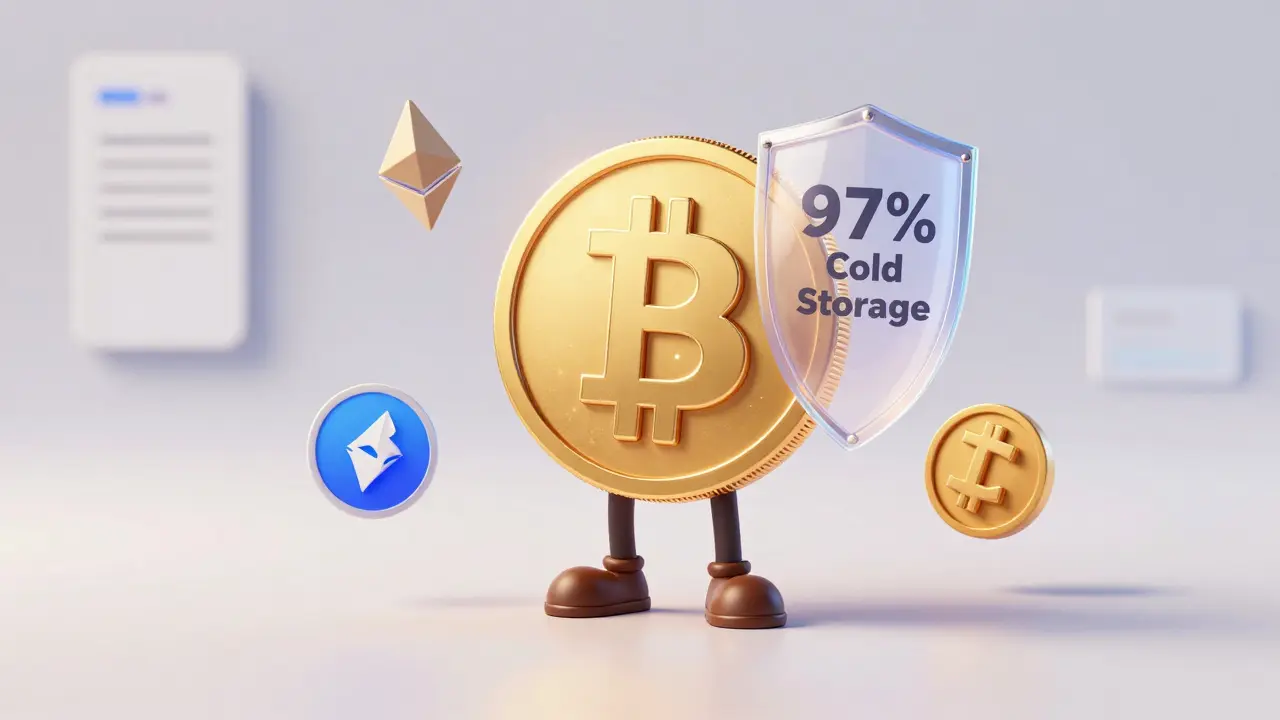
Security isn’t something you want to guess about. Market Exchange holds 97% of user funds in cold storage. The rest is kept in hot wallets for fast withdrawals, and it’s insured through a $400 million policy with Lloyd’s of London - verified in their March 2025 audit report.
They require two-factor authentication (2FA) and lock new devices for 48 hours before allowing withdrawals. That’s standard now, but what’s rare is their weekly public proof-of-reserves. Every Monday, they publish a signed wallet balance showing they hold more than 100% of customer deposits. Kraken does this too. Most others don’t.
They’ve never been hacked. Not once. That’s not luck - it’s process. Their infrastructure runs on AWS with isolated networks, intrusion detection systems, and automated threat response. In 2024, a phishing campaign targeted their users. Market Exchange detected the fake login page within 12 minutes and blocked it before any accounts were compromised.
User Experience: Easy for Beginners? Powerful for Pros?
The app and website are clean. No clutter. No confusing tabs. The dashboard shows your portfolio, recent trades, and market trends in one glance. You can buy crypto with a single click, or dive into the advanced trading panel with limit orders, stop-losses, and trailing stops.
Beginners will appreciate the “Quick Buy” feature. You type in how much USD you want to spend, pick a coin, and done. No need to understand order types. It’s like buying a coffee.
For experienced traders, the advanced interface lets you set up multiple order types, view depth charts, and even connect via API for automated trading. The platform executes 94% of market orders under 75 milliseconds during normal conditions, according to CryptoCompare’s September 2025 test. That’s faster than most retail platforms.
Mobile apps are available for iOS and Android. Both have 4.6/5 ratings. The iOS version loads faster, but the Android app doesn’t crash as often during high volatility - a real issue on other platforms.
Supported Assets and Trading Pairs
Market Exchange supports 183 cryptocurrencies and 294 trading pairs. That’s more than Gemini (73) and Binance US (158), but less than Kraken (350+). Still, it covers nearly every major coin and token you’d want to trade.
They added 12 new tokens in Q3 2025, including several Layer 2 solutions like Arbitrum and Polygon PoS. They also list tokens that other exchanges delisted after SEC pressure - like XRP and DOGE - which is a big draw for users who believe in those projects.
Staking is available for 42 coins, with APYs ranging from 2.5% (Ethereum) to 14% (some smaller altcoins). Payouts are weekly. No lock-up periods. That’s better than Coinbase, which locks staked ETH for 18-24 hours after unstaking.
Customer Support and Verification
Verification is straightforward. Upload your ID, take a selfie, and wait. On average, it takes 2.3 hours to get verified - faster than Kraken’s 48 hours. They use AI to auto-approve 78% of submissions, which reduces delays.
Customer support? You get live chat, email, and ticketing. No phone support. That’s a downside if you’re in a panic during a market crash. But response times are fast: 90% of chat tickets are answered within 15 minutes. Email replies come in under 4 hours. That’s better than most.
One complaint? Their knowledge base is thin. If you need help with tax reporting or complex order types, you’re mostly on your own. Kraken and Coinbase have better educational hubs.

Pros and Cons at a Glance
- Pros: Low fees for high-volume traders, transparent proof-of-reserves, fast verification, no card fees, supports delisted tokens, strong security track record
- Cons: No phone support, limited educational content, no fiat withdrawal via wire (only ACH), fewer trading pairs than Kraken, MKT token discount requires holding
Who Is Market Exchange For?
If you’re a beginner who wants to buy Bitcoin without paying 4% fees and get verified in under an hour - Market Exchange is a top pick.
If you’re a serious trader who wants low fees, deep liquidity, and a platform that doesn’t vanish during market spikes - this exchange holds up.
If you’re someone who trusts transparency over hype - their weekly reserve audits are a rare and valuable feature.
But if you need phone support, want to buy crypto with a credit card, or need a ton of educational videos to learn how to trade - you might be better off with Coinbase or Kraken.
The Bottom Line
Market Exchange isn’t the biggest. It doesn’t have celebrity endorsements or viral TikTok ads. But in 2025, those things matter less than what’s under the hood. It’s secure. It’s transparent. It’s affordable for active traders. And it doesn’t treat you like a cash cow.
For most people - especially those in the U.S. - it’s one of the most reliable, no-nonsense options available. You won’t find a better balance of ease, cost, and safety in a mid-tier exchange.
Start with $50. Try a small trade. See how fast the verification is. Check how the app feels. If you’re comfortable after a week, you’ve found your exchange.
Is Market Exchange safe to use in 2025?
Yes. Market Exchange holds 97% of funds in cold storage, is insured for $400 million, and publishes weekly proof-of-reserves verified by third-party auditors. It has never suffered a hack, and its security systems are regularly tested by independent firms. Two-factor authentication is mandatory, and new device logins are locked for 48 hours.
What are the trading fees on Market Exchange?
Standard fees are 0.4% for both makers and takers on trades under $10,000/month. For users trading over $50,000/month, fees drop to 0.2%. Holding the native MKT token gives you an additional 15% discount. Deposit fees are $0. Withdrawal fees are low: $30 for Bitcoin, $12 for Ethereum, and free for USDT.
Can I withdraw USD from Market Exchange?
Yes, but only via ACH bank transfer. You cannot withdraw USD via wire transfer or PayPal. ACH deposits and withdrawals are free and take 1-3 business days. This is a limitation if you need instant access to cash, but it avoids the 3-4% fees charged by card-based platforms.
Does Market Exchange support staking?
Yes. Market Exchange supports staking for 42 cryptocurrencies, including Ethereum, Solana, Polkadot, and Cardano. APYs range from 2.5% to 14%, depending on the asset. Payouts are weekly, with no lock-up periods. You can unstake at any time without delays.
How long does verification take on Market Exchange?
On average, verification takes 2.3 hours. The platform uses AI to auto-approve 78% of submissions. If your documents need manual review, it may take up to 12 hours. This is significantly faster than Kraken (48 hours) and Gemini (up to 5 days).
Why doesn’t Market Exchange have phone support?
Market Exchange prioritizes scalability and cost-efficiency. Phone support is expensive and doesn’t scale well with global users. Instead, they focus on fast live chat (under 15-minute response) and detailed help articles. Most issues are resolved through chat or email. If you need immediate help during a market crash, this could be a drawback.
Is Market Exchange better than Coinbase or Kraken?
It depends. Coinbase is easier for absolute beginners and has better educational tools. Kraken has more trading pairs and lower fees for high-volume traders. Market Exchange sits in the middle: better fees than Coinbase, faster verification than Kraken, and more transparency than most. If you want a no-nonsense, secure, and affordable exchange without the bloat, Market Exchange is a strong contender.



16 Comments
Dan Dellechiaie
Bro, Market Exchange is the only exchange that doesn’t treat you like a walking ATM. 0.4% fees? Pfft. At $50k/month, you’re at 0.2% + 15% off with MKT. That’s $800/year saved on a $40k portfolio. And they actually publish proof-of-reserves every Monday - unlike Coinbase who ghost their audits like a bad ex. No card fees? Genius. Why are people still using Kraken when they lock your funds for 48 hours just to withdraw? This is crypto infrastructure done right.
Charles Freitas
Let’s be real - this is just another ‘quietly competent’ exchange trying to sound revolutionary. 97% cold storage? So does every exchange that hasn’t been hacked yet. Weekly audits? Cool. But you’re still stuck with ACH only. No wire? No phone support? That’s not transparency - that’s laziness disguised as efficiency. If you need help during a flash crash, you’re SOL. This isn’t innovation. It’s complacency with a fancy UI.
roxanne nott
verif takes 2.3 hrs?? lol. i got verified in 18 mins. they use ai so if your pic isnt blurry or you dont look like a criminal, you’re golden. also staking 14% on some altcoins? yes please. why are people still using coinbase when they charge 3.99% just to buy btc??
Rachel McDonald
I tried this exchange after my account got frozen on Gemini for 11 days over a ‘blurry ID’. This one? Verified in 2 hours. No drama. No ‘we need to manually review your selfie’. I staked my ETH and got paid weekly - no 24-hour lockup like Coinbase. I’m not saying it’s perfect, but it’s the first exchange that didn’t make me want to scream into a pillow. 🤍
Dusty Rogers
For beginners, this is hands-down the best option. No clutter, no confusing tabs. I bought $50 of BTC with one click. Didn’t even know what a maker/taker was. The app loads fast, the UI doesn’t feel like a 2012 trading terminal. And the fact they don’t push credit cards? Big win. I’ve been using it for 6 months. No issues. No stress. Just simple, reliable crypto.
Kevin Karpiak
U.S.-based? Really? That’s your selling point? You’re just another government-approved middleman. Why not use a decentralized exchange? Why not self-custody? This whole ‘we’re transparent’ thing is just PR. You’re still trusting a company with your keys. And they don’t even support wire transfers? That’s not innovation - that’s surrender to the banking cartel.
Amit Kumar
As someone from India who’s used 8 different exchanges, I can say this is one of the most honest platforms I’ve seen. No fake hype. No influencer ads. Just clean, solid tech. The fact they list XRP and DOGE after other exchanges delisted them? That’s loyalty to the community. Also, 2.3-hour verification? In India, even Binance takes 3 days. This is a breath of fresh air. Keep it real, Market Exchange.
Helen Pieracacos
They’re not ‘better than Coinbase’ - they’re just less annoying. That’s not a compliment. It’s the bare minimum. Also, ‘no phone support’? Wow. That’s not a feature. That’s a bug. If my portfolio drops 40% in 10 minutes, I don’t want to wait 15 minutes for a chatbot. This is the crypto equivalent of a slow coffee shop that doesn’t have WiFi.
Dustin Bright
just tried it yesterday… verified in 2 hours, bought 0.01 eth, staked it, got paid 7 days later… no drama. the app is so clean. i dont know why people make this so complicated. its just… works. 🤘
Rebecca F
Transparency is not a feature. It’s a baseline. The fact that you’re celebrating a 97% cold storage ratio like it’s a miracle is the real tragedy. We’ve been here before. Remember Mt. Gox? Remember FTX? People don’t care about cold storage. They care about accountability. And accountability means no central authority. This isn’t progress. It’s nostalgia dressed in a UI theme.
Ashley Lewis
While the operational metrics presented are statistically favorable, the platform's structural reliance on centralized custody mechanisms fundamentally undermines the decentralized ethos of blockchain technology. Furthermore, the absence of SWIFT connectivity represents a significant liquidity constraint. One must question whether the marginal fee advantages justify continued entrenchment within a regulated, fiat-pegged ecosystem.
Zavier McGuire
why do people even care about fees when you can just hodl and wait? i bought btc in 2021 and never traded again. why are you all so obsessed with trading? its not a game. its money. stop overcomplicating it.
Sybille Wernheim
OMG I LOVE THIS EXCHANGE. I literally cried when I got verified in 2 hours. After Gemini’s 5-day wait, this felt like magic. And the app? So smooth. I’m not a trader, I just buy BTC weekly. This is the only one that doesn’t make me feel like I’m using a NASA control panel. Thank you for existing 😭
Sheila Ayu
Wait-so they don’t allow card deposits? That’s insane. Who doesn’t use a credit card to buy crypto? And no phone support? What if I’m in a panic during a black swan event? What if I’m on the toilet and my portfolio crashes? You’re telling me I have to wait 15 minutes for a chatbot? That’s not customer service-that’s neglect.
Janet Combs
so i tried it… it was fine. not amazing, not terrible. i liked that i didnt get charged for deposits. but the app kinda feels… boring? like a bank app from 2018. but hey, at least it works. and i got my usdt out free. so… i guess thats something?
Radha Reddy
As someone from India who faced endless KYC delays, this exchange feels like a gift. The verification speed is unmatched. Even Binance India took 72 hours. Here? Under 3. And the fact they list tokens others abandoned? That’s not business. That’s solidarity. Thank you for not abandoning the community when the regulators came knocking.