
Imagine waking up tomorrow to find your entire life savings in Bitcoin gone. Not stolen by a hacker breaking into your exchange account, but erased because a new type of computer cracked the math keeping your wallet safe. This isn't science fiction. It is the looming reality of Post-Quantum Cryptography for cryptocurrency networks facing the threat of quantum computing attacks. As quantum computers grow more powerful, the digital locks protecting our crypto assets are becoming increasingly fragile.
You might think this is a problem for decades down the road. But experts warn that adversaries are already stealing data today to decrypt it later-a tactic known as "harvest now, decrypt later." With over $1.2 trillion in global cryptocurrency value at risk, understanding how post-quantum cryptography works and why it matters is no longer optional for serious investors and developers. Let's break down what this means for your digital wallet, the technology behind the shield, and the timeline you need to watch.
The Quantum Threat to Your Crypto Wallet
To understand the solution, we first need to grasp the problem. Most cryptocurrencies, including Bitcoin and Ethereum, rely on a mathematical system called Elliptic Curve Digital Signature Algorithm (ECDSA). Think of ECDSA as a complex puzzle that is incredibly hard to solve in one direction but easy to verify. Your private key is the solution; your public address is the puzzle. Classical computers would take billions of years to reverse-engineer your private key from your public address.
But quantum computers play by different rules. Using an algorithm developed by mathematician Peter Shor in 1994, known as Shor's Algorithm and a method capable of factoring large numbers exponentially faster than classical algorithms, a sufficiently powerful quantum computer could crack ECDSA in hours or even minutes. This doesn't mean quantum computers can steal money directly from exchanges yet. The real danger lies in addresses where your public key has been exposed-such as legacy Bitcoin addresses or reused addresses.
Dr. Michele Mosca, Deputy Director of the Institute for Quantum Computing at the University of Waterloo, published research in the Journal of Cryptology (Volume 35, Issue 4, August 2022) stating there is a 1 in 7 chance that quantum computers will break ECDSA by 2026, and a 50% chance by 2031. That window is closing fast. Currently, approximately 4 million BTC-worth roughly $114 billion-are sitting in vulnerable p2pkh addresses that expose the public key upon transaction. If a quantum attacker targets these, they could drain them before anyone reacts.
What Is Post-Quantum Cryptography?
Post-Quantum Cryptography (PQC) is a class of cryptographic algorithms designed to be secure against attacks from both classical and quantum computers. Unlike current systems that rely on prime factorization or discrete logarithms, PQC uses mathematical problems that quantum computers struggle to solve efficiently. These include lattice-based mathematics, hash-based signatures, and multivariate equations.
The National Institute of Standards and Technology (NIST and the U.S. federal agency responsible for developing technical standards for industry and government) has been leading a multi-year competition to standardize these algorithms. In 2022-2024, NIST finalized two key standards:
- Crystals-KYBER: Used for key encapsulation (securely exchanging keys).
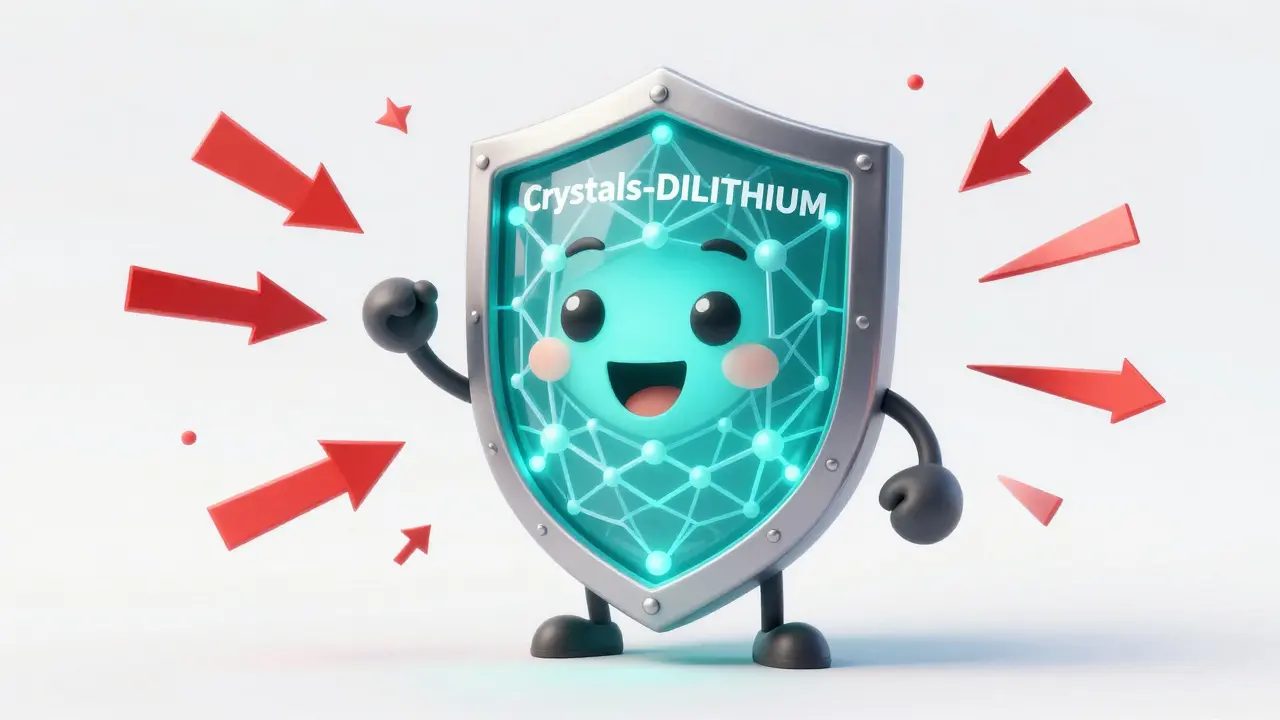
- Crystals-DILITHIUM: Used for digital signatures (proving ownership of funds).
These aren't just theoretical concepts. They are battle-tested algorithms chosen after years of scrutiny by cryptographers worldwide. For cryptocurrency, Crystals-DILITHIUM is particularly relevant because it secures transactions-the core function of any blockchain. However, adopting these standards comes with significant trade-offs that every user and developer must understand.
The Scalability Problem: Size Matters
Here is the catch: post-quantum algorithms are bulky. Current Bitcoin transactions use ECDSA signatures that are about 72 bytes long. A signature using NIST-standardized Crystals-DILITHIUM Level 3 is approximately 2,420 bytes-that’s 33 times larger. To put that in perspective, if Bitcoin switched entirely to DILITHIUM without changing its block size, the network’s throughput would plummet.
| Algorithm | Signature Size | Public Key Size | Signing Time (Modern CPU) | Quantum Security |
|---|---|---|---|---|
| ECDSA (Current Bitcoin Standard) | ~72 bytes | 33 bytes (compressed) | 0.02-0.05 ms | None |
| Crystals-DILITHIUM (NIST Standard) | ~2,420 bytes | 2,500-4,000 bytes | 0.8-1.2 ms | 128-bit |
| SPHINCS+ (Hash-Based) | ~8,000 bytes | ~32 KB | Variable (slower) | Provable | d>
This size increase creates a bottleneck. Bitcoin’s block limit (effectively 4MB with SegWit) handles about 3,000 ECDSA transactions per block. With DILITHIUM, that number drops to 120-250 transactions. For Ethereum, average fees were around $1.50 in September 2023. Implementing DILITHIUM without adjusting block sizes could theoretically push fees above $50 per transaction, based on calculations from the Ethereum Foundation. This is why many experts advocate for Layer-2 solutions or hybrid approaches during the transition.
Who Is Already Adopting Post-Quantum Solutions?
While major players like Bitcoin and Ethereum are still in the research phase, some projects have moved faster. Quantum Resistant Ledger (QRL) launched in June 2018 specifically to offer quantum resistance. QRL uses hash-based signatures via SPHINCS+, which provides provable security but results in massive 8,000-byte signatures. As of September 2023, QRL held a market cap of approximately $35 million, compared to Bitcoin’s $570 billion. The adoption gap highlights a critical tension: security vs. scalability.
Other notable efforts include:
- Ethereum Research: EIP-3037 was proposed in June 2021 to introduce quantum-resistant signatures. The Ethereum Foundation lists quantum resistance as a long-term priority, with research completion targeted for 2025.
- JPMorgan Chase: Filed a patent in January 2023 for "quantum-resistant distributed ledger technology," signaling institutional readiness.
- Google Cloud: Announced testing PQC for blockchain applications in their Confidential Computing environment in September 2023.
Despite these steps, less than 0.1% of total cryptocurrency market capitalization currently uses quantum-resistant cryptography. The barrier isn’t lack of interest-it’s the technical complexity and coordination required to upgrade global decentralized networks.
Harvest Now, Decrypt Later: The Silent Killer
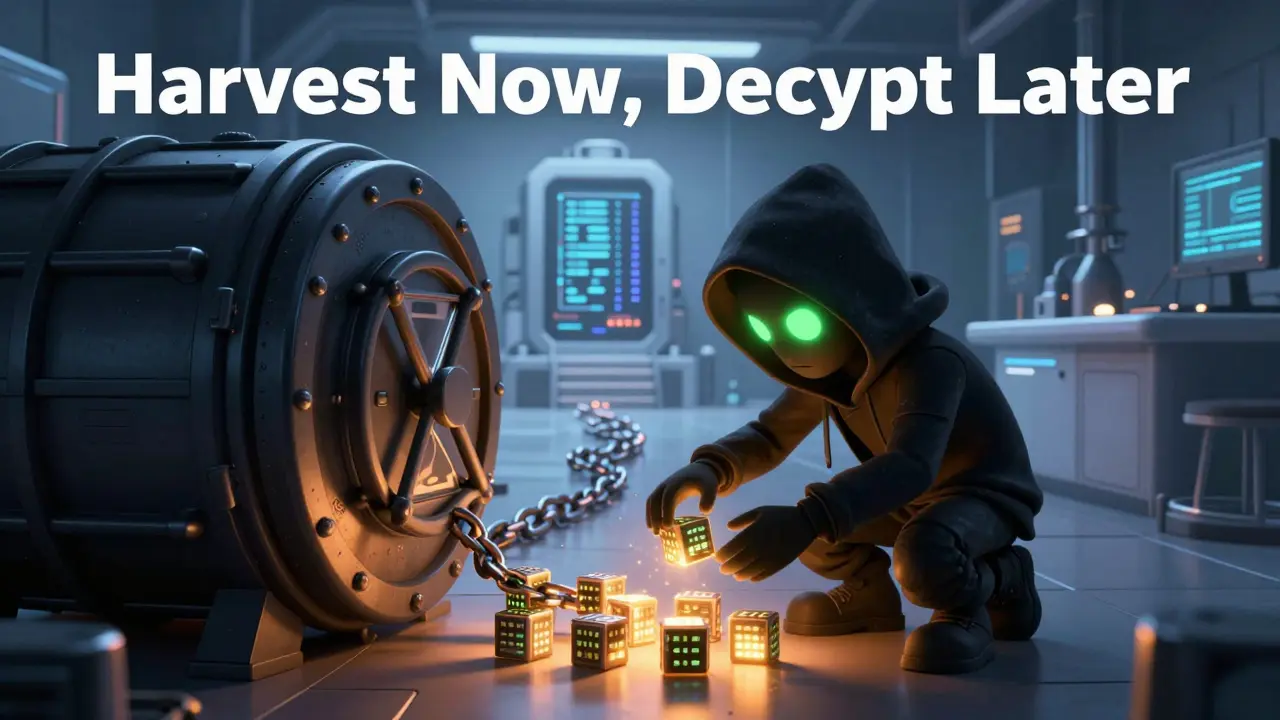
You might wonder, "If quantum computers aren’t here yet, why rush?" The answer is the "harvest now, decrypt later" attack vector. Adversaries-including state actors-are already collecting encrypted blockchain data today. They store it, waiting for the day when quantum computers become powerful enough to break the encryption. Once they have the decryption key, they can retroactively sign fraudulent transactions spending coins from compromised addresses.
Google Cloud’s Chief Scientist for Quantum AI, Hartmut Neven, stated in a September 2023 whitepaper that "the transition to PQC for cryptocurrency must begin now due to the long migration timelines." The U.S. National Security Agency estimated in August 2023 that such collection is already underway. This means the clock started ticking years ago. Every day you wait increases the amount of historical data available for future exploitation.
How Can You Protect Yourself Today?
Until blockchains implement full post-quantum upgrades, individual users can take steps to reduce exposure. Here’s what you can do right now:
- Use Native Segwit Addresses: Legacy Bitcoin addresses (starting with '1') expose your public key when you spend. Native Segwit addresses (starting with 'bc1q') keep your public key hidden until you broadcast a transaction, giving you more time to move funds if a quantum threat emerges.
- Avoid Address Reuse: Never reuse addresses. Each new transaction should generate a fresh address. This limits the amount of data an attacker can collect about any single key pair.
- Move Funds Regularly: Consider consolidating holdings into newer, safer address formats. User 'QuantumHedge' on Bitcointalk documented moving 2.3 BTC from legacy to bech32 addresses in March 2023 to mitigate risk.
- Monitor Protocol Updates: Follow announcements from Bitcoin Core and Ethereum Foundation regarding PQC integration. Early adopters of hybrid wallets may gain an edge.
Remember, no action is foolproof against a future quantum attack, but these steps significantly raise the bar for attackers relying on current vulnerabilities.
The Road Ahead: Hybrid Systems and Hard Forks
Transitioning to post-quantum cryptography won’t happen overnight. Experts predict the first major cryptocurrency hard fork implementing hybrid PQC will occur between 2026 and 2028. A hybrid approach combines traditional ECDSA with PQC algorithms like DILITHIUM. This ensures security even if one algorithm fails, while allowing gradual adaptation to larger signature sizes.
However, implementing PQC requires fundamental protocol changes. Developer Luke Dashjr noted in May 2022 that "PQC integration requires fundamental protocol changes that would necessitate a hard fork, creating significant coordination challenges." Imagine convincing millions of nodes, exchanges, and users to upgrade simultaneously. It’s akin to upgrading the operating system of every computer on Earth without shutting down the internet.
Regulatory pressure may accelerate this process. The European Union’s Cyber Resilience Act, proposed in September 2022, requires "quantum-safe cryptography for critical infrastructure." While not explicitly naming crypto, major exchanges could fall under this umbrella, forcing them to demand quantum-resistant options from underlying blockchains.
Frequently Asked Questions
Will quantum computers destroy Bitcoin?
Not necessarily. Bitcoin can survive if it successfully transitions to post-quantum cryptography. The threat is real, but so is the solution. The challenge lies in executing a coordinated upgrade across the entire network before quantum computers become powerful enough to break ECDSA. Without action, yes, vulnerable funds could be stolen. With proactive migration, Bitcoin remains secure.
When will quantum computers break cryptocurrency encryption?
Estimates vary widely. Dr. Michele Mosca suggests a 50% chance by 2031. Other experts believe it could take several decades. However, the "harvest now, decrypt later" strategy means attackers don’t need to wait-they’re collecting data today. Therefore, preparation must start immediately, regardless of the exact breakthrough date.
Is my Ethereum wallet safe from quantum attacks?
Currently, Ethereum uses ECDSA similar to Bitcoin, making it equally vulnerable to quantum attacks on exposed public keys. If you’ve never revealed your public key (e.g., by only receiving funds), you are safer. But once you send a transaction, your public key is visible on the blockchain. Moving to native Segwit-like structures (if implemented) or avoiding address reuse helps mitigate risk until PQC is adopted.
What is Crystals-DILITHIUM?
Crystals-DILITHIUM is a lattice-based digital signature algorithm standardized by NIST for post-quantum security. It offers 128-bit quantum security, meaning it would require immense computational power-even for quantum computers-to forge a signature. Its main drawback is large signature size (~2,420 bytes), which impacts blockchain scalability.
Should I buy quantum-resistant cryptocurrencies like QRL?
That depends on your investment goals. Projects like Quantum Resistant Ledger (QRL) offer built-in quantum resistance but suffer from lower liquidity, higher fees, and smaller communities compared to Bitcoin or Ethereum. They represent a niche bet on early adoption. For most users, securing existing holdings through best practices (Segwit, no reuse) is more practical than speculating on small-cap altcoins.
How does "harvest now, decrypt later" work?
Attackers record encrypted blockchain transactions today. When quantum computers eventually become powerful enough to break current encryption, they use those records to derive private keys and create fake transactions spending old funds. Since blockchain history is immutable, these fraudulent transactions could be validated if the network hasn’t upgraded to quantum-resistant standards.
Can hardware wallets protect against quantum attacks?
Hardware wallets protect against malware and physical theft, but they do not change the underlying cryptography. If your wallet uses ECDSA and your public key is exposed on-chain, a quantum computer could still derive your private key. Hardware wallets are essential for general security but insufficient alone against quantum threats unless they support PQC algorithms in the future.



Write a comment