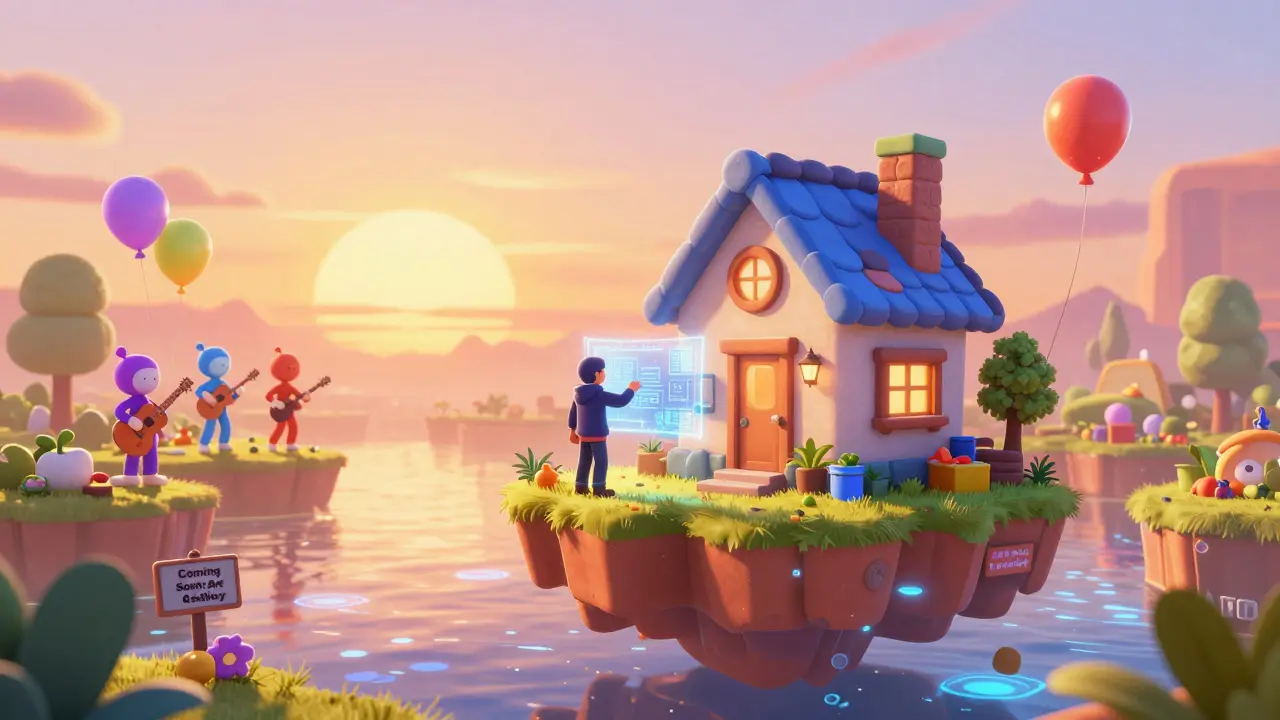
Buying land in the metaverse isn’t science fiction anymore-it’s a real market with billions in transactions, wild price swings, and real businesses operating on digital plots. But here’s the truth: most people who bought virtual land in 2021 lost money. And those who made it? They didn’t just buy a plot. They built something.
Virtual land ownership means owning a piece of digital space in a persistent online world, like Decentraland or The Sandbox. It’s not a screenshot. It’s not a game item. It’s a blockchain-backed asset-a Non-Fungible Token (NFT)-that proves you control a specific location in a virtual world. Unlike physical property, you can’t touch it. But you can build on it, rent it out, host concerts, or sell it for profit. The catch? It only has value if someone else thinks it’s worth something.
How Virtual Land Actually Works
Every parcel of land in the metaverse is tied to a blockchain, mostly Ethereum. Each plot is a unique NFT with a digital ID, coordinates, and smart contract rules. In Decentraland, one LAND equals a 16x16 meter square. In The Sandbox, it’s 96x96 meters. These aren’t arbitrary sizes-they’re baked into the platform’s code. If you own a plot in Decentraland, you can’t use it in The Sandbox. The worlds don’t talk to each other.
Ownership is recorded on the blockchain. No bank. No government. Just a public ledger that says: “This wallet owns this token.” You can transfer it, sell it, or even divide it into fractions using newer smart contracts. That’s the big shift since 2023: you don’t need to buy an entire plot anymore. You can own 5% of a virtual mall and earn rent from advertisers.
The technical setup is simple: get a crypto wallet (like MetaMask), buy Ethereum or MATIC, go to the platform’s marketplace, and click “Buy.” But don’t underestimate the hidden costs. Gas fees during peak times in 2021 hit over $100 per transaction. Even now, with Polygon-based land, you’re still paying $2-$10 just to move your NFT. And if your wallet connection fails? You’re stuck. No customer service. No refund.
Why People Thought It Was a Gold Rush
Back in late 2021, the hype was insane. Meta (formerly Facebook) rebranded. Snoop Dogg bought land in The Sandbox. Sotheby’s hosted an NFT auction in Decentraland. Prices exploded. Prime plots on Fashion Street in Decentraland sold for $450,000. A single plot in The Sandbox’s VIP district hit $1.3 million. People were flipping land like it was Bitcoin in 2017.
What drove it? Three things:
- Scarcity: Each platform limits how many parcels exist. Decentraland has 90,601 total LANDs. That’s it.
- Speculation: Investors bought land hoping someone else would pay more later.
- Corporate FOMO: Brands like Samsung, JPMorgan, and Atari rushed in to claim digital real estate before competitors did.
By early 2022, over $900 million changed hands in virtual land sales. But then the crypto market crashed. Ethereum’s price dropped. Gas fees stayed high. And suddenly, the fantasy cracked.
The Reality Check: What Happened After the Boom
By mid-2023, transaction volumes had dropped 87%. The market isn’t dead-it’s sobering up.
Here’s what changed:
- Prices crashed: Plots that sold for $10,000 in 2021 were worth under $1,000 by 2023. One Reddit user saw their $250,000 portfolio drop to $20,000 in 18 months.
- Dead districts emerged: In Decentraland, 87% of parcels in “Crypto Valley” remain empty. No buildings. No visitors. Just digital ghosts.
- Ownership shifted: In 2021, individual investors bought 71% of land. By 2023, institutions (like Republic Realm and Yield Guild Games) owned 63% of high-value sales.
The biggest lesson? Land doesn’t have value just because it’s scarce. It needs use.
Real Use Cases That Are Actually Making Money
Forget flipping. The winners now are builders.
Republic Realm bought 116 parcels in The Sandbox for $4.3 million. They didn’t sit on them. They built an Atari-themed world with games, ads, and merch. In 2022, it generated $1.2 million in monthly revenue.
Sotheby’s hosted a virtual art show in Decentraland during Art Basel. 7,000+ people showed up. They sold $500,000 in NFTs. Not because the land was valuable. Because the experience was.
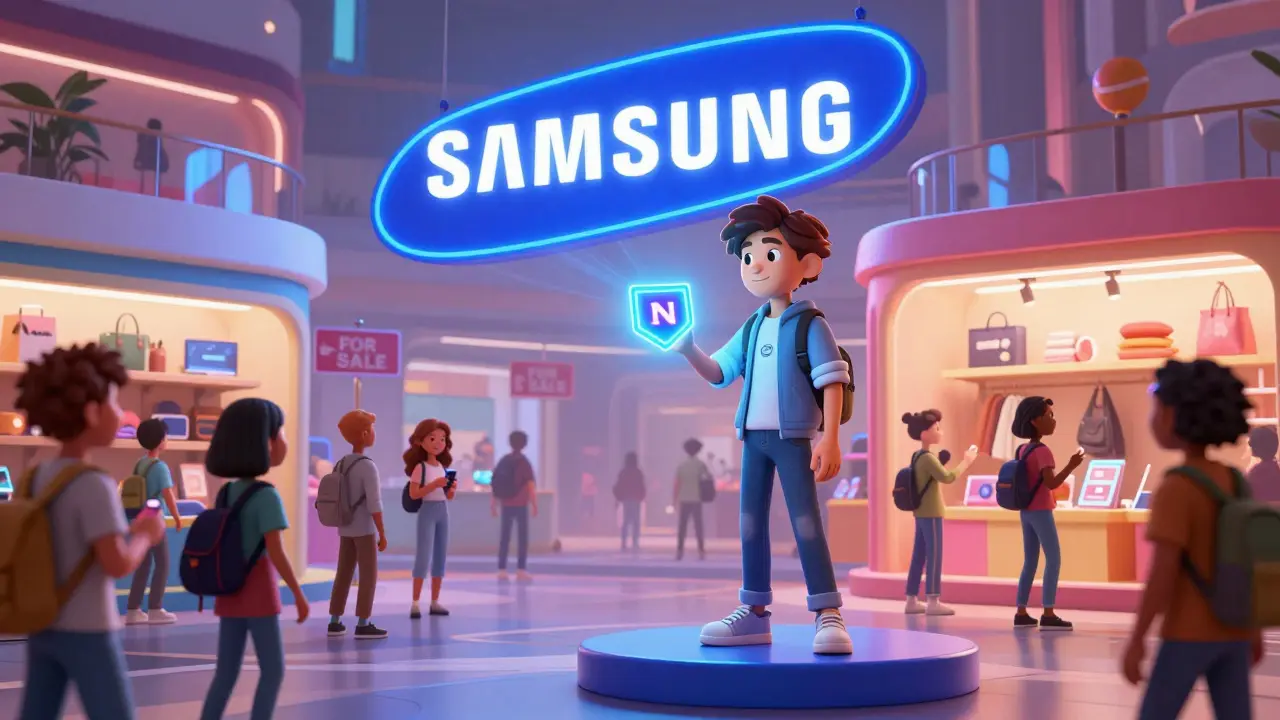
Brands like Samsung and JPMorgan now run virtual stores and lounges. Samsung’s 82-store in The Sandbox gets 15,000 visitors a week. JPMorgan’s lounge hosts client meetings. These aren’t gimmicks-they’re customer engagement tools.
Even individuals are finding ways: musicians host concerts. Artists sell digital galleries. Creators rent out their land for events. The value isn’t in the plot. It’s in what you do with it.
The Big Problems Nobody Talks About
Here’s what most guides skip:
- No legal protection: If someone steals your land through a hacked wallet? No court will help you. There’s no “metaverse police.”
- Platform risk: What if The Sandbox shuts down? Your NFT becomes a digital relic. No value. No backup.
- Interoperability is a myth: You can’t take your Decentraland house to The Sandbox. Even avatar tools like Ready Player Me only work in select platforms.
- Environmental cost: Ethereum used to consume 26.5 kWh per transaction. That’s the same as running a fridge for a day. While the Merge reduced this, many newer platforms still rely on energy-heavy chains.
- Smart contract bugs: In 2022, a flaw in The Sandbox’s minting contract led to a $1.5 million exploit. You own an NFT? You’re trusting code written by strangers.
And then there’s the biggest question: Who’s actually using these places?
Most virtual worlds have fewer than 10,000 daily active users. Compare that to Roblox’s 70 million. The metaverse isn’t a mass market yet. It’s a niche playground for crypto enthusiasts and corporate experimenters.
Who Should Even Consider Buying?
Here’s the honest breakdown:
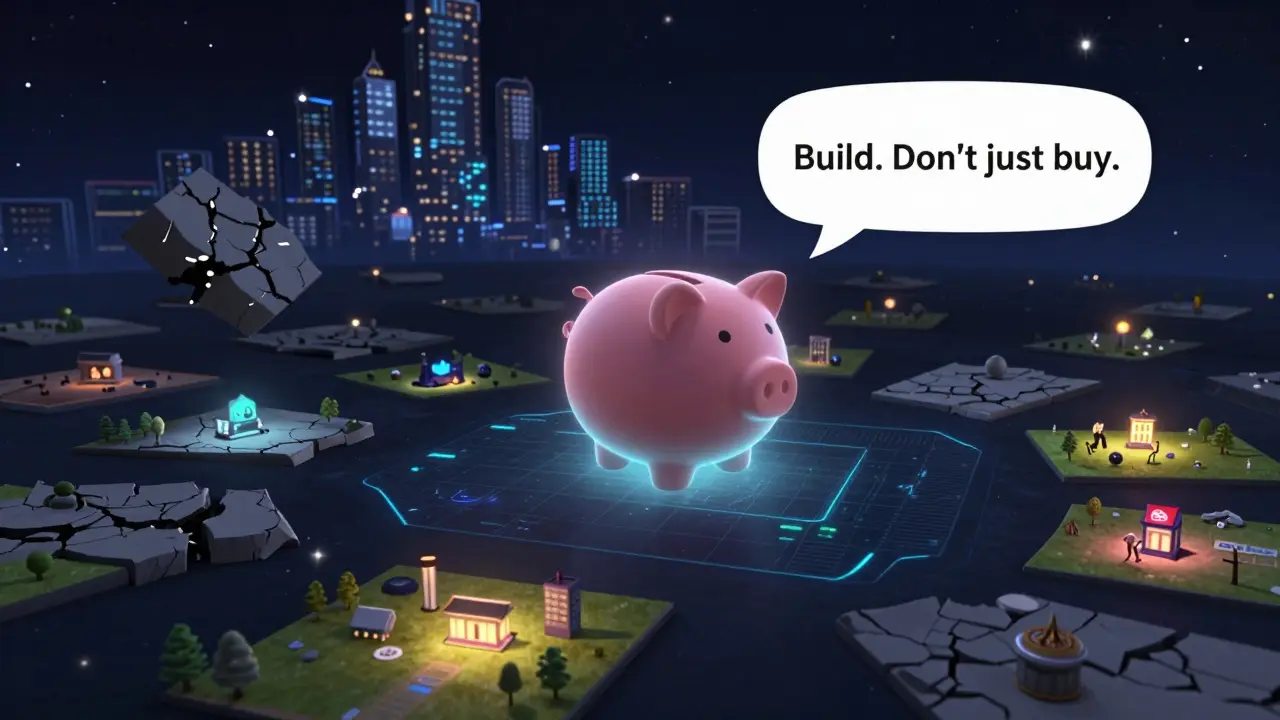
- Don’t buy if: You’re looking for an investment. You don’t know how to use a crypto wallet. You expect your land to appreciate like Bitcoin.
- Buy if: You’re a creator and want to build a digital space. You’re a brand testing virtual marketing. You’re comfortable losing your entire investment. You enjoy being part of an early tech experiment.
There’s no “best” platform. Decentraland is open, developer-heavy, and favors creators. The Sandbox is more user-friendly, with better tools for non-coders. Newer platforms like Bloktopia (a 21-story Bitcoin-themed skyscraper) or Spatial.io (for meetings) offer niche use cases.
Start small. Buy one parcel for under $500. Build something simple-a gallery, a logo, a pop-up shop. See if people come. If they do, you’ve got a real project. If not? You lost $500. Not $50,000.
What’s Next? The Road to 2026
Gartner predicts 25% of people will spend at least one hour a day in the metaverse by 2026-for work, shopping, or socializing. That’s real.
But here’s the twist: the future isn’t about owning land. It’s about owning experiences. Companies aren’t buying plots. They’re buying access-to audiences, to data, to engagement.
Deloitte’s 2023 report says virtual land will stabilize at $50-70 billion by 2027. That’s down from $900 billion in 2021. But it’s still massive. And it’s not based on speculation anymore. It’s based on usage.
Platforms are adapting. The Sandbox launched v2.0 smart contracts in March 2023 that let owners update content without selling the land. That’s huge. It means your virtual store can evolve without needing to relist.
And regulation? It’s coming. South Korea has rules. The EU’s MiCA framework might classify some virtual assets as digital property. The U.S. is watching. The legal gray zone won’t last forever.
Final Thought: It’s Not About the Land. It’s About the Layer.
Virtual land ownership isn’t about owning pixels. It’s about owning a layer of the next internet. The same way websites needed domains in the 1990s, the metaverse needs digital addresses. But not every domain becomes Google. Most become forgotten blogs.
If you’re thinking of buying, ask yourself: What will I build? Not what I’ll sell. Not what I’ll flip. What will I create?
Because in the end, the metaverse doesn’t reward landowners.
It rewards builders.
Can you really make money from virtual land in 2026?
Yes-but not by buying and holding. The days of flipping land for quick profits are over. Real money now comes from building functional spaces: virtual stores, art galleries, event venues, or branded experiences. Companies like Republic Realm and Samsung are earning six-figure monthly revenue from their metaverse properties. Individuals can too, by hosting events, renting space, or selling digital goods. The key is utility, not scarcity.
Is virtual land a good investment?
As an investment? Only if you treat it like a startup. Most plots have lost 70-90% of their 2021 peak value. There’s no guarantee it will rebound. If you’re looking for stable returns, skip it. But if you’re willing to experiment, build, and take risks, it can be a low-cost way to enter the next wave of digital commerce. Think of it as buying a plot in a new tech hub-not a house in a proven neighborhood.
What’s the difference between Decentraland and The Sandbox?
Decentraland is more open and developer-focused. It uses a grid system with fixed 16x16 meter plots and supports full Unity-based development. The Sandbox is more game-like, with easier building tools (VoxEdit) and a focus on gaming and entertainment. The Sandbox dominated sales volume in 2022, but Decentraland has stronger developer tools. If you’re a coder, Decentraland gives you more control. If you’re a designer or brand, The Sandbox is more beginner-friendly.
Do I need to know how to code to buy virtual land?
No. You can buy land without coding. But if you want to build something useful on it, you’ll need at least basic 3D modeling skills or hire someone. Platforms like The Sandbox let you create simple experiences with drag-and-drop tools. For advanced builds-like interactive games or custom stores-you’ll need Unity, C#, or Blender. The barrier isn’t buying. It’s building.
Can I lose my virtual land?
Yes. If you lose your private key, your land is gone forever. There’s no password reset. No customer support. If the platform shuts down (like many have), your NFT becomes worthless. And if someone hacks your wallet, they can transfer your land. Blockchain secures ownership-but it doesn’t protect you from human error or theft. Treat your private key like cash in a safe.
Is virtual land environmentally harmful?
It depends on the platform. Ethereum, the original chain for most metaverse land, used to consume 26.5 kWh per transaction-equivalent to running a fridge for a day. After the 2022 Merge, Ethereum’s energy use dropped by 99.95%. Most new land is now on Polygon or other low-energy chains, making transactions nearly negligible. Still, older land purchases and transfers may have left a footprint. If sustainability matters to you, choose platforms built on eco-friendly blockchains.


20 Comments
Lucy Simmonds
This whole metaverse thing is a scam. They're selling pixels like they're gold. Remember when people bought Beanie Babies? Same energy. I bought one plot for $800. Now it's worth $45. And don't even get me started on the 'builders'-they're just people with Photoshop skills and too much time on their hands. 💀
Maggie House
I think it's kinda beautiful actually. I bought a tiny plot just to host my digital art. No one’s there yet... but one day maybe? It’s like planting a tree you’ll never sit under. Still worth it. 🌱
Dana Sikand
I’ve been in this space since 2021 and I’ve seen it all. The hype was insane but the real magic happened when people stopped thinking about flipping and started thinking about building. I run a virtual bookstore now-people come in, chat, buy signed NFTs. It’s not about the land. It’s about the community. You don’t need a million dollars. Just a good idea and the guts to try.
Jessica Carvajal montiel
They don’t want you to know this but the metaverse is a government-backed surveillance experiment. Every time you log in, they track your eye movements, your voice tone, your emotional response. The ‘land’? It’s just a lure. The real product is your biometric data. They’re building the blueprint for a digital police state. Wake up. The Merge? That was just cover for the real upgrade. You think Ethereum is decentralized? It’s owned by three hedge funds and a Chinese mining pool.
maya keta
If you're still buying land on Polygon, you're already behind. Real builders use Solana. And if you're using MetaMask? Honey, you're using a 2018 wallet. You need Phantom. You need Raydium. You need to be on the edge. I bought 12 parcels in 2022. They're now worth 3x. You're not poor. You're just lazy.
Curtis Dunnett-Jones
While the speculative frenzy surrounding virtual land ownership has undoubtedly subsided, it remains a compelling frontier for digital innovation. The structural underpinnings of blockchain-based asset ownership are not only sound, but represent a foundational shift in how humans conceptualize property in the digital age. One must approach this not as a financial instrument, but as a sociotechnical experiment of unprecedented scope.
Sean Logue
I’m from Nigeria and I’ve seen how this tech changes lives. My cousin in Lagos built a virtual salon in The Sandbox. Now she teaches hair braiding to 300 kids a week. No one paid her for it. But they donated crypto. She bought a real sewing machine with it. This isn’t fantasy. It’s survival. The metaverse isn’t for rich guys in San Francisco. It’s for people who need to build something from nothing.
Carl Gaard
I tried to buy land once. I clicked buy. My wallet crashed. I lost $300. No one helped. No one even replied. I just... gave up. I still have the NFT. It’s just sitting there. A digital ghost. 😔
bella gonzales
I don’t get why people care. It’s just games. I have a cat. My cat is more real than any of this. Why are we wasting time on this? Just... why?
Paul Reinhart
I think the real question isn’t whether virtual land has value-it’s whether we’re ready to accept that value can exist outside of physical form. For centuries, land meant food, shelter, power. Now, it’s attention, interaction, experience. We’re not losing something. We’re expanding what ownership means. I used to think this was nonsense. Now I see it as a mirror. We’re not building worlds. We’re revealing who we are.
Samantha Stultz
You people don’t even understand how the smart contracts work. The Sandbox’s v2.0 isn’t ‘user-friendly’-it’s a honeypot for rug pulls. The minting API has a backdoor that allows the core team to mint unlimited parcels. I’ve got the logs. The whole thing is rigged. And you’re all just clicking ‘buy’ like sheep. You think you own something? You’re a data point in their analytics dashboard.
Robert Conmy
Stop pretending this isn’t a pyramid scheme. The only ones making money are the ones who sold before the crash. Everyone else is just feeding the machine. You’re not a builder. You’re a sucker. And if you think Samsung or JPMorgan are ‘building’? They’re just using it as a tax write-off. The real value is in the hype. And hype dies.
Lilly Markou
I find this entire concept deeply unsettling. The erosion of tangible value in favor of digital abstractions is not progress-it is alienation. To assign worth to pixels governed by unregulated code, under the illusion of ownership, is to surrender our connection to the physical world. I cannot, in good conscience, endorse this.
McKenna Becker
The land isn’t the point. The act of building is. If you’re waiting for permission to create, you’ll never start.
precious Ncube
If you’re still using Ethereum, you’re outdated. The future is Solana. The future is StarkNet. The future is not for amateurs. If you can’t spell ‘smart contract’ without Google, you shouldn’t be here.
Jan Czuchaj
I used to think this was all nonsense. Then I watched a 70-year-old woman in rural Ohio host a virtual poetry reading on her parcel. 200 people showed up. From 12 countries. She cried. She said it was the first time she felt heard. That’s not tech. That’s human. Maybe the metaverse isn’t about land. Maybe it’s about connection. And maybe that’s worth something.
Tracy Peterson
I bought a plot in Decentraland because I was bored. Now I run a free coding class for teens. 300 kids have passed through. 12 are now devs. I didn’t make money. But I made a difference. That’s the real ROI. Stop chasing price charts. Start building something that matters.
George Suggs
I’ve got one parcel. It’s empty. I like it that way. Sometimes silence is the best design.
Dianna Bethea
If you’re new to this, start small. Don’t go all-in. Buy one plot for under $100. Try dragging a 3D model onto it. Make a sign. Say hi. If someone replies, you’re already ahead. You don’t need to be a coder. You just need to be curious. I’ve helped 12 beginners this year. All they needed was someone to say: ‘You can do this.’
KingDesigners &Co
The metaverse isn’t dead. It’s evolving. And the winners? They’re not the ones who bought land. They’re the ones who built tools for others to build. I made a plugin that lets anyone turn a JPEG into a 3D storefront. 10,000 creators use it. I don’t own a single plot. But I’m the one making the real money.