Trading stablecoins shouldn't feel like gambling, but on most exchanges, it often does. You swap one dollar-pegged asset for another, and suddenly you've lost a chunk of value to slippage. That was the problem Curve Finance was built to solve, and the Curve DAO Token (CRV) is the key that unlocks its full potential. If you've been hearing about CRV in crypto circles but aren't sure if it's just another governance token or something with real utility, you're in the right place. By 2026, Curve has cemented itself as essential infrastructure for the decentralized finance (DeFi) world, handling billions in volume simply because it makes moving stable money efficient.
This isn't about hype or moonshots. It's about understanding a mechanism that powers a massive chunk of the crypto economy. Whether you're a trader looking to minimize fees or an investor curious about yield farming, understanding CRV is non-negotiable. Let's break down exactly what this token does, how the locking mechanism works, and why it remains a cornerstone of the Ethereum ecosystem.
Quick Summary: What You Need to Know
- Curve DAO Token (CRV) is the native governance token of Curve Finance, a decentralized exchange optimized for stablecoins.
- It operates on the Ethereum blockchain as an ERC-20 token with a fixed supply of roughly 3 billion.
- Holders can lock CRV to receive veCRV, which grants voting power and boosts trading rewards.
- Curve uses a unique stableswap algorithm that significantly reduces slippage compared to standard exchanges like Uniswap.
- The ecosystem includes major partners like Convex Finance, which simplifies the process of earning rewards from CRV.
What is Curve Finance?
To understand the token, you first need to understand the platform. Curve Finance is a decentralized exchange (DEX) protocol. Unlike your typical exchange where you trade Bitcoin for Ethereum, Curve specializes in assets that are supposed to be worth the same amount. Think USDC, DAI, and USDT. These are all stablecoins pegged to the US dollar.
The problem with trading these on a standard exchange is that even though they are both worth $1, their market prices fluctuate slightly due to supply and demand. A standard Automated Market Maker (AMM) model, like the one used by Uniswap, treats every trade the same. If you swap a volatile asset, the price curve is steep. If you swap stablecoins on Uniswap, you still face unnecessary slippage because the math isn't optimized for assets with the same value.
Curve solved this with its stableswap invariant. This is a mathematical formula that adjusts the price curve dynamically. When assets are near parity (like $1.00 and $1.00), the curve is very flat, meaning you can trade large amounts with almost zero slippage. When assets drift apart, the curve steepens to protect liquidity providers. This design makes Curve the go-to venue for stablecoin swaps, processing billions in daily volume.
Understanding the Curve DAO Token (CRV)
The Curve DAO Token (CRV) is the fuel that keeps this engine running. Launched in August 2020, it serves two main purposes: governance and incentives. As a governance token, it allows holders to vote on how the protocol evolves. This includes decisions on new trading pairs, fee structures, and treasury management. It's a decentralized autonomous organization (DAO), meaning the community, not a central company, runs the show.
However, the utility goes deeper. CRV is used to reward liquidity providers. When you deposit assets into a Curve pool to facilitate trades, you earn fees. But on top of those fees, you also earn CRV tokens. This creates a flywheel effect: more CRV rewards attract more liquidity, which makes the pools deeper, which attracts more traders, which generates more fees.
Technically, CRV is an ERC-20 token, meaning it lives on the Ethereum blockchain. It has a fixed maximum supply of 3,030,000,000 tokens. This fixed supply is important because it prevents inflation from diluting the value indefinitely, although the distribution schedule matters. Originally, 62% of the supply was allocated to liquidity providers to bootstrap the network, while 30% went to founders and shareholders with vesting schedules.
The veCRV Mechanism: Locking for Power
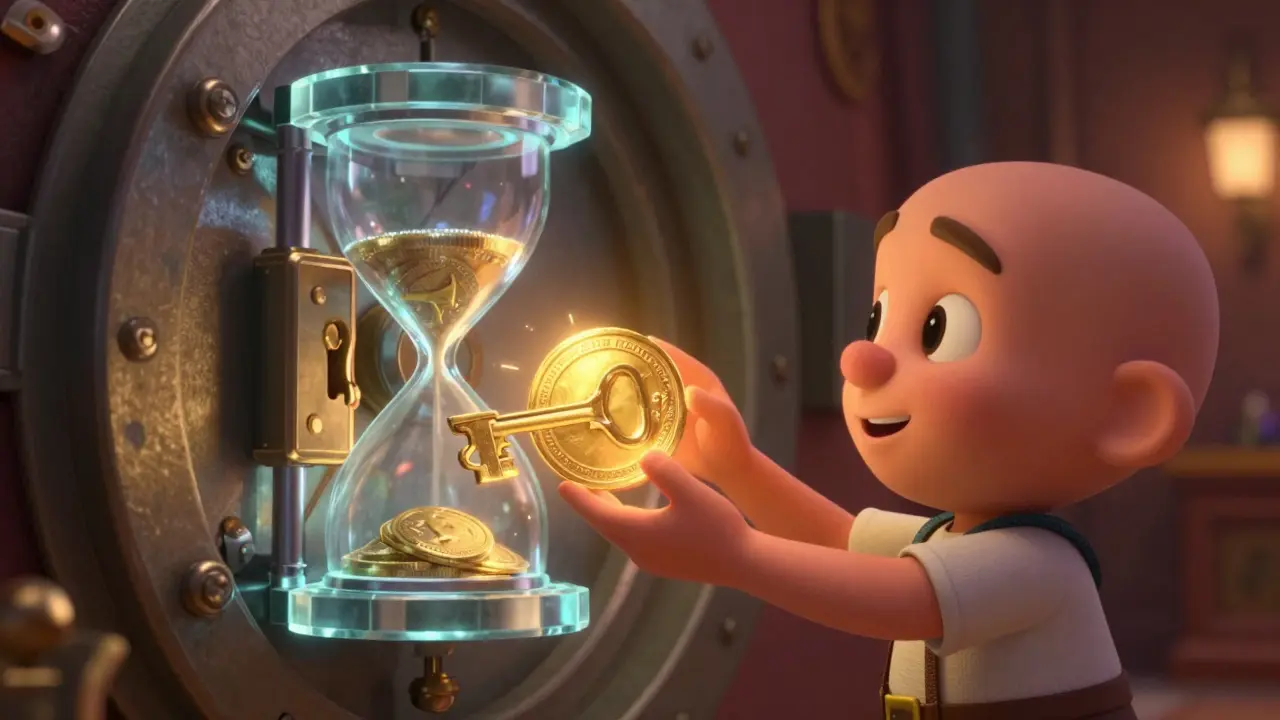
This is where things get interesting and slightly more complex. Simply holding CRV in your wallet gives you basic governance rights, but the real power lies in veCRV (vote-escrowed CRV). This is a mechanism where you lock your CRV tokens for a specific period, ranging from 1 day up to 4 years.
Why would you lock your tokens? Because locking converts your CRV into veCRV, which has two superpowers:
- Voting Power: veCRV holders vote on which liquidity pools receive a larger share of the CRV emissions. This is crucial because pools with more votes get more rewards, attracting more liquidity. It allows the community to direct capital where it's needed most.
- Reward Boosts: If you provide liquidity to a Curve pool, you can boost your CRV rewards by up to 2.5x based on how much veCRV you hold. The formula is roughly proportional to your locked amount relative to the total locked supply.
The math is straightforward: veCRV = CRV amount * (lock duration / 4 years). So, if you lock 100 CRV for 2 years, you get 50 veCRV. If you lock for 4 years, you get the full 100 veCRV. This mechanism aligns long-term holders with the health of the protocol. It discourages short-term speculation and encourages people to keep their capital locked in the system.
Curve vs. Uniswap: A Direct Comparison
Many new users ask why they should use Curve instead of the more famous Uniswap. The answer depends entirely on what you are trading. Uniswap is a general-purpose DEX. It uses a constant product formula (x * y = k). This works great for volatile assets like ETH or SOL, but it's inefficient for stablecoins.
| Feature | Curve Finance | Uniswap |
|---|---|---|
| Primary Use Case | Stablecoins and similar assets | General crypto assets (volatile) |
| Slippage on Stablecoins | Very Low (<0.05%) | Higher (0.3% - 0.5%) |
| Algorithm | Stableswap Invariant | Constant Product (x * y = k) |
| Governance Token | CRV (Lockable for veCRV) | UNI (Standard voting) |
| Impermanent Loss Risk | Low for stable pairs | High for volatile pairs |
If you try to swap $10,000 worth of USDC for USDT on Uniswap, you might lose $30 to $50 in slippage. On Curve, that same trade might cost you less than $5. That efficiency is why institutions and whales prefer Curve for stablecoin management. However, Curve is not designed for trading Bitcoin against Ethereum. For that, Uniswap or Balancer is better suited.
The Ecosystem: Convex and Others
Managing veCRV can be tricky. You have to decide how long to lock, when to vote, and how to optimize your yield. This complexity led to the rise of third-party platforms like Convex Finance. Convex allows users to deposit their CRV or liquidity provider (LP) tokens and automatically manages the locking and voting process for them.
Users on Convex often earn higher yields because the platform aggregates the voting power and rewards, then distributes them to depositors. It abstracts away the technical headache of interacting with the Curve DAO directly. While this makes earning CRV easier, it does introduce a layer of dependency on a third-party smart contract. Always remember that in DeFi, every additional layer adds a bit more risk.
Another key player is StakeDAO, which offers similar yield optimization strategies. These platforms have become integral to the Curve ecosystem, helping to maximize the Total Value Locked (TVL) in the protocol. As of late 2023, Curve maintained a TVL of around $2.8 billion, a testament to how effective these optimization layers are at attracting capital.

Risks and Considerations
Before you dive in, you need to be aware of the risks. The first is Impermanent Loss. While Curve minimizes this for stablecoins, it's not zero. If one stablecoin de-pegges (like USDT dropping to $0.98), you could end up holding more of the devalued asset. This is a real risk in the stablecoin market.
Second, there is smart contract risk. Curve has been audited by firms like Trail of Bits, and the code is generally considered robust. However, no code is perfect. A vulnerability in the stableswap algorithm or the locking mechanism could theoretically be exploited. Always use a hardware wallet and never invest more than you can afford to lose.
Finally, regulatory risk is a factor. In 2023, the SEC mentioned CRV in guidance regarding governance tokens potentially being securities. While Curve has taken steps to comply, the regulatory landscape for DeFi tokens remains uncertain. This could affect how easily you can trade CRV on centralized exchanges in the future.
How to Get Started with CRV
Getting into Curve is straightforward if you have a MetaMask wallet and some ETH for gas fees. Here is the basic path:
- Connect Wallet: Go to the Curve.fi website and connect your Ethereum wallet.
- Buy CRV: Purchase CRV on a centralized exchange or swap ETH for CRV directly on Curve.
- Choose a Pool: Navigate to the 'Pool' tab and select a stablecoin pool (e.g., 3pool with USDC, DAI, USDT).
- Provide Liquidity: Deposit your stablecoins. You will receive LP tokens representing your share.
- Stake for CRV: Go to the 'Gauge' tab and stake your LP tokens to earn CRV rewards.
- Optional Lock: If you want to boost rewards, go to the 'Vote' tab and lock your CRV to get veCRV.
For most beginners, simply providing liquidity and earning CRV without locking is a good starting point. It lets you learn the mechanics without committing your tokens for years. Once you understand the flow, you can experiment with locking strategies or using platforms like Convex.
Next Steps and Troubleshooting
If you encounter issues, the most common problem is gas fees. During network congestion on Ethereum, transaction fees can spike, making small trades unprofitable. Always check the gas tracker before interacting with the protocol. If fees are too high, consider using Curve on a Layer 2 network like Polygon or Avalanche, where Curve also operates with much lower costs.
Another common pitfall is miscalculating lock durations. If you lock for 4 years and the price of CRV drops significantly, you are stuck with that value until the lock expires. A strategy many users employ is locking for shorter periods (6 months to 1 year) to maintain flexibility. There is no one-size-fits-all answer, but flexibility often beats maximum yield in volatile markets.
What is the main purpose of the Curve DAO Token (CRV)?
The CRV token serves as the governance token for Curve Finance, allowing holders to vote on protocol changes. Additionally, it acts as a reward mechanism for liquidity providers who deposit assets into Curve pools to facilitate trading.
How does veCRV work?
veCRV is created when users lock their CRV tokens for a set period (up to 4 years). Holding veCRV grants voting power on liquidity mining emissions and allows liquidity providers to boost their CRV rewards by up to 2.5x.
Is Curve Finance safe to use?
Curve has undergone multiple audits by firms like Trail of Bits and has a strong track record. However, like all DeFi protocols, it carries smart contract risk and impermanent loss risk, especially if stablecoins de-peg.
Can I use CRV on networks other than Ethereum?
Yes, Curve has expanded to multiple chains including Polygon, Avalanche, Fantom, and Arbitrum. This allows users to trade and earn CRV rewards with lower gas fees compared to the Ethereum mainnet.
What is the difference between Curve and Uniswap?
Curve is optimized for stablecoin trading with low slippage using a stableswap algorithm. Uniswap is a general-purpose DEX using a constant product model, which is better for volatile assets but less efficient for stablecoins.
How do I earn yield on CRV?
You can earn yield by providing liquidity to Curve pools and staking your LP tokens in governance gauges. You can also lock CRV to earn voting power or use platforms like Convex Finance to optimize your returns.
What is the total supply of CRV?
The maximum supply of Curve DAO Token is fixed at 3,030,000,000 CRV. This fixed supply helps prevent inflationary pressure on the token value over time.
Does CRV have a dividend or buyback?
CRV does not pay dividends in the traditional sense. However, protocol fees generated by trading can be distributed to veCRV holders through specific governance proposals, effectively acting as a value accrual mechanism.


13 Comments
Shayne Cokerdem
peopl forget impermant loss can stil eat your gains
John Alde
The stableswap invariant is really what changed the game for everyone. Most people think AMMs are all the same but they are not. You need to understand the math to see why slippage is lower. When assets are pegged the curve stays flat for a long time. This allows huge trades without moving the price too much. That is why institutions use Curve for their stablecoin swaps. The governance token adds another layer of complexity though. Locking tokens creates the vote escrowed mechanism we see now. People lock for years to get the full voting power boost. It aligns incentives between the traders and the liquidity providers. Without this lockup the emissions would just be farmed and dumped. Convex Finance made it easier for normal users to participate. They handle the locking so you do not have to manage the time. Still the risk of smart contract bugs is always there to consider. Security audits are frequent but nothing is ever truly safe in DeFi. I think the ecosystem will keep growing as long as stablecoins exist.
Andy Green
the average investor misses the point about value accrual entirely
Jenni Moss
you have the power to shape the future of finance right now
vu phung
the bonding curve mechanics are actually quite elegant in design
Pradip Solanki
veCRV is just a way to lock value but why bother if the protocol changes
Tony Phillips
seems like a solid play for anyone holding stablecoins
Anna Lee
I love the boosts and the rewards are amzing
Alice Clancy
us crypto is the best dont listen to others :)
Dominic Taylor
liquidity mining incentives need to be sustainable long term
Mohammed Tahseen Shaikh
stop sleeping on this protocol it is a beast
Sarah Terry
the math checks out for stablecoin swaps
manoj kumar
too complicated for most people to understand properly