
You might have seen the hype around Million Token, also known as MM or a decentralized digital currency and social token with a strictly fixed supply of exactly 1,000,000 tokens. It was launched on 1 July 2021 by Patrick Shyu, better known online as "TechLead," a former Google and Facebook engineer with over a million YouTube subscribers. But here is the catch: this isn't your typical cryptocurrency designed for payments or smart contracts. It was created as a scarcity-based social experiment.
If you are wondering whether MM is a legitimate investment, a scam, or just a meme coin that lost its spark, you are not alone. Since its launch in 2021, MM has swung from trading at over $200 per token to hovering right around its intended $1 floor. By mid-2026, the token sits at a micro-cap status, trading between $0.99 and $1.00. Let's break down what MM actually is, how it works, and why it remains controversial five years later.
The Core Concept: Scarcity Over Utility
Most cryptocurrencies, like Bitcoin or Ethereum, have supplies that can grow over time through mining or staking rewards. Bitcoin has a cap of 21 million coins, but new ones are still being mined. Million Token differs because it has an absolute maximum supply of 1,000,000 tokens, encoded directly into its smart contract so that no new tokens can ever be minted beyond this cap.
The project’s marketing leans heavily on this scarcity. The official site claims MM is "21× the rarity of Bitcoin" and boasts a 0.00% inflation rate. For context, Bitcoin has an approximate annual inflation rate of 2.0%, while Ethereum and Dogecoin sit around 4.2% and 3.8% respectively. The idea is simple: if supply cannot increase, demand should theoretically drive the price up forever. However, critics argue that without utility-meaning real-world use cases like payments or governance-the token relies entirely on speculative buying pressure.
How the "Liquidity Wall" Works
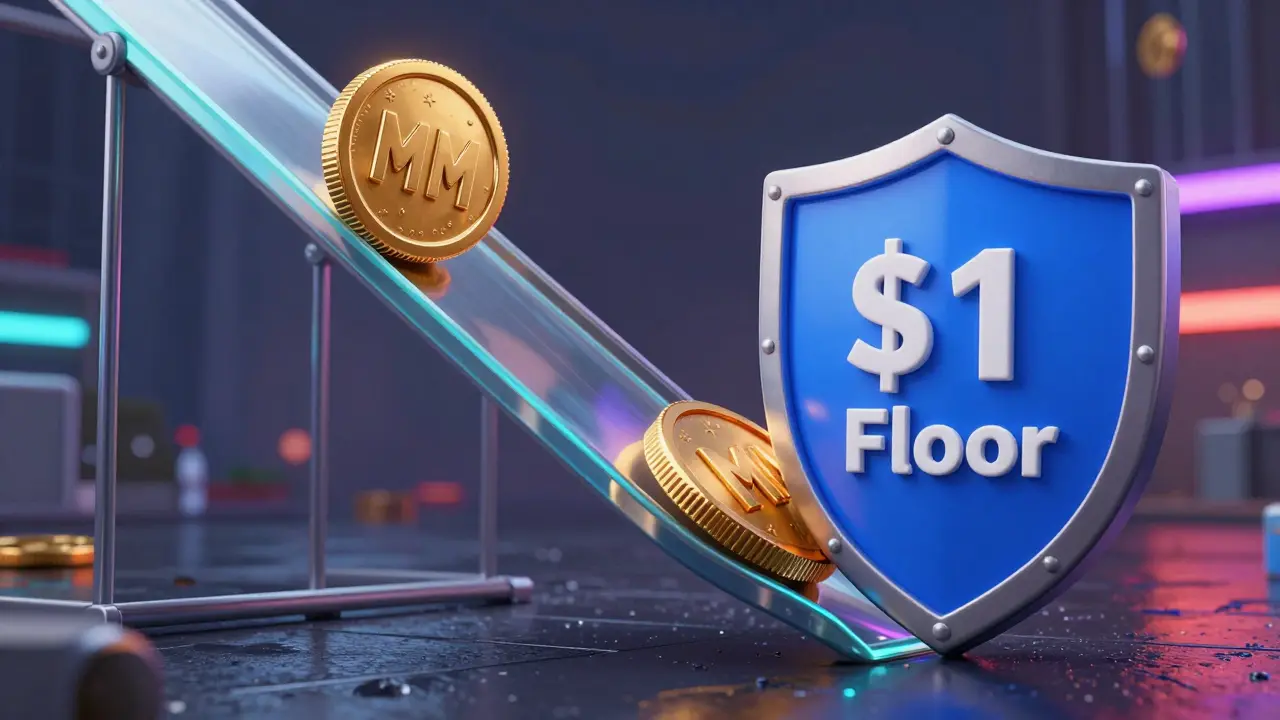
One of the most unique aspects of MM is its pricing mechanism. Patrick Shyu marketed MM as being pegged to a minimum value of 1.00 USDC per token via a concept called a "liquidity wall." In theory, this means there is on-chain liquidity denominated in USDC backing a floor price of $1 per MM. If the market price drops toward $1, the liquidity pool is supposed to support it, preventing further crashes below that threshold.
However, it is crucial to understand that MM is not a stablecoin. Stablecoins like USDT or USDC maintain their value through reserves or algorithms that adjust supply. MM allows its price to float above $1 based on demand. As Gate.io noted in April 2026, MM is not a classical stablecoin; its market price is allowed to fluctuate, and there is no algorithmic supply adjustment. This distinction matters because it means holders can lose money if the price falls below their entry point, even if it stays near the $1 floor.
Technical Architecture and Availability
Technically, MM operates as an ERC-20 token on the Ethereum blockchain and as a BEP-20 token on Binance Smart Chain (BSC). This multi-chain presence makes it accessible to users across different ecosystems. You can find MM listed on centralized exchanges like Gate.io, ZT Global, and Bilaxy, as well as on various decentralized exchanges (DEXs).
For those looking to buy or trade MM, the process involves standard cryptocurrency knowledge. You need a wallet compatible with ERC-20 or BEP-20 tokens, such as MetaMask or Trust Wallet. When interacting with DEXs, you must be vigilant about contract addresses. The official r/milliontokenofficial subreddit frequently warns users about imitation scam coins that spoof MM’s branding. Always verify the contract address before sending funds.
| Feature | Million Token (MM) | Bitcoin (BTC) | Ethereum (ETH) |
|---|---|---|---|
| Max Supply | 1,000,000 | 21,000,000 | Infinite (uncapped) |
| Inflation Rate | 0.00% | ~2.0% annually | ~4.2% annually |
| Pricing Model | Floating with $1 USDC floor | Market-driven | Market-driven |
| Primary Use Case | Social experiment / Speculation | Store of value / Payments | Smart contracts / DeFi |
| Blockchain | Ethereum (ERC-20), BSC (BEP-20) | Bitcoin Network | Ethereum Network |
Price History: From Hype to Reality
The journey of MM’s price is a classic case study in crypto volatility. At launch in July 2021, MM started at $1. Within weeks, driven by TechLead’s massive audience and FOMO (fear of missing out), the price skyrocketed. Community reports from Reddit indicate an all-time high (ATH) of approximately $223 per MM. Some users saw gains of over 200x in a matter of days.
But then came the crash. Without fundamental utility to support such a high valuation, the price collapsed back down. By August 2021, prices had already fallen to around $12-$24. Fast forward to mid-2026, and MM is trading very close to its intended $1 floor. Data from CoinGecko on July 1, 2026, shows MM at approximately $0.9914, with a 24-hour trading volume of only about $163.76. Kraken reported similar figures in May 2026, with a market capitalization near $991,575.
This low volume indicates limited ongoing liquidity and speculative activity. The token has transitioned from a viral sensation to a niche asset with minimal daily turnover. For investors, this means entering or exiting positions can be difficult due to slippage and lack of depth in the order books.
Controversies and Criticisms
You cannot discuss MM without addressing the controversy. From day one, critics labeled the project a "crypto Ponzi scheme." TechStartups published an article in August 2021 accusing Patrick Shyu of misleading subscribers about the extent of his personal USDC backing. The claim was that Shyu did not put $1 million of his own money into the token despite marketing implications to the contrary.
YouTube analysts and Reddit threads have echoed these sentiments. One popular video titled "TechLead Scammed You With Million Token" argues that the structure is deceptive, relying on the "greater fool theory"-where investors buy assets hoping to sell them to someone else at a higher price, regardless of intrinsic value. Many users view MM as having "no use case" beyond its fixed supply and the promotional efforts of its creator.
Despite these criticisms, MM persists. The official website remains active, and the token continues to trade on major exchanges. However, the narrative surrounding it has shifted from excitement to caution. It serves as a reminder of the risks associated with influencer-led crypto launches.

Is Million Token Worth Buying in 2026?
Deciding whether to buy MM depends entirely on your risk tolerance and understanding of the market. Here are the key factors to consider:
- Speculative Nature: MM has no inherent utility. Its value is derived solely from scarcity and community sentiment. If demand dries up, the price may stay near $1 or drop slightly below if the liquidity wall fails.
- Liquidity Risks: With daily volumes often under $200, selling large amounts of MM could significantly impact the price. You might not be able to exit your position quickly without taking a loss.
- Regulatory Uncertainty: Influencer-promoted tokens face increasing scrutiny from regulators. While no specific actions against MM have been detailed in recent sources, the broader landscape is tightening.
- Community Sentiment: The dedicated subreddit and exchange listings show that some users remain committed. However, the overall sentiment is mixed, with many viewing it as a cautionary tale.
If you are looking for a store of value or a productive asset, MM likely does not fit the bill. If you are interested in observing social experiments in crypto or want exposure to a highly scarce asset, you might consider it-but only with money you can afford to lose.
Conclusion
Million Token (MM) stands out in the crypto world for its extreme scarcity and unique pricing model. Launched by TechLead in 2021, it captured imaginations with promises of a $1 floor backed by USDC and a fixed supply of 1 million tokens. However, five years later, it trades near that $1 mark with minimal volume and significant controversy surrounding its origins and utility.
Whether you view MM as a fascinating social experiment or a risky speculative asset, one thing is clear: it requires careful consideration. Always do your own research, verify contract addresses, and understand the risks before participating in any crypto project.
Who created Million Token (MM)?
Million Token was created by Patrick Shyu, known online as "TechLead," a former Google and Facebook engineer with a large YouTube following. He launched the token on July 1, 2021, as a social experiment focused on scarcity.
What is the maximum supply of MM?
The maximum supply of Million Token is exactly 1,000,000 tokens. This number is hardcoded into the smart contract, meaning no additional tokens can ever be minted, resulting in a 0.00% inflation rate.
Why is MM called a "social experiment"?
MM is described as a social experiment because it was designed to observe market behavior around a strictly scarce crypto asset rather than serving as a conventional investment product with utility. It tests whether scarcity alone can sustain value without underlying use cases.
Is Million Token a stablecoin?
No, MM is not a stablecoin. While it has a "liquidity wall" intended to support a $1 floor backed by USDC, its price can float above or potentially dip below $1 based on market demand. It lacks the algorithmic or reserve-backed mechanisms of true stablecoins like USDC or USDT.
Where can I buy Million Token?
You can buy MM on centralized exchanges such as Gate.io, ZT Global, and Bilaxy. It is also available on decentralized exchanges (DEXs) on the Ethereum and Binance Smart Chain networks. Always verify the contract address to avoid scams.
What is the current price of MM in 2026?
As of mid-2026, MM is trading very close to its $1 floor, typically between $0.99 and $1.00. Market data from CoinGecko and Kraken shows a market capitalization of approximately $1 million, reflecting its fully diluted supply.
Is Million Token a scam?
Opinions vary. Critics label it a "Ponzi scheme" or "scam" due to concerns about misleading marketing regarding USDC backing and lack of utility. Supporters view it as a valid scarcity experiment. Regardless of labels, it is considered a high-risk speculative asset with no intrinsic value beyond community belief.


Write a comment