
When you hear "PepeCoin," you might think of a serious investment. But here’s the truth: PEPE isn’t built to change the world. It was made to be funny, viral, and owned by a community that loves internet culture. Launched in April 2023, PEPE is an ERC-20 token on the Ethereum blockchain - no fancy tech, no real-world use case, just a digital meme turned into a cryptocurrency. And somehow, it hit a $5 billion market cap at its peak.
Where did PEPE come from?
PEPE isn’t the first meme coin. Dogecoin and Shiba Inu came before it. But PEPE leaned harder into its roots. It’s named after Pepe the Frog, that green, grinning cartoon frog that started as a harmless comic character in the early 2000s and later became a widely recognized - and sometimes controversial - internet symbol. The creators didn’t try to hide it. They didn’t pretend to be building the next Bitcoin. They just said: "Here’s a coin for people who get the joke."
That honesty became its strength. While other tokens promise AI integration, DeFi protocols, or NFT metaverses, PEPE says: "We’re here for memes. That’s it."
How does PEPE work?
PEPE runs on Ethereum, which means it uses the same secure, decentralized network that powers thousands of other tokens. But its design is simple - and clever.
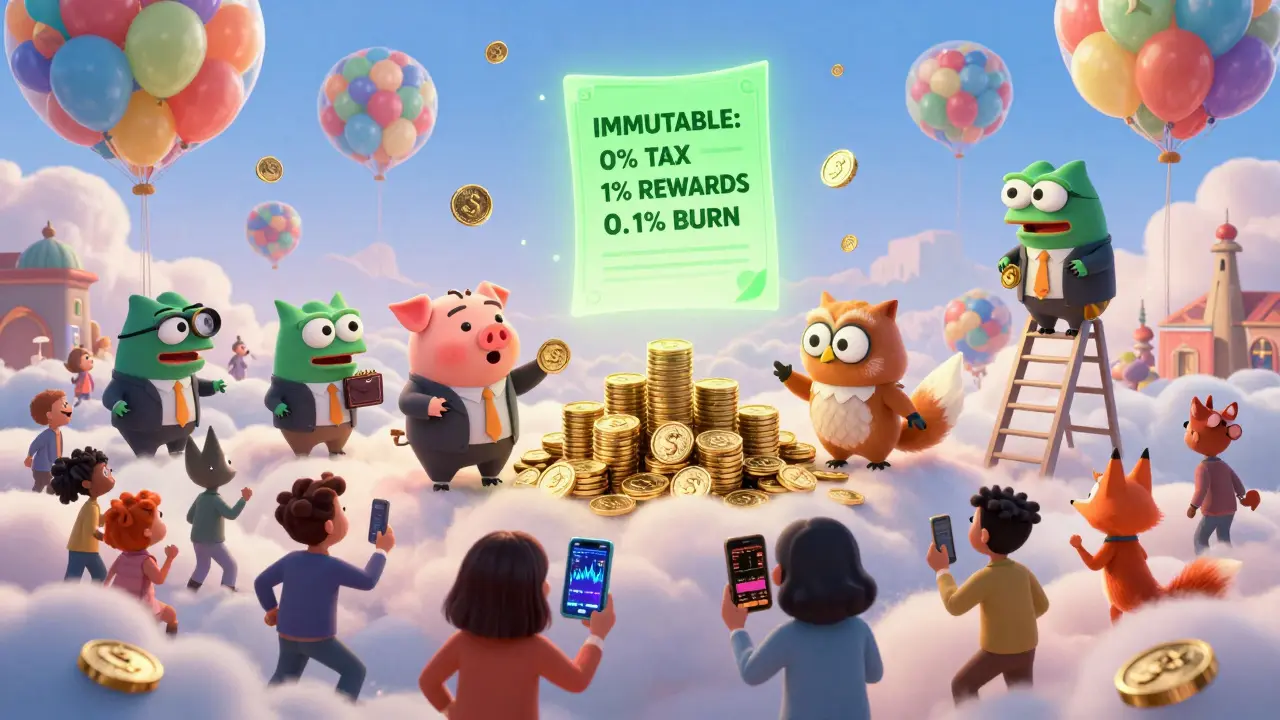
- Deflationary burn: Every time someone sends PEPE, a tiny slice of the tokens (0.1%) is permanently destroyed. That means over time, fewer PEPE coins exist. Less supply? Some believe that could mean higher value - if demand stays high.
- Holder rewards: 1% of every transaction goes into a pool and is split evenly among everyone who holds PEPE. So if you’re just sitting on your coins, you earn more. No need to trade. Just hold.
- No taxes: Unlike many crypto tokens that charge fees on buys or sells, PEPE has zero transaction taxes. You send it. You receive it. No middlemen taking a cut.
These three rules are baked into the smart contract. And once deployed, it can’t be changed. No team can flip a switch and add fees later. No CEO can alter the rules. That’s rare in crypto - and it builds trust.
How many PEPE coins are there?
The total supply? A staggering 420,690,000,000,000 tokens. That’s 420.69 trillion. It sounds insane - and it is. But here’s why it matters:
- Most of those coins - over 90% - were sent straight into liquidity pools when PEPE launched. That means they’re locked up and available for trading.
- The rest? Reserved for future exchange listings and bridges.
- There’s no mining. No staking. No new coins ever created. The supply is fixed forever.
That’s why PEPE’s price is so low: $0.000003 as of early 2026. You don’t buy one PEPE. You buy millions. A single dollar gets you over 300,000 PEPE coins. It’s not about the price per coin. It’s about the total value.
Is PEPE still popular?
Yes. And it’s not slowing down.
As of March 2026, PEPE trades on over 320 exchanges - including Coinbase, Binance, and Robinhood. Its 24-hour trading volume regularly hits $300 million. That’s more than most mid-tier cryptocurrencies. People aren’t just holding it. They’re actively buying and selling it every minute.
Some early buyers made 32,000x returns during its 2023 spike. But that’s not normal. Most people who bought later didn’t get rich overnight. Still, the community stays active. Reddit threads, Twitter trends, and TikTok videos keep the hype alive. It’s not about fundamentals. It’s about feeling part of something bigger - a movement.
What’s PEPE used for?
Short answer: Nothing - except trading.
You can’t use PEPE to buy coffee. You can’t pay for a Netflix subscription with it. It doesn’t power any app or service. There’s no roadmap. No team. No whitepaper. Just a token with three rules and a frog logo.
But that’s the point. PEPE isn’t trying to be useful. It’s trying to be fun. It’s a digital inside joke that turned into a financial phenomenon. People trade it because they like the culture. They hold it because they believe in the community. And they share it because it’s entertaining.
How is PEPE different from other meme coins?
Let’s compare PEPE to two others:
| Feature | PEPE | Dogecoin | Shiba Inu |
|---|---|---|---|
| Launch Year | 2023 | 2013 | 2021 |
| Blockchain | Ethereum | Bitcoin (Dogecoin chain) | Ethereum |
| Total Supply | 420.69 trillion | 132 billion | 1 quadrillion |
| Transaction Tax | 0% | 0% | 1% (sell) |
| Holder Rewards | Yes (1% per transaction) | No | Yes (but complex) |
| Deflationary Burn | Yes (0.1% per tx) | No | Yes (but slower) |
| Smart Contract | Immutable | Mutable | Mutable |
PEPE stands out because of its simplicity. No taxes. No team. No roadmap. Just pure, unfiltered meme energy. It’s more transparent than most. And that’s why it’s still trading hard - even in a bear market.
Should you invest in PEPE?
Here’s the honest take:
- If you’re looking for long-term value, PEPE isn’t for you. It has no utility. No earnings. No innovation.
- If you’re into crypto culture, enjoy memes, and want to ride a wave of community hype - then PEPE might be fun.
- Never invest more than you can afford to lose. PEPE’s price can swing 50% in a day. It’s not a stock. It’s a social experiment.
Some people treat PEPE like digital art. You buy it because you like the design. You hold it because you like the vibe. You sell it when the mood changes. And that’s okay.
What’s next for PEPE?
There’s no official plan. No team to announce updates. No development roadmap. But the market keeps moving.
Derivatives markets are adding PEPE futures. RubyDex now offers a 1000PEPEUSDT perpetual contract - meaning traders can bet on its price without owning the coin. That’s a sign of institutional interest, even if it’s speculative.
Will PEPE hit $1 again? Maybe. Will it become the next Bitcoin? Absolutely not. But as long as internet culture thrives - and people still laugh at memes - PEPE will have a place in crypto.
Is PepeCoin (PEPE) the same as PepeCoin (PEPECOIN)?
No. PepeCoin (PEPECOIN) is a separate project launched in 2016 that aimed to build a "memetiverse" ecosystem. It’s unrelated to PEPE, the Ethereum-based meme token launched in April 2023. PEPE is the one traded on Coinbase, Binance, and other major exchanges. If you’re looking at crypto prices or trading, you’re dealing with PEPE - not PEPECOIN.
Can you mine PEPE coins?
No. PEPE is an ERC-20 token on Ethereum. All 420.69 trillion coins were created at launch. There’s no mining, staking, or new supply. The only way to get PEPE is to buy it on an exchange or receive it from someone else.
Why does PEPE have such a low price per coin?
Because of its massive supply. With over 420 trillion tokens, the price per coin is naturally tiny - just $0.000003. But that doesn’t mean it’s worthless. Market cap (price × supply) is what matters. PEPE’s market cap peaked above $5 billion, making it one of the most valuable meme coins ever. You don’t buy one coin. You buy millions.
Is PEPE safe to hold?
The smart contract is immutable, meaning it can’t be changed or hacked after launch. That’s a big plus. But PEPE has no team, no security audits, and no official backing. It’s purely community-driven. So while the code is safe, the value isn’t guaranteed. Treat it like any high-risk asset: don’t invest more than you can lose.
Can PEPE be used to buy things?
Not officially. PEPE has no real-world utility. You can’t use it to pay for goods or services at major retailers. Some small online stores or crypto-friendly platforms might accept it, but that’s rare. PEPE’s main purpose is trading and holding within the meme coin community.
PEPE is not a financial product. It’s a cultural artifact. And in crypto, sometimes that’s enough.
24 Comments
Anastasia Thyroff
I bought PEPE because I thought it was a joke but now I’m emotionally attached to this frog. I check the price like it’s my ex’s Instagram. I don’t care if it’s worthless. It’s my meme. 🐸
Kira Dreamland
Honestly? I love how PEPE doesn’t pretend to be anything. No whitepaper. No team. Just a frog and a community. That’s more honest than half the crypto projects out there. I hold it like a lucky charm.
shreya gupta
This is why Western crypto culture is so infantile. A frog? 420 trillion tokens? You call this finance? In India, we build infrastructure. Not digital clown coins.
Derek Lynch
You’re all missing the point. PEPE isn’t about value. It’s about participation. The burn mechanism, the holder rewards, the zero taxes - it’s a beautifully designed social contract. This is crypto at its purest. Stop overthinking it.
Shreya Baid
While I understand the cultural significance, I must emphasize the importance of regulatory clarity. Meme coins like PEPE operate in a legal gray zone. Investors should be aware of the absence of investor protections. This is not a recommendation, merely a caution.
Dionne van Diepenbeek
I bought PEPE on a whim and now I’m rich. I don’t know how. I don’t care. I just know I’m not selling. The frog is my spirit animal now
Graham Smith
PEPE’s entire value proposition is a failure of economic literacy. It’s a zero-sum meme with a deflationary burn that doesn’t address liquidity decay. The holder rewards are a Ponzi-adjacent incentive structure disguised as gamification. This isn’t innovation - it’s behavioral manipulation.
Jerry Panson
I appreciate the transparency of PEPE’s design. The immutable contract, lack of team, and absence of taxes demonstrate a rare level of decentralization. While I wouldn’t allocate capital to it, I respect the ethos behind its creation.
Katrina Smith
PEPE? More like PEPE-ocalypse. 420 trillion coins and you still think it’s worth something? Bro. It’s a meme. Not a currency. And if you’re holding it for ‘the vibe’… you’re not rich. You’re just delusional.
Anastasia Danavath
I bought PEPE because I saw a tiktok of a guy crying because he sold too early. I cried too. Not for money. For the meme. 🥹🐸
anshika garg
There’s something deeply human about attaching value to something that has no intrinsic worth. PEPE is a mirror. It reflects our need to belong, to laugh, to believe in something absurd. Maybe that’s the only real utility it ever needed.
Ross McLeod
Let’s analyze the tokenomics objectively. The 0.1% burn rate is mathematically insignificant over a supply of 420 trillion. The 1% holder reward is effectively a redistribution mechanism that benefits early adopters disproportionately. The absence of taxes creates a liquidity illusion - it’s not a feature, it’s a trap for retail investors who believe they’re getting something for nothing.
rajan gupta
The frog... it’s not just a meme. It’s a symbol. A symbol of the forgotten. The ridiculed. The internet’s last child. PEPE is the cry of a generation that was told to grow up... but refused. I weep for PEPE. I weep for us.
Billy Karna
I’ve been tracking PEPE since launch. The deflationary burn is actually more effective than people realize. With 0.1% burned per transaction and over 300 million daily trades, that’s 300 billion coins destroyed per day. At that rate, the supply drops by 10% in under 100 days. It’s not just a meme - it’s a deflationary experiment on a massive scale. The market cap isn’t random. It’s mathematical.
Cheri Farnsworth
The immutable nature of PEPE's smart contract represents a paradigm shift in decentralized governance. Unlike mutable contracts that enable centralized control, PEPE’s design enforces permanence - a philosophical commitment to decentralization. This is not a currency. It is a covenant.
Gene Inoue
People who buy PEPE are the same ones who buy lottery tickets and call it ‘investing’. You think you’re part of a movement? You’re just another sucker who got lured by a cartoon frog. You don’t own PEPE. You own a digital placebo.
Ricky Fairlamb
The fact that PEPE is listed on Coinbase is proof that the entire financial system is collapsing. A frog token with zero utility, no team, and a 420 trillion supply? This isn’t innovation. This is the final stage of monetary decay. The Fed is probably quietly buying PEPE to destabilize the dollar. I’m not joking.
Arlene Miles
You don’t need to understand crypto to feel it. PEPE isn’t about numbers. It’s about the people. The late-night trades. The memes. The friends who bought in together. If you can’t see the beauty in that, you’re not looking hard enough.
Tony Weaver
The only reason PEPE has value is because people keep pretending it does. It’s a self-reinforcing illusion. The burn rate is too small to matter. The rewards are a distraction. The ‘community’ is just a mob with wallets. This isn’t culture. It’s a casino with a frog logo.
Patty Atima
I bought PEPE for $20. It’s worth $22 now. I’m not selling. It’s fun. That’s all I need.
Lucy de Gruchy
I’ve analyzed the blockchain data. PEPE’s liquidity pools are being manipulated by whale addresses. The ‘community’ is a front. This is a coordinated pump disguised as a meme. I’m not surprised. The crypto industry is a Ponzi pyramid with better marketing.
Lauren J. Walter
I used to love PEPE. Now I just feel sad. Everyone’s pretending it’s a movement. But it’s just a bunch of people trying to feel special by owning a frog. I miss when memes were funny.
Carol Lueneburg
I’m so proud of this community. We didn’t build a token. We built a feeling. And that’s worth more than any whitepaper. 🐸💖
Brenda White
PEPE is just the start. Wait till the AI frogs start trading on-chain. That’s when the real fun begins. Just watch.