China doesn’t just regulate cryptocurrency-it bans it. Fully. Completely. No gray areas. If you’re a Bitcoin holder living in China, or even just connected to the Chinese financial system, this isn’t a policy shift. It’s a wall. And that wall has real consequences.
What Exactly Is Banned?
It’s not just about not being able to buy Bitcoin on a local app. China’s ban is all-encompassing. Since 2021, every single crypto-related activity is illegal under Chinese law. That includes:- Operating or using any cryptocurrency exchange inside China
- Trading Bitcoin or altcoins through peer-to-peer platforms
- Mining Bitcoin with hardware in China
- Providing financial services tied to crypto-like bank accounts, loans, or payment processing
- Any company, even foreign ones, offering services to Chinese residents
What Happened in 2021? The Real Turning Point
Many people think the ban started in 2017 when exchanges were shut down. But the real turning point was May 21, 2021. That’s when China’s Financial Stability and Development Committee-led by a vice premier-publicly declared they were cracking down on Bitcoin mining and trading. The statement was short. It was blunt. And it changed everything. Before that, Bitcoin mining was still alive in China. The country produced over 70% of the world’s Bitcoin. Mining farms in Sichuan, Inner Mongolia, and Xinjiang ran on cheap hydro and coal power. Then, overnight, power plants stopped supplying them. Mining rigs were seized. Data centers were shut down. Within months, China’s mining share dropped to near zero. The government didn’t hide its reasoning: "high energy consumption and low efficiency." But everyone knew the real goal was control. Bitcoin’s decentralized nature threatened the state’s ability to monitor money flow. And that’s not something Beijing tolerates.Bitcoin Holders in China: Living in the Gray Zone
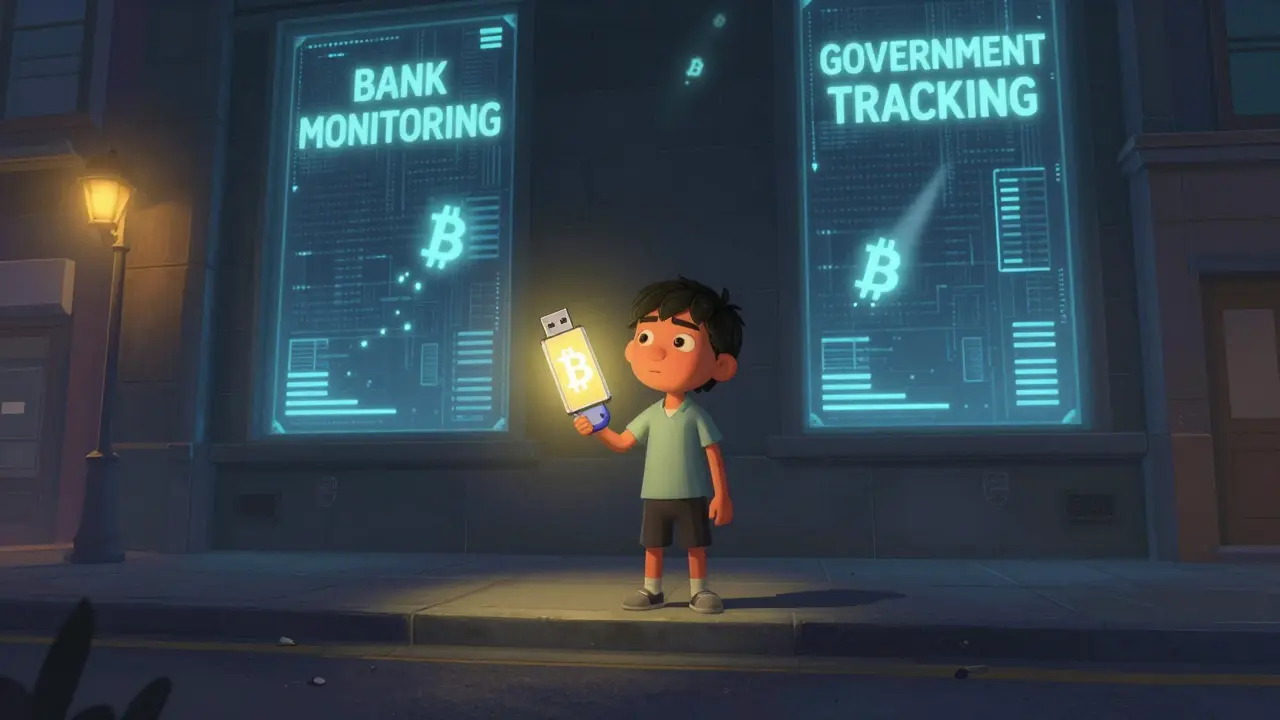
Here’s the contradiction: the ban is total on paper. In practice? It’s not that simple. Thousands of Chinese citizens still hold Bitcoin. Many bought before the ban. Others use P2P platforms, cash trades, or offshore wallets. Some use VPNs to access Binance or Kraken. The government knows this. They just can’t stop it completely. Why? Because Bitcoin is digital. It moves across borders. It doesn’t need banks. You can store it on a USB drive. You can send it through a messaging app. You can’t ban a piece of code. But the risks are real. If you try to cash out Bitcoin through a Chinese bank, your account gets flagged. You might get called in for questioning. Your funds could be frozen. There’s no legal protection. If someone steals your Bitcoin, you can’t go to court. If you get scammed, there’s no recourse. A 2024 notice from the People’s Bank of China made it clear: cryptocurrencies are not legal tender. You can’t use them to pay for goods. You can’t use them to settle debts. Any attempt to do so puts you in violation of financial law.
The CBDC: China’s Answer to Bitcoin
While Bitcoin is banned, China is building its own digital currency-the Digital Yuan, or e-CNY. It’s not a replacement for Bitcoin. It’s the opposite. The Digital Yuan is fully controlled by the People’s Bank of China. Every transaction is tracked. Every user is identified. It’s designed to replace cash, not decentralize finance. It gives the government more power, not less. This isn’t an accident. It’s strategy. China doesn’t want to compete with Bitcoin. It wants to make Bitcoin irrelevant by offering a state-approved alternative that still lets them watch everything you do.Are There Any Loopholes?
Some people claim you can still trade crypto if you’re outside China. That’s true-but only if you’re not a Chinese resident. The ban explicitly targets Chinese citizens. So if you’re a Chinese national living abroad, you can hold Bitcoin. But if you’re in China-even on a temporary visa-you’re still bound by the rules. And if you use a Chinese bank account to move money to or from crypto, you’re breaking the law. There’s also no legal way to convert Bitcoin to RMB inside China. No licensed exchange. No ATM. No over-the-counter desk. Any service offering this is operating illegally-and you’re taking a huge risk by using it.
The Global Ripple Effect
China’s ban didn’t just affect its citizens. It reshaped the global crypto market. When mining left China, hash power shifted to the U.S., Kazakhstan, and Russia. Bitcoin’s network became more decentralized-but also more expensive to mine. The price of electricity for mining rose globally. Meanwhile, Chinese investors who held Bitcoin before the ban became a silent force in global markets. Many moved their holdings to Hong Kong, Singapore, or Switzerland. Some sold. Others held tight. Either way, their actions influenced price swings. And then there’s the rumor cycle. Every year since 2016, someone claims China is about to ban Bitcoin again. In early 2025, fake news spread across social media that China had imposed a "new ban." Elon Musk’s X feed even shared it. It wasn’t true. But it caused a 12% drop in Bitcoin’s price in 48 hours. That’s how powerful the perception of China’s policy is. Even a rumor can move markets.What Does This Mean for You If You Hold Bitcoin?
If you’re a Bitcoin holder with ties to China, here’s what you need to know:- Don’t use Chinese banks to move crypto funds. They’re monitored.
- Don’t try to cash out in China. There’s no legal path.
- Don’t assume your holdings are safe just because you didn’t get caught. The system is watching.
- Don’t fall for rumors about new bans. They’re almost always false.
- If you’re outside China, you’re free to hold Bitcoin-but if you send money back home, you risk triggering investigations.
Will China Ever Lift the Ban?
Right now? Unlikely. The government has invested billions into the Digital Yuan. They’re not going to abandon it to make room for Bitcoin. The central bank’s priority is control, not decentralization. And Bitcoin, by design, resists control. Some analysts say China might one day allow licensed exchanges or regulated trading. But even that would require Bitcoin to be wrapped in government oversight-something the core community rejects. For now, the ban stands. And for Bitcoin holders connected to China, the only safe move is to hold quietly, avoid the banking system, and understand that the law doesn’t protect you.Can I still buy Bitcoin in China?
No. Buying Bitcoin through any exchange, app, or service based in mainland China is illegal. Even peer-to-peer trades through local platforms are banned. While some people still trade informally using cash or encrypted apps, there’s no legal way to purchase Bitcoin within China’s borders.
What happens if I get caught trading Bitcoin in China?
There’s no standardized punishment, but consequences vary. You could face account freezes, fines, or be flagged by authorities for "illegal financial activity." In extreme cases, if large sums are involved or linked to money laundering, you could be investigated by public security. There’s no court system to appeal crypto-related disputes.
Can I mine Bitcoin in China?
No. All Bitcoin mining operations were shut down in 2021. Power suppliers stopped providing electricity to mining farms. Equipment was confiscated. Even if you set up a rig today, you’d risk losing everything and facing legal penalties.
Is the Digital Yuan the same as Bitcoin?
No. The Digital Yuan (e-CNY) is a government-controlled digital currency. Every transaction is tracked, users are identified, and the central bank has full control. Bitcoin is decentralized, anonymous, and operates without government oversight. They’re opposites in design and purpose.
Why do rumors about China banning Bitcoin keep coming back?
Because China’s policy has such a big impact on global markets. Even small rumors can cause price swings. Since 2016, false reports about new bans have spread every year-often through unverified social media accounts. These rumors are fake, but they’re effective because they play on fear and uncertainty.
Can I keep Bitcoin if I’m a Chinese citizen living overseas?
Yes. If you’re a Chinese citizen living outside mainland China and don’t use Chinese financial services, you can hold Bitcoin without legal risk. But if you send money back to China or use Chinese bank accounts to fund crypto purchases, you could trigger regulatory scrutiny.


22 Comments
Tom Jewell
It's wild how China's ban isn't really about Bitcoin-it's about control. You can't ban a concept, only its expression. Bitcoin's code is free. It doesn't care about borders. The state can shut down mines, freeze accounts, and track transactions-but they can't unwrite the math. The real victory isn't in outlawing it. It's in realizing you can't stop it. And that terrifies them more than any price drop ever could.
They built a wall. But walls don't stop water. They just make it flow somewhere else.
And now? The water's everywhere.
Even in their own homes.
karan narware
China bans Bitcoin? Cute. Meanwhile, my cousin in Mumbai just bought 0.5 BTC with UPI cash-no KYC, no bank, no paper trail. They think they're building a digital fortress? I'm building a digital jungle. Trees grow through concrete, baby. And guess what? The roots don't need permission.
Also, 'high energy consumption'? Have you seen how much power your Netflix binge uses? But sure, let's demonize mining while your phone updates in the background for 3 hours straight.
hypocrisy, much?
ann neumann
They're not banning Bitcoin-they're banning freedom. You think this is about energy? Please. It's about the fact that you can't control what you can't see. And that's terrifying to a regime that needs to see everything. Every purchase. Every transfer. Every thought. Bitcoin? It's the ghost in the machine. The silent scream. The one thing they can't track. And they'd rather burn the whole system than let one person be free.
I'm not even scared anymore. I'm fascinated. Because the more they try to crush it, the more it multiplies. Like a virus. A beautiful, decentralized, unkillable virus.
And they're the ones who gave it life.
They're not the enforcers. They're the midwives.
William Montgomery
If you're holding Bitcoin in China, you're not a tech pioneer-you're a fool. You knew the rules. You chose to break them. Now you're playing Russian roulette with your bank account. No one owes you protection. No court will help you. No government will bail you out. Stop whining and take responsibility.
It's not the system that's broken. It's you.
Mara Alves Mariano
China bans crypto? LOL. They're scared because their own citizens are smarter than their propaganda. They're scared because people are using tech they can't control. And they're scared because their precious Digital Yuan? It's a glorified spreadsheet with a flag on it.
Meanwhile, real money moves without permission. Real wealth doesn't need a government stamp. And real people? They don't care about your 'e-CNY'. They care about freedom. And Bitcoin? It's the last free thing left.
So go ahead, ban it. We'll just move it to the darknet. And laugh while you count your yuan.
Adam Ashworth
China's ban made Bitcoin stronger. Period. The mining migration forced decentralization. The crackdown forced users to learn self-custody. The fear forced innovation. The more they try to kill it, the more it evolves. They didn't stop Bitcoin-they accelerated its global adoption.
Every time they shut down a mine, a new one pops up in Texas. Every time they freeze an account, someone learns how to use a hardware wallet.
This isn't a setback. It's a bootcamp.
Allison Davis
It's important to understand that the ban is not about technology-it's about sovereignty. The People's Bank of China isn't trying to out-innovate Bitcoin. They're trying to out-manage it. The Digital Yuan isn't a competitor. It's a surveillance tool. And Bitcoin's value isn't in its price-it's in its refusal to be owned.
If you're holding Bitcoin and you're in China, you're not breaking the law-you're exercising a fundamental human right: the right to control your own wealth. That's not illegal. That's revolutionary.
Michael Suttle
They're not banning Bitcoin-they're banning the truth. The truth that money doesn't need permission. The truth that the state can't control everything. The truth that when you lock people in, they build doors.
And guess what? The USB drives with Bitcoin on them? They're already on airplanes. They're in suitcases. They're in the pockets of diplomats. They're in the hands of students. They're in the minds of kids who know better than their government.
They think they're winning? They're just planting the seeds for the next revolution.
And we're all waiting for it.
❤️
Jenni James
While I appreciate the technical exposition, one must consider the epistemological implications of state-sanctioned digital currency vis-à-vis decentralized autonomous systems. The PBOC's e-CNY constitutes a performative assertion of ontological authority over financial agency. Bitcoin, by contrast, operates within a post-sovereign paradigm wherein trust is algorithmically distributed rather than hierarchically imposed. Therefore, the Chinese state's prohibition is not merely regulatory-it is epistemologically anachronistic. One must question: in an age of distributed ledgers, can centralized control remain epistemologically coherent? I think not.
Chelsea Boonstra
Wait-so if I'm a Chinese citizen living in Canada and I buy Bitcoin with my Canadian bank account, then wire the money back to my parents in Shanghai as a gift... is that illegal? Or just risky? Because I've seen people do this. And no one gets arrested. So what's the real line? Is it the amount? The frequency? The method? Or is it just whatever they feel like enforcing that day?
Because that's not a law. That's a game.
Alex Thorn
Let me tell you something: Bitcoin isn't about money. It's about dignity.
When you hold it, you're saying: I don't need your permission. I don't need your bank. I don't need your approval. I can store value without asking for a visa.
And that's terrifying to anyone who believes control equals power.
China banned Bitcoin because they know what it represents-not just a currency, but a quiet rebellion. A whisper that says: you can't own everything.
And that whisper? It's getting louder.
Howard Headlee
They thought shutting down mining farms would kill Bitcoin. They were wrong. It didn't die-it went global. It didn't fade-it grew. And now? Every miner in Texas, every node in Poland, every wallet in Nigeria? They're all part of the same movement.
China didn't win. They lit the match.
And now the whole world is burning with it.
Let's go. Let's build. Let's outlast them.
Julie Tomek
It is imperative to recognize that the Chinese government's regulatory stance toward cryptocurrency is not an isolated phenomenon but rather a manifestation of broader macroeconomic governance priorities. The imposition of the Digital Yuan is a strategic pivot toward financial sovereignty, predicated upon the necessity of monetary policy precision, anti-money laundering efficacy, and capital flow surveillance. In contrast, Bitcoin's inherent design characteristics-including pseudonymity, decentralization, and non-sovereign issuance-present a structural challenge to these objectives. Consequently, the prohibition is not merely reactive but anticipatory. The state is not opposing technology; it is defending institutional authority. The choice is not between innovation and control-it is between autonomy and order. And in this calculus, order prevails.
Brandon Kaufman
I used to think China's ban was a death sentence for Bitcoin. Then I talked to a guy in Guangzhou who's been holding since 2017. He said, 'I don't trade. I don't sell. I just keep it. And every time they say 'ban,' I feel a little more free.'
That stuck with me.
It's not about money. It's about hope.
And hope doesn't need a bank.
Craig Gregory
They're not banning Bitcoin. They're banning the idea that people can be trusted with their own money. That's the real threat. Not the tech. Not the mining. Not even the price.
The threat is that if people can hold Bitcoin, they might start asking: why do we need the state to control anything?
And once that question is asked?
The whole system starts to crack.
So they silence it.
Because silence is easier than truth.
Anshita Koul
China bans Bitcoin? Okay. But have you seen how many Indian students are buying it through UPI? Through crypto kiosks? Through WhatsApp groups? They're not waiting for permission. They're not asking for approval. They're just doing it.
And guess what? The government doesn't even care.
Because they know: you can't stop a generation that's already moved on.
Bitcoin isn't banned in China. It's just... invisible.
And that's scarier than any law.
PIYUSH KOTANGALE
China bans mining? Cool. Now the US has more hash power than ever. And guess who's buying all that power? American investors.
So China banned Bitcoin... and accidentally made Bitcoin stronger?
Classic.
Also, I just bought 0.01 BTC with cash at a Mumbai street vendor. No ID. No app. Just a handshake and a smile.
They can ban it. But they can't ban human connection.
❤️
vishnu mr
china ban bitcoin? lol they dont even know how many people are using it. i mean my uncle in delhi has 2 usb drives with btc on them. he says its like gold but digital. he dont even know what a blockchain is. he just knows its his. and thats enough.
they can ban it. but they cant take it. cause its not in the bank. its in the mind.
Grace van Gent-Korver
So if you live in China and have Bitcoin, you're basically just holding a secret. Like a diary. No one else can see it. No one else can take it. And no one else can stop you from keeping it.
That's not illegal. That's just... human.
Zephora Zonum
It's fascinating how people romanticize Bitcoin as some kind of libertarian utopia when in reality it's just a volatile asset class with no intrinsic value, no legal recourse, and no regulatory oversight. The Chinese government is not irrational for banning it-they're rational. They're protecting their citizens from speculative risk, financial instability, and the inherent volatility of a commodity that has no underlying economic foundation.
Frankly, anyone holding Bitcoin in China is not a pioneer-they're a gambler.
Anthony Marshall
They think they're stopping Bitcoin? Nah. They're just making it more valuable. Every time they ban it, more people wake up. More people learn. More people buy. This isn't a crackdown. It's a marketing campaign.
And guess who's getting the free ads?
Us.
Keep banning. We'll keep building.
Lindsay Girvan
The Digital Yuan is a prison with a better UI. Bitcoin is the key. And China? They're trying to burn the key. But they forgot one thing.
You can't burn an idea.
And the key? It's already in every phone. Every USB. Every heart that refuses to be controlled.