
Imagine building a bank that has no doors, no guards, and exists on every computer in the world simultaneously. Now imagine that same bank handing you a ticket that says, "Sorry, you can't enter from this zip code." It sounds like an oxymoron, right? That is exactly the situation facing traders on dYdX, a prominent cryptocurrency derivatives platform that markets itself as decentralized but enforces strict geographic bans. You might have heard the pitch: dYdX is a Decentralized Exchange (DEX). It runs on blockchain technology. It’s open to everyone. But if you try to access it from the United States, Canada, or several other major jurisdictions, you hit a wall. Your wallet gets flagged. Your trading stops. You are forced into a "close-only" purgatory. Why does a protocol built on Ethereum care where you live? The answer lies in the messy reality of modern crypto regulation. While the core ledger is immutable and global, the front-end interface-the website you click on-is not. This distinction creates a hybrid model that satisfies regulators but confuses users who expected true censorship resistance. Let's break down why dYdX blocks specific countries, how they enforce these rules, and what it means for your funds.
The Illusion of Total Decentralization
To understand the restrictions, we first need to separate the engine from the steering wheel. In traditional finance, the bank owns both. In pure DeFi (Decentralized Finance), neither entity really owns anything; the code runs automatically. dYdX sits uncomfortably in the middle. The core trading logic of dYdX operates on the Ethereum blockchain. Once a transaction is signed by your wallet and broadcast to the network, it is processed by smart contracts. These contracts do not check your IP address. They do not care if you are in New York or North Korea. If you have the gas fees and the correct cryptographic signature, the math works. This part is truly decentralized. However, most users do not interact directly with raw smart contracts via command lines. They use a user interface (UI). dYdX provides this UI through a centralized entity called dYdX Operations Services Ltd. (the corporate body responsible for operating the dYdX frontend and enforcing compliance measures). This company hosts the website at dydx.trade. When you connect your wallet to this site, you are agreeing to their Terms of Service. It is this layer-the frontend-that acts as the gatekeeper. This architecture allows dYdX to claim decentralization for its settlement layer while maintaining centralized control over access. It’s a pragmatic compromise. By controlling the entry point, they can filter out prohibited traffic before it ever touches the blockchain. For regulators, this looks like a compliant financial service provider. For idealists, it looks like a betrayal of the ethos. For traders, it just means you need to know the rules before you deposit money.
Which Countries Are Banned?
If you are wondering whether your location puts you at risk, the list of restricted jurisdictions is extensive and largely driven by international sanctions programs. dYdX prohibits access from residents, citizens, agents, or entities incorporated in specific regions. Here is a breakdown of the primary blocked areas:
- United States: Perhaps the biggest ban. U.S. residents are strictly prohibited due to SEC regulations regarding securities and derivatives.
- United Kingdom & Canada: Both nations have tightened crypto regulations, leading to broad bans for retail traders on many platforms.
- Sanctioned Nations: This includes Iran, Cuba, North Korea, Syria, Myanmar (Burma), Crimea, Donetsk, Luhansk, Iraq, Libya, Mali, Democratic Republic of Congo, Cote D'ivoire, Nicaragua, Somalia, Sudan, Yemen, and Zimbabwe.
| Region / Country | Status on dYdX | Primary Reason |
|---|---|---|
| United States | Banned | SEC Regulations & Derivatives Laws |
| Canada | Banned | Local Regulatory Compliance |
| China | Accessible* | No direct OFAC Sanctions |
| Russia | Accessible* | Selective Compliance Strategy |
| North Korea | Banned | U.S. Treasury Sanctions |
*Note: Accessibility does not imply legality under local laws. Users must comply with their own national regulations.

How Do They Catch You? (IP Detection & Wallet Flagging)
You might think, "I’ll just use a VPN." Or, "My wallet is anonymous; how do they know where I am?" This is where the technical enforcement gets interesting-and invasive. dYdX uses standard geolocation technology to detect your IP address when you load the frontend. If your IP resolves to a restricted country, the system flags your connected wallet immediately. This isn't just a one-time check. The platform monitors ongoing activity. If you manage to bypass the initial IP check (perhaps using a proxy) but later trigger a compliance alert-maybe by interacting with a known sanctioned wallet or showing suspicious transaction patterns-the backend systems can still identify your wallet address. Once flagged, the consequences are severe. The system doesn't just kick you off the site. It alters the functionality of your account permanently until resolved. This leads us to the dreaded "Close-Only Mode."
The Nightmare of Close-Only Mode
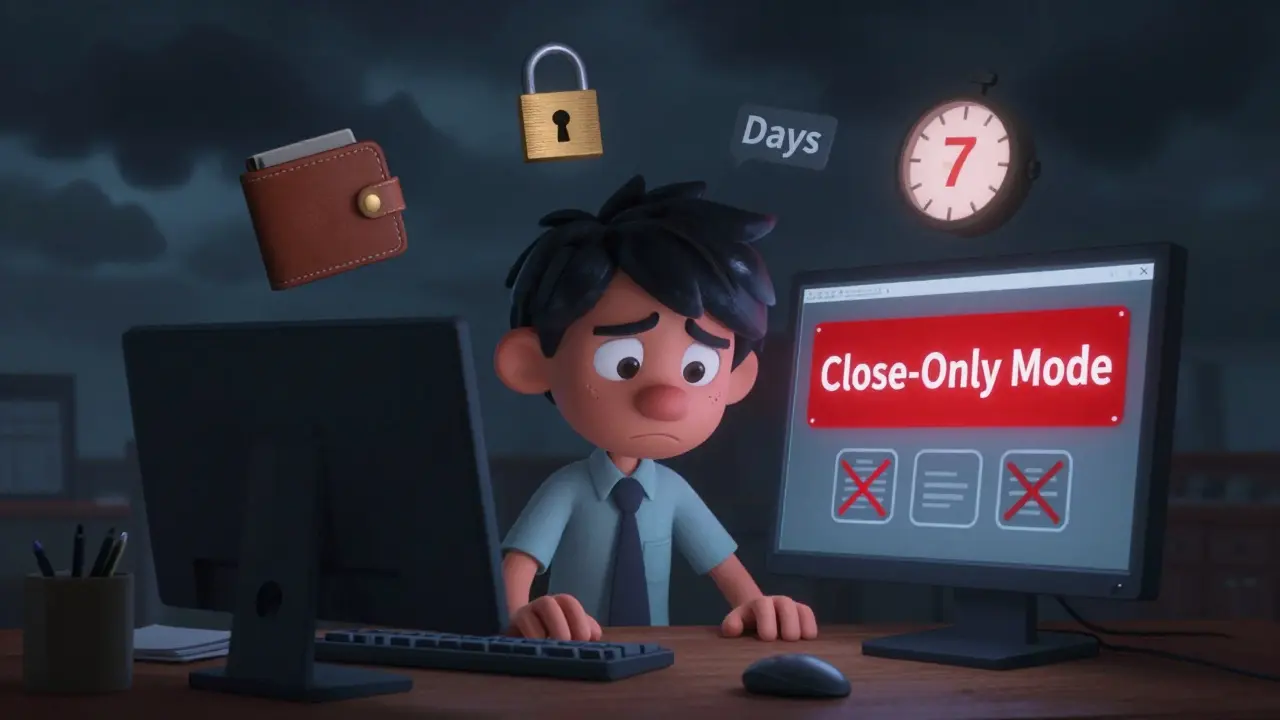
If you violate the geographic restrictions, dYdX doesn’t necessarily freeze your funds forever (which would cause a massive legal backlash). Instead, they put you in Close-Only Mode, a restrictive state where users can only reduce positions and withdraw funds, but cannot trade or deposit. Here is what happens step-by-step:
- Flagging: Your wallet is identified as non-compliant. Red warning banners appear on the interface.
- Trading Halt: You cannot open new positions. You cannot deposit more funds. You cannot transfer assets between subaccounts.
- Reduce-Only Orders: Any order you place defaults to "reduce-only." This means if you have a long position on Bitcoin, you can only sell. You cannot buy more to average down.
- The Seven-Day Countdown: If your wallet remains in this mode for seven consecutive days without resolving the issue (which is usually impossible if you are banned), it transitions to "Blocked" status.
- Total Lockout: In Blocked status, you lose access to the frontend entirely. You cannot view history, manage subaccounts, or even withdraw easily through the UI. You are left relying on raw blockchain interactions, which requires exporting your Secret Recovery Phrase and using external tools-a dangerous process for inexperienced users.
Why Does This Matter for DeFi?
The dYdX case study highlights a fundamental tension in the cryptocurrency space. We are promised permissionless innovation. Yet, the most successful platforms often rely on centralized choke points to survive. Antonio Juliano, the founder of dYdX, built this platform after working at Coinbase. He understood early on that purely decentralized protocols struggle with scalability and user experience. By introducing centralized elements-like the frontend operated by dYdX Operations Services Ltd. and the foundation based in Zug, Switzerland-he created a product that feels familiar to traditional traders. But this familiarity comes at a cost. True decentralization implies that no single entity can stop you from using the protocol. With dYdX, the entity behind the website absolutely can stop you. This challenges the narrative that DeFi is a haven for those seeking to escape government oversight. If you are in a restricted country, dYdX is not free; it is censored. For the broader industry, this sets a precedent. As regulators like the SEC and CFTC crack down, expect more "hybrid" exchanges to emerge. They will look like DEXs, they will talk like DEXs, but they will act like banks when the authorities knock. The era of naive trust in "decentralized" labels is ending. Users must now audit the centralization risks of any platform they use.
What Should You Do?
If you are considering using dYdX, take these steps to protect yourself:
- Check Your Jurisdiction: Do not guess. Read the current prohibited territories list on the official dYdX help center.
- Avoid Proxies for Trading: Using a VPN to hide your location is a violation of terms of service. If detected, you will face close-only mode. The risk of losing access to your funds outweighs the benefit of trading.
- Monitor Your Wallet: Ensure your wallet hasn't interacted with sanctioned addresses in the past. Chain analysis firms track these flows, and dYdX may pull data from them.
- Have an Exit Strategy: Keep your private keys secure. If you ever get blocked, remember that your funds are technically still on the blockchain. However, recovering them without the frontend support is complex and risky.
Can I use a VPN to trade on dYdX from a restricted country?
Technically, you might bypass the initial IP check, but it is highly discouraged. dYdX's terms of service explicitly prohibit accessing the platform from restricted jurisdictions. If their compliance systems detect suspicious activity or link your wallet to a banned region through chain analysis, they can flag your wallet. This results in "close-only mode," preventing you from opening new trades or depositing funds, and potentially locking you out entirely after seven days.
Is dYdX truly decentralized if it blocks countries?
dYdX is a hybrid platform. Its core trading engine runs on Ethereum smart contracts, which are decentralized and cannot be shut down by a single entity. However, the user interface (frontend) is operated by a centralized company, dYdX Operations Services Ltd. This company enforces geographic restrictions to comply with laws. Therefore, while the settlement layer is decentralized, the access layer is centralized and subject to regulation.
What happens if my wallet enters close-only mode?
In close-only mode, you cannot open new positions, deposit funds, or transfer assets. You can only cancel existing orders, reduce your open positions, and withdraw funds. All new orders default to "reduce-only." If the wallet remains in this state for seven consecutive days, it becomes "Blocked," restricting access to the frontend entirely, including viewing history and managing subaccounts.
Why is the US banned on dYdX?
The United States has strict regulations regarding cryptocurrency derivatives and securities enforced by agencies like the SEC and CFTC. To avoid legal liability and potential shutdowns, dYdX blocks access for U.S. residents, citizens, and entities. This is part of their broader compliance strategy to adhere to Anti-Money Laundering (AML) and Counter-Terrorism Financing (CTF) protocols.
Are there any countries typically banned on other exchanges that work on dYdX?
Yes. Unlike some conservative centralized exchanges, dYdX currently allows access from countries like China, Russia, South Korea, Japan, and Vietnam. Their restriction list focuses primarily on U.S. sanctions targets (like North Korea and Iran) and specific Western jurisdictions with strict crypto laws (like the UK and Canada), rather than implementing a blanket ban on all nations with ambiguous crypto regulations.



14 Comments
Carl Hanzel
Everyone is crying about censorship but let's be real. If you're trading derivatives on a platform that isn't fully non-custodial and permissionless, you are already playing with fire. The 'decentralized' label is just marketing fluff to attract retail degenerates who don't read whitepapers. It is not a betrayal of ethos if the ethos was never there in the first place. You want true freedom? Run your own node and interact directly with the contracts. Stop whining because a centralized frontend did its job.
Abby Martin
I mean, it's pretty obvious why they do this. They are a business entity, not a charity for anarchists. If they didn't block US users, the SEC would shut down their operations overnight and everyone loses their money anyway. It's basic risk management. People who think crypto is above the law are just naive. I've seen too many projects get crushed by regulators because they refused to comply. dYdX is smart to keep their heads down and follow the rules so they can actually stay in business. It's not an oxymoron, it's survival.
Melissa L
i dont get why ppl use vpn tho... seems risky af
Trent Erman1
Great breakdown! 👍 It really highlights the difference between the protocol and the interface. Most people forget that the UI is just a gateway. If you really want to trade without restrictions, you have to learn how to use the raw contract addresses or third-party frontends that might not have these checks (though those come with their own risks). Education is key here. Don't let the convenience of the official site blind you to the architecture. Stay safe out there! 🚀
Emma Rémond
The semantic distinction between settlement layer decentralization and access layer centralization is trivial to the layperson but catastrophic for institutional adoption. This hybrid model is a regulatory hack, nothing more. It creates a false sense of security for users who believe their assets are truly sovereign. In reality, the counterparty risk remains entirely with the entity controlling the UI. This is not DeFi; this is CeFi wearing a costume. The jargon-heavy marketing obscures the fact that your keys may be yours, but your access is leased from a compliant corporation. Disappointing.
ELNORA JEFFERSON
This is such a mess. Why do we even bother with crypto if it's just going to ban us anyway. It's all a scam. I'm done.
Fiona Ellis
Actually, I checked my IP and I'm fine, but it's scary how easy it is to slip up. 😱 One wrong move and boom, close-only mode. I feel like we're being watched everywhere now. It's not just crypto, it's everything. We need better privacy tools that don't require a PhD to set up. Why is it so hard to just trade without jumping through hoops? 🤔
Routh Middaugh
It is interesting to note that while the US is banned, countries like Russia and China are accessible. This suggests that the primary driver is not moral alignment with global sanctions, but rather compliance with US Treasury OFAC lists. This is a pragmatic, albeit cynical, approach. It allows them to serve the majority of the global market while avoiding the specific legal wrath of American regulators. Is it perfect? No. Is it effective? Yes. We should probably accept this nuance rather than demanding utopian ideals from a profit-driven entity.;;)
Daniel J. Cox
Hey folks, just wanted to add some context from my experience in Asia. Here, we see a lot of platforms trying to balance local laws with global access. dYdX is actually one of the few that lets us in, which is rare given how strict places like South Korea can be with outbound capital controls. It's a weird middle ground. We appreciate the access, but we also know the risks. Just remember, always check your local laws too, not just the exchange's TOS. Cheers! 🍻
Rebecca Shoniker
The technical implementation of wallet flagging via chain analysis is far more sophisticated than most retail traders comprehend. Once your wallet interacts with a tainted address, the taint propagation algorithms used by firms like Chainalysis or Elliptic will flag you indefinitely. This is not a temporary glitch; it is a permanent stain on your digital identity. You cannot simply 'reset' this. The assumption that anonymity exists in public ledgers is fundamentally flawed. You are exposed. Always. And dYdX is merely leveraging existing surveillance infrastructure to enforce compliance. Do not mistake opacity for invisibility.
Carol @minaszilda
Let's focus on what we can control. Your private keys. Your security. If you understand the tech, you know your funds are on the blockchain, not in the exchange's bank account. That's the power of DeFi. Even if they block the UI, you can still withdraw if you know how. Let's support each other in learning these skills instead of getting angry at the system. Knowledge is freedom. 💛
Jon Milton
Look, I get the frustration. But fighting the SEC is a losing battle for any entity that wants to remain solvent. dYdX made a choice to prioritize longevity over ideological purity. That's a valid business decision. If you want purity, go run a node. If you want leverage and ease of use, accept the constraints. It's not black and white. It's grey. And that's where the real world lives. Stop expecting perfection from imperfect systems.
Sajjad Ghorbani Moghaddam
I think a lot of people miss the point about the 'close-only' mode. It's not just a punishment; it's a mechanism to prevent further loss. If you're banned, you can't make new bets. That forces you to exit. It's harsh, but it stops you from digging a deeper hole while you figure out how to get your money out. Maybe it's not ideal, but it's better than having your funds frozen completely. At least you have a path out, even if it's narrow.
Nicole Woessner
the thing is once you get flagged its game over basically. i heard stories of people losing access for months. its wild how fast they act. no warning just boom you cant trade. makes me nervous every time i connect my wallet