
You have probably seen the term "bonding" pop up in crypto chats before. It usually involves locking tokens to earn rewards or helping a new project raise money. But ApeBond is a decentralized finance (DeFi) token that powers the ApeBond protocol, a multi-chain, on-chain over-the-counter (OTC) bonding marketplace designed to help crypto projects raise capital using their own native tokens while offering discounted access to major assets such as BTC, ETH, and BNB to participants. If you are wondering whether this sub-cent coin is worth your attention or just another speculative asset, you need to look past the hype and understand how the mechanics actually work.
The crypto landscape is crowded with fundraising tools. Some are centralized launchpads where you trust a company with your funds. Others are complex liquidity pools that require deep technical knowledge. ApeBond tries to sit in the middle. It offers an on-chain OTC marketplace. This means transactions happen directly between parties via smart contracts, without a central authority holding your money. The goal? To make raising capital for projects easier and give everyday users access to discounted big-name cryptocurrencies like Bitcoin and Ethereum through a system called Flash Bonds.
How the ApeBond Protocol Works
To understand what ABOND does, you first need to understand the platform it lives on. Think of ApeBond as a bridge. On one side, you have new crypto projects that need funding but don't want to list on a traditional exchange immediately. On the other side, you have investors who want early access to these tokens at a discount. The protocol connects them using smart contracts.
Here is the simple flow:
- Projects create bonds: A team sells their native tokens at a discount to raise cash. Instead of a messy public sale, they set up a bond contract.
- Users buy bonds: You provide stablecoins or other assets to buy into the bond. In return, you get the project's tokens later, often at a lower price than the open market.
- Flash Bonds offer shortcuts: This is the unique twist. ApeBond also allows users to get discounted access to major assets like BTC, ETH, and BNB. These are short-duration opportunities that require specific participation criteria.
The whole process is non-custodial. That is crypto speak for "you keep control of your keys." The smart contracts handle the exchange automatically once conditions are met. This reduces the risk of a platform running away with user funds, which has happened all too often in the history of DeFi.
The Role of the ABOND Token
So, what exactly is the ABOND coin itself? It is not just a currency you can spend at a coffee shop. It is a utility token. Its primary job is to act as the key to the ecosystem. Without holding and locking ABOND, you miss out on most of the platform's benefits.
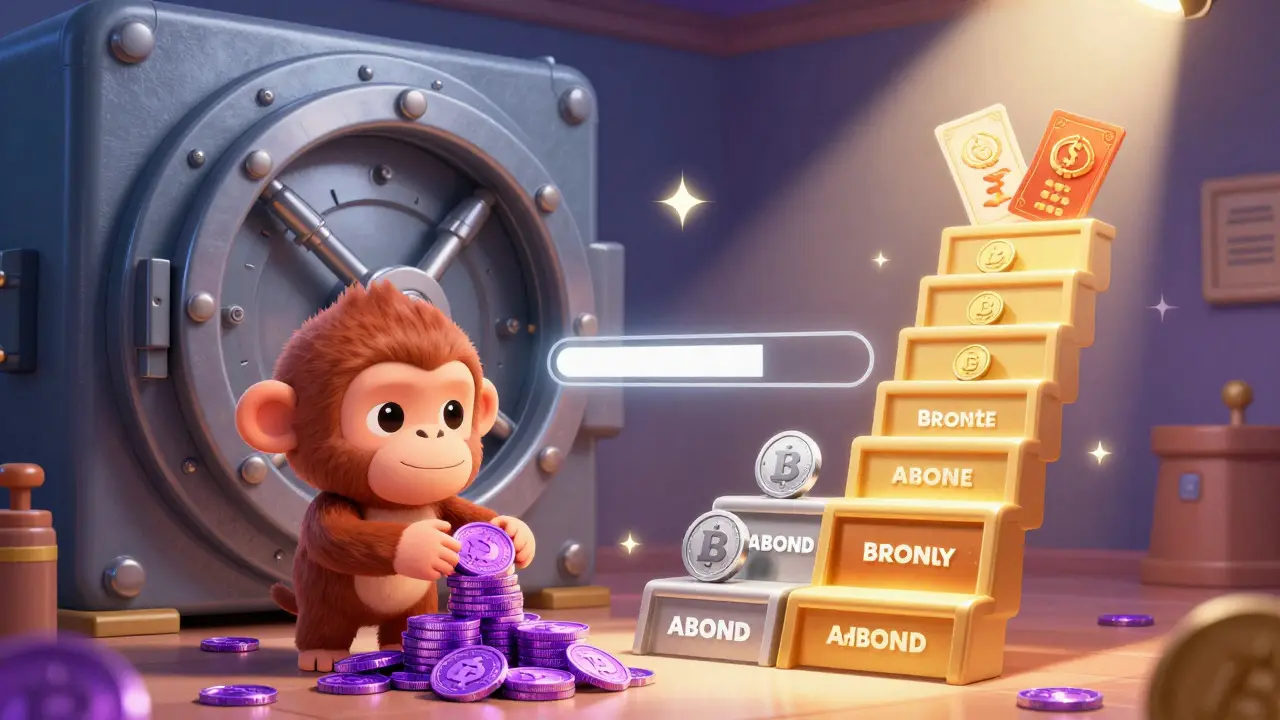
The core mechanism here is called True Yield is a feature within the ApeBond ecosystem that requires users to lock their ABOND tokens to earn Ape Points and unlock higher status tiers. Here is how it breaks down:
- Locking: You deposit your ABOND tokens into the True Yield vault. You choose a duration for the lock-usually longer locks mean better rewards.
- Earning Points: Based on how much you locked and for how long, you earn Ape Points.
- Tier Status: Your points determine your Ape Tier. Higher tiers unlock exclusive benefits. These include priority access to new token sales, better discounts on Flash Bonds, and potentially higher yields on standard bonds.
This design forces long-term commitment. If you are looking for a quick flip-buy low, sell high in an hour-ABOND might frustrate you. The value comes from staying put and using the token to gatekeep access to profitable opportunities within the protocol. It turns the token from a simple tradeable asset into a membership card for the ApeBond community.
Multi-Chain Architecture and LiFi Integration
One of the biggest headaches in DeFi is moving assets between different blockchains. Want to use Ethereum gas fees? Great, if you have ETH. Want to save money? Move to Polygon. But bridging assets manually is risky and slow. ApeBond addresses this by being a multi-chain protocol from the start.
The token was originally built on BNB Chain is the primary blockchain network where the ABOND token operates under the BEP-20 standard, known for its low transaction fees and high speed. However, the protocol supports several other networks, including Polygon, Ethereum, Base, and Lynex. This flexibility is crucial because it allows users to participate regardless of which chain they prefer or hold assets on.
Under the hood, ApeBond uses LiFi is a multichain DEX aggregator technology that enables seamless cross-chain swaps and liquidity aggregation within the ApeBond interface. LiFi acts as the routing engine. When you want to swap tokens or move funds across chains within the ApeBond dashboard, LiFi finds the best path and executes the trade. You don't need to visit three different bridges and two different exchanges. You do it all in one place. This integration lowers the barrier to entry for users who are intimidated by the complexity of managing multiple wallets and chains.
Tokenomics and Supply Details
If you are looking at the charts, you will notice some confusion about the numbers. Different data aggregators report different figures for supply and market cap. This is common in smaller DeFi projects, but it requires careful checking.
| Metric | CoinMarketCap | CoinGecko | CoinDesk | CoinCarp |
|---|---|---|---|---|
| Price (USD) | ~0.0004510 | ~0.0004828 | ~0.001221 | ~0.00103 |
| Circulating Supply | N/A | 380,000,000 | 440,070,000 | N/A |
| Total Supply | N/A | N/A | 455,800,000 | 650,000,000 |
| Max Supply | N/A | N/A | Infinite (∞) | 650,000,000 |
| Market Cap | N/A | $184,314 | $537,525 | N/A |
Notice the discrepancies. CoinDesk lists the max supply as infinite, suggesting the contract can mint more tokens indefinitely. CoinCarp cites a hard cap of 650 million. CoinGecko shows a circulating supply of 380 million. Why the difference? It could be due to delayed updates, different methods of calculating "circulating" versus "total," or actual changes in the token contract parameters over time.
For an investor, this uncertainty is a red flag to pay attention to. Always check the official contract address (0x34294afabcbaffc616ac6614f6d2e17260b78bed on BNB Chain) on a block explorer like BscScan to see the real-time total supply and holder distribution. Do not rely solely on third-party aggregators for critical decisions.
Market Performance and Liquidity Risks
Let's talk about the elephant in the room: liquidity. As of mid-July 2026, ApeBond is classified as a small-cap asset. Its market capitalization hovers between $180,000 and $500,000 depending on the source. That is tiny compared to blue-chip DeFi tokens.
Low market cap means two things: high potential volatility and low liquidity. Trading volume on major decentralized exchanges like Thena Fusion is often below $300 per day for the ABOND/WBNB pair. What does this mean for you?
If you try to buy or sell a large amount of ABOND, you will likely face significant slippage. Slippage is the difference between the expected price of a trade and the price at which the trade is executed. In a thin market, buying 1,000 ABOND might push the price up by 5% instantly. Selling the same amount might crash it by 5%. For small trades, this is manageable. For larger positions, it can eat into your profits or amplify your losses.
Historically, the price has fluctuated wildly. Quotes from late 2025 showed prices around $0.00149, while mid-2026 data shows dips below $0.0005. This multi-fold change in a few months highlights the speculative nature of the asset. It is not a store of value; it is a tool for participating in the protocol's specific yield mechanisms.

Who Is ApeBond For?
ApeBond is not for everyone. It fits a specific profile of crypto user. Here is a breakdown of who might benefit and who should stay away.
It is for you if:
- You are already comfortable using DeFi wallets like MetaMask or Trust Wallet.
- You understand the risks of smart contracts and want exposure to early-stage project fundraising.
- You are interested in earning yield by locking tokens rather than active trading.
- You want a simplified way to swap across multiple chains (BNB, Polygon, Ethereum) without manual bridging.
It is NOT for you if:
- You are a beginner who has never interacted with a decentralized exchange.
- You need high liquidity to enter and exit large positions quickly.
- You are looking for a stable investment with predictable returns.
- You prefer centralized platforms with customer support chatbots.
Safety and Due Diligence
Before connecting your wallet, you must do your homework. While ApeBond operates as a non-custodial protocol, the code itself carries risk. Have the smart contracts been audited by reputable firms? Public documentation mentions the project is maintained by the ApeSwap Finance team, leveraging their existing reputation, but specific audit reports for the latest ApeBond iterations are not prominently featured in general listings.
Always start small. Connect your wallet, navigate the interface, and perhaps lock a negligible amount of ABOND to test the True Yield mechanism. Check the update timestamps on the official documentation. As of June and July 2026, the docs show recent activity, which suggests the team is still working on the product. Abandoned projects are a major risk in DeFi; active maintenance is a positive sign, even if it doesn't guarantee success.
Remember, the lack of named institutional partnerships or listings on major centralized exchanges (CEXs) means ApeBond remains a niche, community-driven experiment. There is no safety net if something goes wrong. You are responsible for your own security.
Is ApeBond (ABOND) a safe investment?
Like all small-cap DeFi tokens, ABOND carries high risk. It has low liquidity, meaning you may struggle to sell large amounts without affecting the price. Additionally, as a smart-contract-based protocol, it is subject to code vulnerabilities. Always do your own research, check for recent smart contract audits, and only invest what you can afford to lose.
Which blockchains does ApeBond support?
ApeBond is a multi-chain protocol. It primarily operates on BNB Chain (where the ABOND token is native as a BEP-20 token) but also supports Polygon, Ethereum, Base, and Lynex. It uses LiFi integration to allow seamless swapping and bridging between these networks.
What are Flash Bonds in ApeBond?
Flash Bonds are short-duration opportunities that offer users discounted access to major assets like Bitcoin (BTC), Ethereum (ETH), and Binance Coin (BNB). Access to these bonds is typically gated by your Ape Tier, which is determined by how much ABOND you have locked in the True Yield system.
How do I earn Ape Points?
You earn Ape Points by locking your ABOND tokens in the True Yield vault. The amount of points you generate depends on two factors: the quantity of ABOND you lock and the duration of the lock. Longer locks and larger amounts result in more points, which increase your Ape Tier status.
Why do different sites show different prices for ABOND?
Price discrepancies arise because ApeBond is traded on decentralized exchanges with varying liquidity levels. Different data aggregators (like CoinMarketCap, CoinGecko, and CoinDesk) may pull data from different sources, update at different intervals, or calculate circulating supply differently. Always verify prices on multiple platforms and check the direct DEX pairs for the most accurate real-time rate.
Is there a maximum supply for ABOND?
There is conflicting information regarding the maximum supply. Some sources like CoinDesk list it as infinite (uncapped), while others like CoinCarp cite a cap of 650 million. This inconsistency suggests you should check the official smart contract on a block explorer for the most current and accurate tokenomics data.



Write a comment