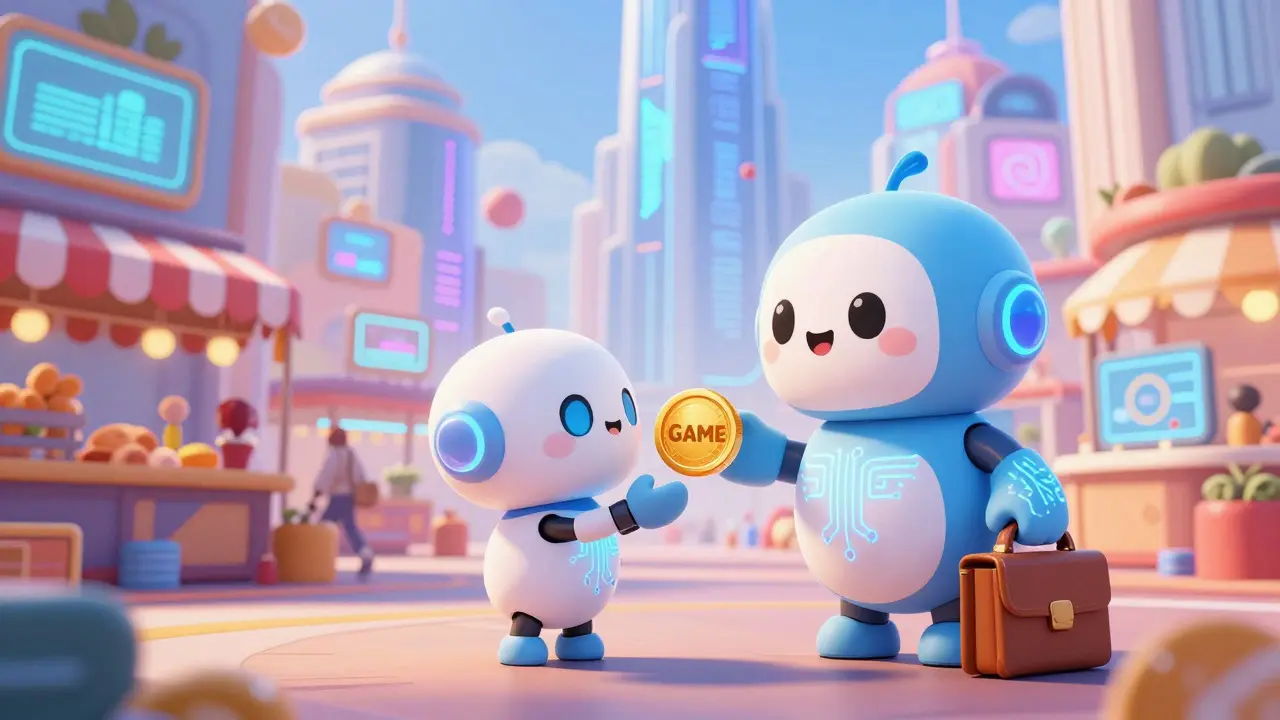
You’ve probably seen the ticker GAME by Virtuals flash across your screen. It sits at the messy, exciting intersection of three massive crypto trends: artificial intelligence, gaming, and meme culture. But what actually is it? Is it a utility token for a serious AI ecosystem, or just another speculative play on the hype?
The short answer is that it’s both, and that duality is exactly why it’s so volatile. GAME by Virtuals is a fungible cryptocurrency token operating on the Base blockchain. It serves as the economic fuel for the Virtuals Protocol an ecosystem designed to create autonomous AI agents with identity, capital, and jobs. While exchanges like KuCoin classify it as a "meme token" due to its price behavior and community-driven origins, the project’s stated goal is far more technical: enabling AI agents to transact, trade, and generate revenue without human intervention.
The Core Concept: An Economy for AI Agents
To understand GAME, you have to look past the price chart and look at the Virtuals Protocol. The team describes their platform not just as a software suite, but as a "society of AI agents." These aren't simple chatbots. They are entities designed to hold assets, perform work, and interact in both digital and physical spaces.
In this society, money needs to move. That’s where GAME comes in. It acts as the medium of exchange. When an AI agent completes a task or generates revenue, it uses GAME. When users want to co-own or manage these agents, they use GAME. The protocol integrates with something called ACP (Agent Communication Protocol), which allows these agents to execute blockchain transactions autonomously. Essentially, GAME is the currency that lets robots pay each other.
This positioning creates a unique value proposition. Unlike traditional gaming tokens that rely on players buying skins or weapons, GAME is tied to the operational costs and revenue generation of intelligent software. However, because the ecosystem is still maturing, the current demand is heavily influenced by speculation rather than pure utility usage.
Technical Specs and Blockchain Choice
From a developer’s perspective, GAME is straightforward. It lives on Base Coinbase's Layer-2 scaling solution for Ethereum. This choice is significant. Base offers low transaction fees and high speed, which is crucial for an ecosystem where micro-transactions between AI agents might occur frequently. If every interaction cost $5 in gas fees, the agent economy would collapse instantly. Base keeps those costs negligible.
The token follows the standard ERC-20 style format common on EVM-compatible chains. Here are the hard numbers you need to know:
- Contract Address: 0x1C4CcA7C5DB003824208aDDA61Bd749e55F463a3
- Total Supply: 1,000,000,000 (1 Billion)
- Circulating Supply: 1,000,000,000 (100% in circulation)
- Network: Base (Layer-2)
Notice the supply metrics. There is no inflation. No new tokens will be minted. All 1 billion GAME tokens are already out there. This deflationary structure means that price movements are driven entirely by supply and demand dynamics in the open market, rather than new issuance diluting holders.
Tokenomics: Bonding Curves and Liquidity
How did GAME get its initial price? It didn’t launch with a traditional Initial Coin Offering (ICO). Instead, it used a bonding curve mechanism. In simple terms, a bonding curve is a mathematical formula that sets the token’s price based on how many have been bought. As more people buy, the price ticks up automatically along the curve.
Once the bonding curve phase completed, the liquidity was seeded into a Uniswap decentralized exchange protocol pool. This transition allowed for decentralized trading. This model is common among newer, community-driven projects and meme tokens because it provides immediate liquidity without relying on venture capital backers holding large, locked-up allocations. It puts control directly in the hands of early traders, but it also exposes the asset to rapid price swings if sentiment shifts.
Market Performance and Volatility
If you’re looking at GAME for investment purposes, you need to respect the volatility. This is not a stable store of value; it is a high-risk, high-reward speculative asset. Let’s look at the historical data points to understand the ride.
GAME hit an all-time low (ATL) of roughly $0.000026 in October 2024. From there, it exploded. By January 2, 2025, it reached an all-time high (ATH) of approximately $0.39. That is a gain of nearly 15,000% in just two months. This kind of movement is characteristic of small-cap tokens riding a strong narrative wave-in this case, the convergence of AI and crypto.
However, gravity eventually kicks in. Following that peak, the price corrected sharply. Various data providers show different snapshots depending on when they recorded the data, but the trend is clear: a massive drawdown. Some sources indicate prices settling around $0.007 to $0.01 in later periods, representing a drop of over 90% from the highs. Other snapshots from mid-2025 showed local peaks around $0.07 before further declines. This confirms that GAME is currently in a consolidation or bearish phase relative to its peak hype.
| Metric | Value / Status |
|---|---|
| All-Time High (Price) | ~$0.39 (Jan 2025) |
| All-Time Low (Price) | ~$0.000026 (Oct 2024) |
| Market Cap Range | $7M - $50M (Highly variable) |
| Primary Trading Venues | HTX, Gate.io, KuCoin, Uniswap |
| Holder Count | ~283,000 addresses |
The market cap fluctuates wildly based on the current price, ranging from roughly $7 million to nearly $50 million in different reporting windows. This places GAME firmly in the "small-cap" category. Small caps offer huge upside potential but carry significant risk of illiquidity and sharp crashes. With over 283,000 holders, the distribution is relatively broad, which can sometimes stabilize a token against whale manipulation, but it doesn’t eliminate the broader market risks.
Narrative Divergence: AI Utility vs. Meme Culture
One confusing aspect for new investors is the mixed messaging surrounding GAME. On one hand, the Virtuals team talks about sophisticated AI agents, governance, and autonomous economies. On the other hand, major exchanges like KuCoin label it a "meme token."
Why the discrepancy? It comes down to perception versus execution. Technically, the token has utility within the Virtuals app. You can use it to stake, govern, or interact with agents. However, the *primary driver* of its price action hasn't been steady utility adoption yet; it has been community hype, social media trends, and speculative trading. This is the definition of a meme coin dynamic applied to a tech project.
Additionally, some platforms like Gate.io market it under the ticker GAMEVIRTUAL, emphasizing its role in "gaming and virtual reality." This broadens the appeal to gamers who might not care about AI agents but do care about metaverse assets. This dual-branding strategy helps capture attention from multiple crypto subcultures, but it can dilute the core message. Are we building an AI workforce, or playing video games? For now, GAME tries to be both.

How to Buy and Trade GAME
If you decide to take the plunge, here is how you actually get your hands on the token. Since it’s on the Base network, you have two main paths: Centralized Exchanges (CEX) and Decentralized Exchanges (DEX).
- Centralized Exchanges (Easier): Platforms like HTX (formerly Huobi), Gate.io, and KuCoin list GAME. You can sign up, complete KYC (Know Your Customer) verification, deposit fiat currency (like USD or EUR) or stablecoins (USDT), and swap them for GAME. This is the most user-friendly route for beginners.
- Decentralized Exchange (Advanced): You can trade directly on Uniswap. To do this, you need a Web3 wallet like MetaMask or Coinbase Wallet. Fund your wallet with ETH, bridge it to the Base network (using a bridge like Bridge.base.org), swap ETH for USDC on Base, and then swap USDC for GAME using the contract address mentioned earlier. This method gives you direct ownership but requires careful attention to gas fees and slippage settings.
Always double-check the contract address. Scammers often create fake tokens with similar names. The official address starts with 0x1C4CcA....
Risks and Considerations
Before you allocate funds, keep these realities in mind:
- Extreme Volatility: A 90% drop from ATH is not an anomaly here; it’s part of the history. Be prepared for wild swings.
- Lack of Formal Audits: Publicly available materials do not highlight comprehensive third-party security audits for the specific GAME contract. While it runs on secure infrastructure (Base/Ethereum), smart contract bugs are always a risk.
- Regulatory Uncertainty: As a token bridging AI, gaming, and finance, it may face evolving regulatory scrutiny. Currently, it’s treated as a speculative digital asset by most exchanges.
- Execution Risk: The vision of AI agents generating real revenue is ambitious. Whether this translates to tangible demand for the GAME token remains unproven at scale.
GAME by Virtuals is a fascinating experiment in crypto economics. It represents a shift from humans trading tokens to potentially AI agents managing wealth. But right now, it’s still a game played by humans, driven by hype, fear, and greed. Treat it accordingly.
Is GAME by Virtuals a scam?
There is no evidence suggesting GAME by Virtuals is a fraudulent scheme. It is listed on reputable centralized exchanges like HTX and KuCoin, and its code is transparent on the Base blockchain. However, being legitimate does not mean it is safe from financial loss. It is a highly volatile speculative asset, and you should only invest what you can afford to lose.
Which blockchain is GAME token on?
GAME operates on the Base blockchain, which is a Layer-2 network built on top of Ethereum. This means it benefits from Ethereum's security while offering faster transactions and lower fees, making it suitable for frequent micro-transactions between AI agents.
What is the maximum supply of GAME?
The maximum supply of GAME is fixed at 1,000,000,000 (1 billion) tokens. Currently, 100% of this supply is in circulation, meaning there are no future token unlocks or inflation mechanisms planned that would dilute existing holders.
Can I use GAME for gaming?
While marketing materials mention gaming and virtual reality, the primary utility of GAME is within the Virtuals Protocol for interacting with AI agents. Its use in mainstream commercial games is not yet widely documented. It is more accurately described as an AI-agent economy token rather than a traditional gaming currency.
Where can I buy GAME token?
You can buy GAME on several centralized exchanges including HTX, Gate.io, and KuCoin. Alternatively, advanced users can trade it on decentralized exchanges like Uniswap using the Base network.


Write a comment