
Imagine a digital ledger where every page is cryptographically sealed, linked to the one before it, and verified by thousands of computers worldwide. That’s essentially what a Bitcoin block is. It’s not just a random collection of data; it’s a precisely engineered container that holds the history of Bitcoin transactions. If you’re a developer, a miner, or just someone who wants to understand how your money is actually secured on the network, knowing the anatomy of a block is non-negotiable.
Most people think of Bitcoin as an app on their phone. But under the hood, it’s a complex protocol built on blocks. Each block serves as a fundamental unit in the blockchain, acting like a chapter in an immutable book. Without understanding how these blocks are structured-how they link together, how they store data, and how they are created-you can’t truly grasp why Bitcoin is secure, decentralized, and resistant to tampering.
| Component | Size | Purpose |
|---|---|---|
| Block Header | 80 bytes | Metadata, cryptographic links, and proof-of-work target |
| Transaction Count | Variable (1-9 bytes) | Indicates how many transactions are in the block |
| Transactions | Variable | The actual value transfers and smart contract executions |
Anatomy of the Block Header
The heart of any Bitcoin block is its header. This small but mighty piece of data is exactly 80 bytes long. Don’t let the size fool you; this header contains all the information needed to validate the block’s integrity and link it to the rest of the chain. Miners spend billions of dollars worth of electricity trying to solve a puzzle based solely on this header.
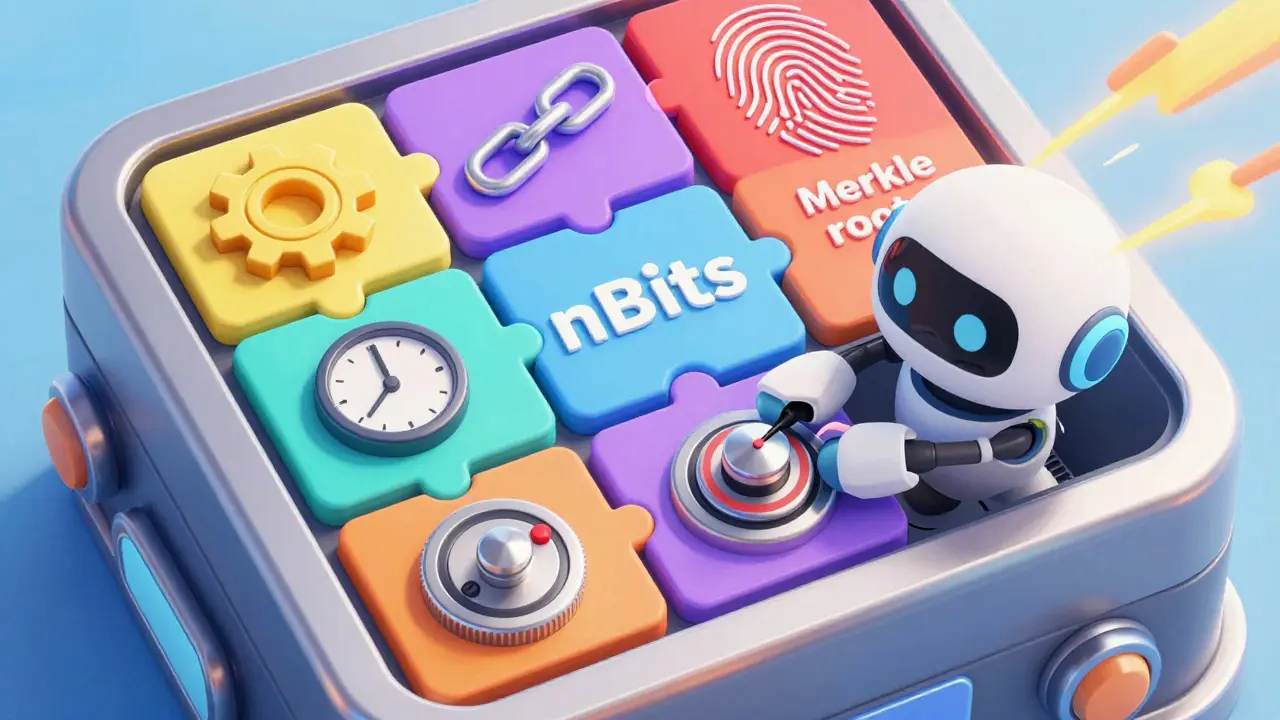
Let’s break down the six fields inside this 80-byte header. They are serialized in a specific order, and changing even one bit would invalidate the entire block.
- Version (4 bytes): This field tells nodes which set of rules to use when validating the block. It’s crucial for protocol upgrades. For example, when SegWit was activated, miners signaled their support by setting the version number to a specific integer. It’s in little-endian format, meaning the least significant byte comes first.
- Previous Block Hash (32 bytes): This is the glue that holds the blockchain together. It’s a SHA-256 hash of the previous block’s header. By including this, each new block points back to its predecessor, creating a chronological chain. If someone tries to alter a past block, this hash changes, breaking the link for all subsequent blocks.
- Merkle Root (32 bytes): Think of this as a fingerprint for all the transactions in the block. The Merkle tree is a binary tree where each leaf node is a transaction hash. These are paired and hashed together until you get a single root hash. This allows efficient verification; you don’t need to download all transactions to prove one exists in the block.
- Timestamp (4 bytes): This records when the miner started hashing the header. It’s a Unix timestamp (seconds since January 1, 1970). There are strict rules here: it must be newer than the median time of the previous 11 blocks and no more than two hours into the future. This prevents miners from manipulating time to gain unfair advantages.
- nBits (4 bytes): This is the encoded difficulty target. It represents the maximum value the block header hash can have to be considered valid. As the network’s total computing power (hashrate) increases, this target gets smaller, making it harder to find a valid hash.
- Nonce (4 bytes): This is the variable that miners change repeatedly. A nonce is just a “number used once.” Miners increment this number, recalculate the header hash, and check if it meets the target. If not, they try again. Billions of times per second.
To see this in action, look at Block 1, the first block mined after the Genesis Block. Its header looks like this:
- Version:
01000000 - Previous Block Hash:
6fe28c0ab6f1b372c1a6a246ae63f74f931e8365e15a089c68d6190000000000 - Merkle Root:
982051fd1e4ba744bbbe680e1fee14677ba1a3c3540bf7b1cdb606e857233e0e - Timestamp:
61bc6649(January 9, 2009) - nBits:
ffff001d - Nonce:
01e36299
The Transaction Section: Where Value Moves
Once the header is locked in, the rest of the block is dedicated to transactions. This section starts with a variable-length field that counts how many transactions are included. In early Bitcoin blocks, this was often just one transaction (the coinbase transaction). Today, blocks are packed with thousands.
Each transaction follows a standardized structure:
- Version: Indicates the transaction format (e.g., v1 for standard, v2 for SegWit).
- Input Count: How many inputs are spending existing UTXOs (Unspent Transaction Outputs).
- Inputs: Each input references a previous output by its transaction ID and index. It includes a scriptSig that proves ownership (usually a signature) and sequence numbers for timelocks.
- Output Count: How many new UTXOs are being created.
- Outputs: Each output has a value (in satoshis) and a scriptPubKey that defines who can spend it (e.g., locking funds to a public key hash).
- Locktime: Optional field that prevents the transaction from being included in a block until a certain time or block height.
It’s important to note that Bitcoin doesn’t have accounts like a bank. Instead, it uses the UTXO model. When you send Bitcoin, you’re not moving balance from Account A to Account B. You’re consuming old outputs (inputs) and creating new ones (outputs). The sum of inputs must equal the sum of outputs plus the miner fee. Any difference is burned or sent to the miner.
Segregated Witness and Taproot: Evolving the Structure
For years, the block size limit was effectively 1 MB. This led to congestion and high fees during peak times. Enter Segregated Witness (SegWit), activated in August 2017. SegWit didn’t increase the base block size, but it introduced a new way to count weight. Witness data (signatures and scripts) was moved out of the main transaction body and into a separate “witness” section. This data counts as only 1/4 of its original size toward the block limit.
This means a block can now hold up to 4 million weight units (WU), which translates to roughly 2-4 MB of effective space depending on transaction types. Structurally, SegWit transactions include a marker byte (00) and a flag byte (01 or higher) to signal the presence of witness data. This maintains backward compatibility with older nodes that ignore the witness data but still validate the core transaction.
Then came Taproot, activated in November 2021. Taproot upgraded the scripting capabilities of Bitcoin. It allows for more complex smart contracts while appearing as simple, standard transactions to the outside world. This improves privacy and efficiency. Structurally, Taproot introduces new output types (P2TR) and modifies how Merkle trees are constructed for multi-signature setups.
How Mining Creates Blocks
So, how does a block actually come into existence? It’s a competitive process called mining. Here’s the step-by-step flow:
- Transaction Selection: Miners pull unconfirmed transactions from the mempool (memory pool). They prioritize those with higher fees to maximize profit.
- Candidate Block Construction: The miner creates a candidate block header. They fill in the version, previous block hash, merkle root (calculated from selected transactions), timestamp, and nBits (difficulty target). The nonce starts at zero.
- Proof-of-Work: The miner hashes the header using SHA-256 twice. If the result is less than or equal to the target (nBits), they’ve found a valid block. If not, they change the nonce and try again. This loop runs billions of times per second.
- Broadcast: Once a valid hash is found, the miner broadcasts the full block (header + transactions) to the network.
- Validation: Other nodes receive the block. They verify the header hash, check the Merkle root against the transactions, ensure all transactions are valid (no double-spends, correct signatures), and confirm the block follows consensus rules.
- Acceptance: If valid, nodes add the block to their local copy of the blockchain and start building on top of it. The miner receives the block reward (currently 3.125 BTC as of 2024, halving to ~1.5625 BTC after the 2024 halving) plus transaction fees.
This process happens roughly every 10 minutes. The difficulty adjusts every 2016 blocks (about two weeks) to keep the average block time stable, regardless of how much total computing power joins or leaves the network.
Why Block Structure Matters for Security
You might wonder why we care about bytes and hashes. The answer is security. The rigid structure of Bitcoin blocks makes them virtually impossible to tamper with.
Suppose an attacker wants to change a transaction in Block 100. To do so, they’d need to recalculate the Merkle root for that block. Then, because the previous block hash in Block 101 points to Block 100, they’d need to recalculate Block 101’s header. And then Block 102, and so on, all the way to the latest block. Since each block requires proof-of-work, the attacker would need to redo the work for all those blocks faster than the honest network is adding new ones. With Bitcoin’s massive hashrate, this is computationally infeasible.
This immutability is what gives Bitcoin its value. It’s not just code; it’s a mathematical guarantee. Every participant in the network independently verifies the block structure. No central authority decides what’s valid. The rules are enforced by cryptography and economics.

Practical Applications: Exploring Blocks Yourself
You don’t need to run a full node to explore block structure. Blockchain explorers like Blockchain.com Explorer or Mempool.space provide user-friendly interfaces. Try searching for a recent block number. You’ll see:
- Block Height: The position in the chain.
- Hash: The unique identifier of the block.
- Transactions: List of all TXIDs included.
- Fee Rate: Average satoshis per virtual byte (vByte).
- Time: When the block was mined.
For developers, tools like bitcoin-cli allow you to query raw block data. Commands like getblock [blockhash] return detailed JSON objects showing the header fields, transaction list, and more. This is invaluable for debugging, auditing, or building applications that interact with the blockchain.
Understanding block structure also helps you optimize transaction fees. By knowing how SegWit reduces weight, you can choose to send from SegWit addresses (Bech32) to save costs. You can also bundle multiple payments into one transaction to reduce overhead.
Future Developments and Consensus Rules
Bitcoin’s block structure has remained largely unchanged since 2009, which is a testament to its robust design. However, evolution continues through soft forks. Soft forks are backward-compatible upgrades that tighten consensus rules. They don’t change the block header size or basic format, but they may introduce new transaction types or validation checks.
Future proposals often focus on scaling and privacy. For instance, Lightning Network operates as a second layer, settling most transactions off-chain and only using the main blockchain for final settlements. This reduces the load on base-layer blocks. Other proposals aim to improve script flexibility or enhance data availability.
As always, any change requires broad consensus among miners, nodes, and users. The decentralized nature of Bitcoin ensures that no single entity can force a change. This slow, deliberate process preserves the network’s security and trustlessness.
What is the exact size of a Bitcoin block header?
A Bitcoin block header is exactly 80 bytes. It consists of six fields: version (4 bytes), previous block hash (32 bytes), Merkle root (32 bytes), timestamp (4 bytes), nBits (4 bytes), and nonce (4 bytes).
How does the Merkle root ensure transaction integrity?
The Merkle root is a hash derived from all transaction hashes in the block via a binary tree structure. If any transaction is altered, its hash changes, which propagates up the tree, changing the Merkle root. Since the root is stored in the block header, altering a transaction would require recalculating the proof-of-work for that block and all subsequent blocks.
What role does the nonce play in mining?
The nonce is a 4-byte number that miners change repeatedly to produce a block header hash below the current difficulty target. It’s the primary variable in the proof-of-work algorithm, allowing miners to brute-force a valid hash without altering other critical block data.
How did SegWit change the block structure?
SegWit separated signature data (witness) from the main transaction body. This data is placed in a new witness section and counts as only 1/4 of its size toward the block weight limit. This effectively increased block capacity without changing the 1MB base size rule, allowing more transactions per block.
Can I view the raw structure of a Bitcoin block?
Yes, you can use blockchain explorers like Mempool.space or Blockchain.com to view decoded block details. For raw hex data, you can use Bitcoin Core’s getblock command with verbose=0, or inspect the blockchain database directly if running a full node.



Write a comment