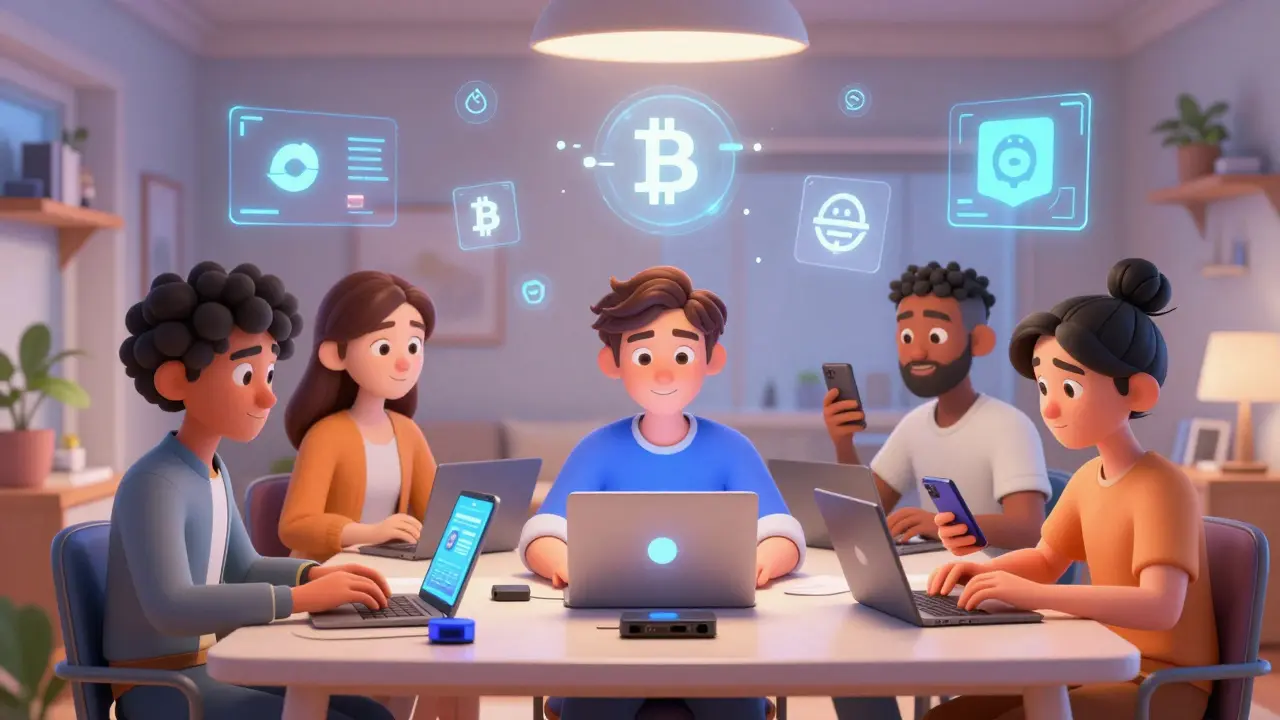
You might have seen the term Ore popping up in your Twitter feed or crypto chats. It’s not a new exchange, and it’s not a DeFi protocol with complex yield farming strategies. Instead, Ore (ORE) is an experiment that asks a simple but radical question: Can we bring back the fun of mining cryptocurrency without needing a warehouse full of noisy machines?
Ore is a token built on the Solana blockchain that uses a Proof-of-Work mechanism similar to Bitcoin. But here is the twist: you can mine it on your laptop, your phone, or even a Raspberry Pi. It combines the scarcity and fairness ethos of Bitcoin with the speed and low costs of Solana. If you are wondering what this means for your wallet or your curiosity about how crypto works, let's break down exactly what Ore is, how it functions, and whether it has any real value beyond the hype.
The Core Concept: Bitcoin Meets Solana
To understand Ore, you first need to look at its two parents: Bitcoin and Solana. Bitcoin introduced the world to decentralized money through Proof-of-Work (PoW), where miners solve complex math puzzles to secure the network and earn rewards. This process is energy-intensive and dominated by industrial farms. Solana, on the other hand, is a high-speed blockchain known for its Proof-of-Stake (PoS) consensus, which is fast and cheap but doesn't involve traditional mining.
Ore is a cryptocurrency token that runs on the Solana blockchain but utilizes a Proof-of-Work distribution model. It is unique because it is the only minable token on Solana. While most tokens on Solana are distributed through initial offerings, liquidity pools, or staking rewards, Ore requires computational work to be created. This hybrid approach allows users to experience the "fair launch" feel of early Bitcoin days while benefiting from Solana's infrastructure.
The project originated from discussions on social media, particularly around the @oresupply account, highlighting the scarcity of mining opportunities for regular people after the 2023 Bitcoin halving made solo mining nearly impossible. Ore aims to democratize this access. It positions itself as a digital store of value, emphasizing community ownership over venture capital allocations.
How Does Ore Mining Actually Work?
If you want to participate, you don't need to buy expensive ASIC miners. The beauty of Ore lies in its accessibility. Here is how the mining process breaks down:
- Device Agnostic: You can run the miner on virtually any device. A standard laptop, a smartphone, or an old desktop computer will do. The software is lightweight compared to Bitcoin mining clients.
- Proof-of-Work Mechanism: Your device performs calculations to find valid blocks. Unlike Ethereum Classic or Bitcoin, the difficulty adjustments and block times are tuned for consumer hardware. This ensures that a single user can still find blocks occasionally, keeping the network somewhat decentralized among individual participants rather than large pools.
- Solana Integration: Once a block is found, the transaction is submitted to the Solana blockchain. Because Solana handles thousands of transactions per second with fractions of a cent in fees, the cost of claiming your mined Ore is negligible. In contrast, mining on Ethereum before its merge would have incurred gas fees that often exceeded the reward value for small miners.
This setup creates a permissionless environment. Anyone with an internet connection and a basic device can contribute to the network's security and issuance. It’s a return to the roots of cryptocurrency, where the barrier to entry was knowledge, not capital.

Tokenomics: Supply, Scarcity, and Discrepancies
When evaluating any cryptocurrency, the tokenomics-how the supply is managed-are crucial. Ore follows a capped-supply model, mimicking Bitcoin’s finite nature. However, there is some confusion in the data across different platforms, which is common for newer, experimental projects.
| Source | Total Cap Claimed | Issuance Rate | Notes |
|---|---|---|---|
| Soladex | 5 Million | 1 token per minute | No pre-mine, no VC allocation |
| Phantom Wallet | 21 Million | 1 token per minute | Fully mined by 2064 |
| CoinMarketCap | N/A (Circulating) | N/A | Reports ~426k currently circulating |
The discrepancy between 5 million and 21 million caps suggests either a change in protocol parameters or inconsistent reporting by aggregators. The 21 million figure aligns more closely with Bitcoin’s psychological cap, suggesting the developers may have intended a long-tail issuance schedule ending in 2064. Regardless of the exact cap, the key takeaway is that Ore has a fixed maximum supply. There is no inflationary pressure from the team printing more tokens. Every Ore in existence was mined by a participant.
The issuance rate of one token per minute is another critical attribute. This slow drip-feed ensures that demand must outpace supply for the price to rise. It prevents the sudden dumps associated with large unlocks seen in many modern altcoins. For investors, this means the market dynamics are driven purely by trading activity and miner sell-pressure, not by scheduled token releases.
Market Performance and Volatility
As of July 2026, Ore has experienced significant volatility. Like many niche tokens, it rode a wave of interest following its launch in November 2025. However, the crypto market is notoriously cyclical. Recent data shows Ore trading significantly below its all-time highs.
Price data from aggregators like CoinGecko indicates that Ore has seen periods of extreme fluctuation. At its peak, it reached notable valuations relative to its early days, but it has since corrected sharply. Trading volumes vary widely, sometimes spiking during bull runs and drying up during risk-off periods. This low liquidity means that large buys or sells can move the price dramatically. If you are considering buying or selling Ore, be aware that slippage-the difference between the expected price and the executed price-can be higher than on major coins like SOL or USDC.
The sentiment around Ore is mixed. Some view it as a fascinating technical experiment that proves PoW can exist efficiently on PoS chains. Others see it as a meme token with limited utility, relying heavily on community engagement rather than fundamental use cases. Currently, it does not offer governance rights or direct utility within a larger ecosystem. Its value proposition rests primarily on its status as a scarce, community-mined asset.

Risks and Considerations Before Participating
Before you download a miner or buy Ore, consider these risks:
- Hardware Wear and Tear: While you don't need industrial gear, running a miner continuously on a laptop or phone can generate heat and drain batteries. Ensure your device is well-ventilated.
- Regulatory Uncertainty: Mining regulations vary by country. While Ore is likely too small to attract immediate regulatory scrutiny, always check local laws regarding cryptocurrency mining and taxation.
- Liquidity Risk: As mentioned, low trading volume means it might be hard to exit large positions quickly. Check the order books on exchanges like Raydium or Orca before making moves.
- Project Longevity: Ore is a relatively new project. There is no guarantee that the development team will maintain the software or that the community will sustain interest long-term. The anonymity of the developers, common in meme and fair-launch projects, adds a layer of uncertainty.
Additionally, verify the contract address. On Solana, scams often copy legitimate token names. The official Ore contract address is oreoU2P8bN6jkk3jbaiVxYnG1dCXcYxwhwyK9jSybcp. Always double-check this against reputable sources like Solscan or the official Ore website before interacting with any smart contracts.
Is Ore Worth Your Time?
Whether Ore is worth your attention depends on your goals. If you are looking for a passive income stream, the rewards from mining on consumer hardware are likely minimal. You won't get rich quick. However, if you are a crypto enthusiast interested in the mechanics of blockchain technology, Ore offers a hands-on way to learn about Proof-of-Work, block validation, and Solana's architecture.
For collectors, the pixel art aesthetic and the narrative of "democratized mining" add cultural value. Holding Ore signals membership in a community that values decentralization and accessibility. It’s less of an investment vehicle and more of a digital artifact representing a specific moment in crypto history-the attempt to blend Bitcoin’s ideals with modern scalability.
Ultimately, Ore serves as a proof-of-concept. It demonstrates that you can layer different consensus mechanisms to create novel distribution models. Whether it survives the next market cycle remains to be seen, but for now, it stands as a unique experiment in the Solana ecosystem.
Can I mine Ore on my iPhone or Android phone?
Yes, Ore can be mined on mobile devices. The mining software is designed to be lightweight enough to run on smartphones without requiring specialized hardware. However, keep an eye on battery usage and heat generation, as continuous mining can drain your battery quickly.
What is the total supply of Ore (ORE)?
There is conflicting information regarding the total supply. Some sources cite a cap of 5 million tokens, while others, including Phantom Wallet, state a cap of 21 million tokens. The issuance rate is generally reported as one token per minute, with the entire supply projected to be mined by 2064. Always verify current supply data on live block explorers.
Is Ore a good investment in 2026?
Ore is considered a high-risk, speculative asset. It has experienced significant volatility and trades at a fraction of its all-time high. It lacks clear utility beyond community engagement and scarcity. Only invest what you can afford to lose, and consider it more of a hobbyist project than a reliable financial instrument.
How do I verify the official Ore contract address?
The official Solana Program Library (SPL) token address for Ore is oreoU2P8bN6jkk3jbaiVxYnG1dCXcYxwhwyK9jSybcp. You can verify this address on Solana block explorers like Solscan or by checking the official Ore social media channels. Never trust addresses posted in random comments or unverified links.
Why is Ore built on Solana instead of its own blockchain?
Building on Solana allows Ore to benefit from high transaction speeds and low fees. Running a separate Proof-of-Work blockchain would require significant infrastructure and energy. By using Solana's existing network, Ore focuses solely on the distribution mechanism (mining) while leveraging Solana for settlement and security, making it accessible to everyday users.



Write a comment